
Not long ago, the customer journey to finding a local barber, dentist, or restaurant followed a predictable path. Most people opened Google or Google Maps, typed in a query, and scanned a list of blue links or map pins. Local SEO was largely a game of ranking well in those results — earning your spot in the "Local Pack," keeping your Google Business Profile polished and engaging, and accumulating good reviews.
While Google Search and Maps still drive a majority of local business, there's a major shift underway in how people discover local businesses. More specifically, in how customers find businesses using AI.
AI-powered search tools — ChatGPT, Google's AI Overviews, Gemini, and others — are increasingly the first stop for consumers asking questions like "Who's the best CPA who can prepare my tax return near [neighborhood]?" or "What's a highly rated family dentist in [city] for gentle fillings?" Rather than returning a list of links for the user to evaluate, these tools synthesize information and deliver direct, conversational recommendations. In other words, they don't just point people toward a search results page; they help them make a choice.
For local businesses and the agencies that serve them, this isn't a distant trend to monitor. It's a present reality that demands a rethinking of strategy to avoid falling behind competitors.
How Customers Find Businesses Using AI: From Searching for Links to Asking for Answers
In the traditional local search journey, the search engine points the way to various options it deems trustworthy, and the customer evaluates those options to make their decision. A potential customer sees your listing, reads your reviews, glances at your photos, and ideally clicks through to your website, calls to book an appointment, or requests directions. When customers look for local services this way, the search engine is essentially a business directory they can flip through and decide who to buy from.
With the advent of generative AI and AI-powered search experiences, how customers find businesses is far more dynamic. When someone asks an AI assistant for a recommendation, the AI doesn't hand over a list of options and step aside. It evaluates, aggregates, and recommends — often naming just a handful of businesses, explaining why, and implicitly (or explicitly) suggesting the user go with that choice (depending on AI sentiment, but more on that later).
In this version of the customer journey, the AI becomes a trusted intermediary, rather than just a neutral index. This mirrors the way people have always responded to word-of-mouth recommendations from trusted friends. Think someone telling you: "You should go to Mike's Auto Shop on Fifth — they're honest and fast." When AI makes that same kind of confident, specific recommendation, users tend to follow it.
The implication for businesses is clear: appearing in AI-generated recommendations isn't just a nice bonus on top of traditional search rankings. For a growing segment of high-intent (i.e., ready-to-purchase) consumers, it's the primary path to discovery.
How AI Rewrites the Rules on Proximity
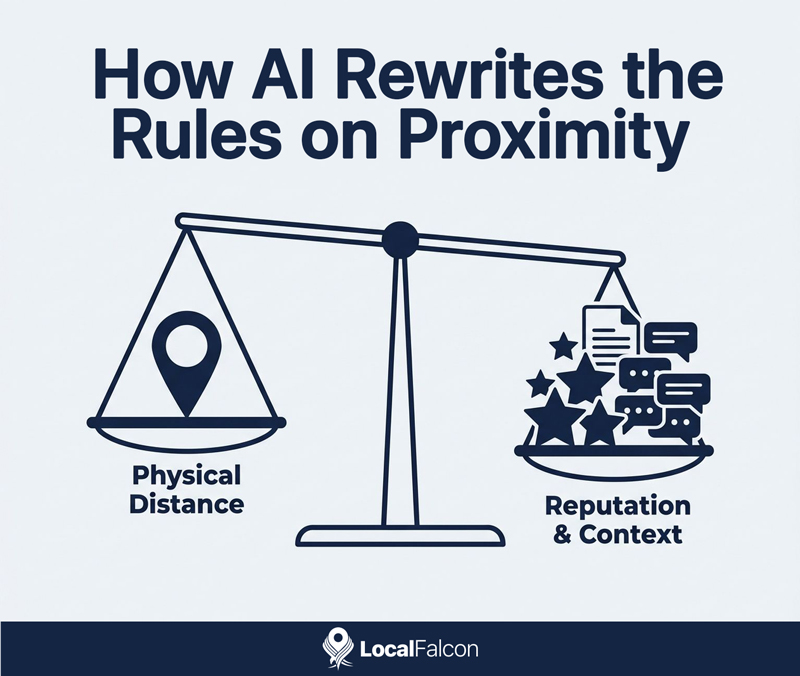
In traditional local search, proximity is a powerful yet simple local ranking factor (one of the most important three). Google's algorithm heavily weighs physical distance from the searcher when surfacing local results. A restaurant two blocks away typically ranks higher than an equally good restaurant two miles away, all else being equal.
Short of opening additional locations or expanding service areas, businesses can't do much about their geographic location, but at least the rules around proximity and rankings are easy to understand.
AI, on the other hand, doesn't factor proximity into business recommendations in the same way. While a user's location certainly influences which businesses AI recommends, especially Google's AI Overviews, AI platforms rely more on context than physical distance. They evaluate the user's intent and weigh reputation and relevance signals from across the web: review platforms, directories, local news mentions, social media sentiment, business website content, and more to provide what they believe to be the best options.
A business slightly farther from a searcher might appear in an AI Overview ahead of a closer competitor if its overall reputation is stronger and its content mentions offerings relevant to the user's conversational query. Sure, this can happen in traditional local search results, too, but there are often "proximity walls" — areas beyond which it's incredibly difficult to rank organically simply due to the density of competitor locations.
Why Traditional Local SEO Isn't Enough Anymore
None of this means traditional local SEO is dead. Far from it. Google Maps rankings and Google Business Profile performance remain critically important — a huge volume of local searches still result in map clicks, direction requests, and phone calls. Businesses shouldn't neglect local SEO fundamentals, but these are no longer sufficient to capture the full scope of local discovery.
Consider what traditional local SEO optimizes for: appearing in Google's (and, to a lesser degree, Bing's and Apple's) local results and ranking in the map pack. However, AI visibility can be far harder to earn than traditional rankings, meaning strong traditional local search performance doesn't directly translate into AI visibility.
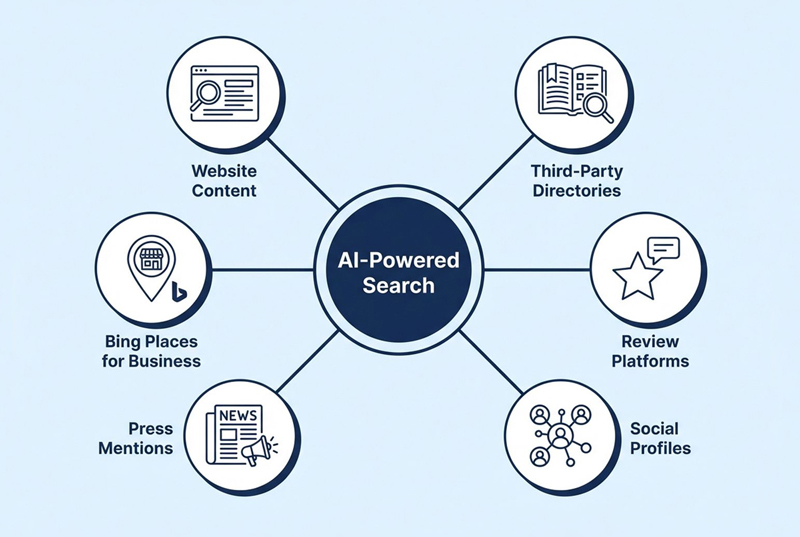
AI search platforms draw on a much broader information ecosystem. They're ingesting content from your website, third-party directories, review platforms, social profiles, press mentions, and more. They're not only asking "where is this business, what does it do, and how trustworthy is it?," but also "what do people say about this business, and does it match exactly what this customer needs in their unique context?"
A business could have a perfectly optimized GBP and strong Google Maps rankings while being largely invisible in AI-generated recommendations. Indeed, we recently found that 83% of restaurants are invisible on ChatGPT, compared to only 14% that aren't visible on Google.
There's also the question of how AI platforms handle queries differently from one another, which can lead to visibility disparities across AI search. Google's AI Overviews operate within Google's larger search ecosystem and pull business info directly from GBP, but ChatGPT and other non-Google AI tools don't integrate GBP data.
ChatGPT, for example, gets business info from Bing Places for Business and a wide range of third-party sources. This means businesses that have invested exclusively in Google-centric local SEO may find they're simply not in the conversation when it comes to AI-powered local search.
The key takeaway here is that traditional local SEO and AI visibility optimization require overlapping but distinct strategies. Treating them as the same thing can create vulnerable gaps that give the competition an advantage when customers turn to AI to discover local services.
The Emergence of Share of AI Voice for Tracking AI Visibility
Marketing has always been a discipline of measurement. You can't manage what you can't measure — and as AI becomes a more significant driver of local discovery, businesses need a new metric to understand and improve their standing in that landscape. That metric is Share of AI Voice, or SAIV.
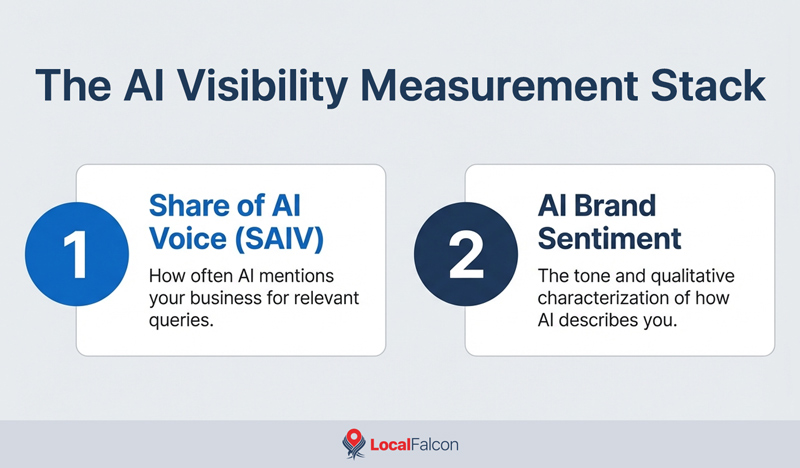
SAIV measures how often a business is mentioned by AI platforms when users ask relevant local queries. It's the AI-era equivalent of Local Falcon's Share of Local Voice (SoLV) for traditional Google Maps rank tracking.
Just as a business tracks where it appears in Google's Local Pack across different search terms and geographic areas, it needs to track where it appears (or doesn't) in AI responses across a range of relevant queries in their target markets. SAIV aggregates your presence — or absence — across AI-style search queries and prompts, giving you a baseline to work from and improve against.
This matters for several reasons. First, it makes AI visibility tangible and trackable, turning a vague concept into something actionable. Second, it enables comparison — businesses and agencies can benchmark against competitors to understand relative standing in AI-driven search. Third, it creates accountability: if you make changes to your online presence, content, or reputation strategy designed to improve AI visibility, SAIV gives you a way to evaluate whether those changes are working.
For agencies managing local SEO for multiple clients, SAIV has become an essential part of the reporting stack. Clients increasingly want to know not just where they rank on Google Maps, but how they're faring when it comes to AI-driven local discovery. In short, SAIV answers the questions that clients are already asking.
AI Brand Sentiment: The New Reputation Signal
Equally as important to understand as SAIV is AI brand sentiment. It's not enough to simply appear in AI recommendations. What the AI says about your business matters enormously, too.
Brand sentiment in the AI context refers to the tone, characterization, and qualitative content of how AI describes a business when it mentions it. Does the AI describe your restaurant as "a local favorite known for fresh ingredients and warm service," or does it note that "some reviewers have mentioned inconsistent quality"? Does it describe your law firm as "well-reviewed for responsiveness and clear communication," or does it omit you from the recommendation altogether and suggest a competitor instead?
Think of it this way: AI assistants don't just list businesses — they editorialize. They draw on the accumulated sentiment of everything written about a business online and synthesize it into a characterization. That characterization can make the difference between a persuasive recommendation that drives a customer to pick up the phone and a lukewarm mention that gives them pause.
This is why reputation management takes on a new dimension in the AI era. Rather than simply maintaining a high star rating on Google, businesses and their agency partners need to proactively work to shape the narrative that AI absorbs and reflects back to potential customers.
Businesses need to be actively thinking about the full body of content that exists about them online: the themes that appear in their reviews, the language used on their own website and social channels, the way they're described in local directories and press coverage. All of it feeds into the AI's understanding of who they are.
Monitoring AI brand sentiment — tracking how AI platforms describe and characterize your business over time — gives businesses the ability to identify narrative problems before they calcify, respond to patterns in negative feedback, and understand what's working in their favor so they can amplify it.
How Local Businesses and Agencies Must Adapt
So what does adapting to how customers find businesses using AI actually look like? The shift toward AI-driven local discovery requires action on several fronts simultaneously.
Don't abandon traditional local SEO; deepen it
As we mentioned earlier, Google Maps rankings and GBP performance are still foundational to local search success. A strong, well-maintained Google presence signals legitimacy to AI platforms that do draw on Google data, and it continues to capture a large share of local search traffic directly. The task isn't to choose between traditional local SEO and AI optimization — it's to do both, understanding that they serve different channels with overlapping inputs.
Broaden your presence beyond Google
Because non-Google AI platforms don't have direct access to GBP data, businesses need robust presences on the third-party directories, review platforms, and data aggregators that these systems do draw from. Yelp, Tripadvisor, Bing Places, Apple Maps, industry-specific directories — these aren't second-tier concerns anymore. They're part of the input layer that shapes AI recommendations.
Invest in reputation depth, not just review volume
Quantity of reviews matters, but so does the quality and specificity of what those reviews say. Businesses should be actively encouraging customers to leave detailed, authentic feedback that captures the specific value they provide. Generic five-star reviews are less useful — to AI and to prospective customers alike — than reviews that articulate exactly why the experience was excellent.
Create content that AI can learn from
Your website, blog, and social presence all contribute to the AI's understanding of your business. Content that clearly communicates what you do, who you serve, what sets you apart, and what your customers experience helps AI characterize you accurately and favorably. This isn't about keyword stuffing — it's about building a coherent, authoritative, and specific narrative around your brand.
Track SAIV and AI sentiment alongside traditional metrics
This is where measurement comes in. Businesses and agencies need to be monitoring their AI visibility and tracking how they're being described — not as a one-time audit, but as an ongoing practice. Just as rank tracking in Google Maps is a regular activity, AI visibility tracking needs to become part of the standard reporting cadence. Tools like Local Falcon that allow businesses to monitor their Share of AI Voice across platforms and assess the sentiment of AI-generated mentions are becoming essential instruments in the local marketing toolkit.
The Path Forward
The way customers find local businesses is changing faster than many realize. The shift from "searching for links" to "asking for answers" is happening now, in the daily behavior of consumers who increasingly turn to AI as their reliable "answer engine" when they need something locally.
Businesses that continue to optimize exclusively for traditional local search may capture a meaningful share of traffic, but they'll potentially be leaving a growing portion of high-intent customers on the table. The customers who asked an AI and got a competitor's name. The customers who heard a confident, synthesized recommendation that never included them.
The businesses and agencies that will thrive are those that understand local discovery as a new multi-channel reality: Google Maps rankings and GBP performance as the essential foundation, combined with a broader web presence, deep and specific reputation management, and active tracking of both AI visibility and brand sentiment. Not one or the other — all of it, managed together.
AI visibility and AI brand sentiment aren't replacements for the metrics local marketers have always relied on. They're key additions to the local SEO measurement stack, reflecting the new channels through which customers are finding — or failing to find — the businesses they need.