
AI-powered search is no longer limited to early adopters or technical users. It is increasingly used by everyday consumers to research stores, restaurants, or services, compare options, and make purchase decisions without interacting with traditional search interfaces.
In local contexts, this shift is especially significant. AI systems frequently surface local recommendations directly, reducing the need to browse Google Maps, scroll through Local Packs, or visit multiple business websites.
For local brands, this introduces a new visibility layer that operates upstream of traditional local SEO metrics and creates a visibility gap between where customers make decisions and where traditional metrics capture performance.
AI Search Today: What We Know
AI-driven discovery is already producing commercial outcomes. Multiple industry studies show that traffic originating from AI platforms converts at higher rates than traditional organic traffic, despite representing a smaller share of overall sessions. Survey data and sales feedback increasingly indicate that AI assistants are being used as primary research tools, particularly for high-intent queries.
At the same time, AI platforms are building direct commercial infrastructure. Integrations with ecommerce systems, local services, and agent-based purchasing models signal a clear intent to shorten the path from research to transaction.
What remains imperfect is attribution. While analytics platforms can track some AI referral traffic, connecting every lead or conversion back to a specific AI interaction is still unreliable, especially for offline or multi-touch local conversions.
However, waiting for perfect attribution before acting applies the wrong decision framework. The relevant question is not whether attribution is complete, but whether sufficient signal exists to indicate that AI-driven discovery is already influencing outcomes. For most local brands, that threshold has been crossed.
Why Delaying Investment Increases the Long-Term Cost of AI Search Optimization for Local Brands
Search history shows a consistent pattern. Early visibility compounds. Late entry requires significantly higher investment to compete for the same attention. AI search follows this pattern.
AI learns which businesses to cite and recommend based on repeated exposure to consistent signals across the web. Over time, these citation and recommendation patterns become self-reinforcing. Brands that appear frequently are more likely to appear again.
For local brands, this means that early participation in AI visibility optimization shapes how AI systems understand entire categories and markets.
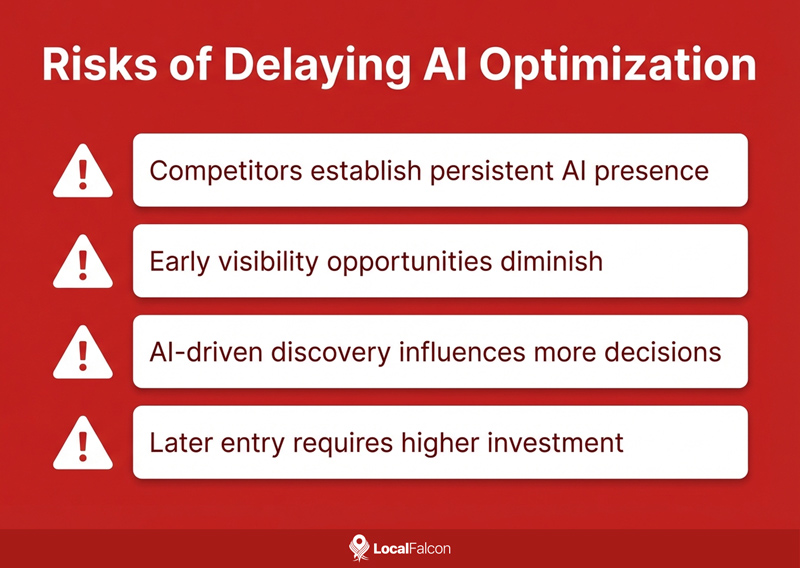
Delaying investment creates potential for several structural disadvantages:
- Competitors establish persistent AI recommendation presence
- Early visibility opportunities diminish, leaving less "low-hanging fruit"
- AI-driven discovery influences a growing share of local decisions
- Later entry requires higher investment in content, data, and authority
This is not a hypothetical risk. It mirrors how authority accumulated in traditional SEO and how late adopters faced higher costs to gain comparable visibility.
Framing AI Search Optimization Correctly
AI search optimization should not be positioned as a new channel that replaces local SEO. That framing creates unnecessary resistance and misrepresents how AI operates.
AI platforms rely on the open web. Much like traditional search algorithms, they draw from crawled, indexed, and trusted sources. So, even though strong Google rankings don't guarantee AI visibility, a strong local SEO foundation does remain a prerequisite for discovery.
AI search optimization builds upon that foundation by improving how clearly a brand and its locations are understood once discovered.
In practical terms, this means ensuring that:
- Services are described consistently and unambiguously
- Location-level information is distinct, not templated and duplicated
- Reviews reinforce specific offerings and outcomes
- Third-party sources accurately reflect the business
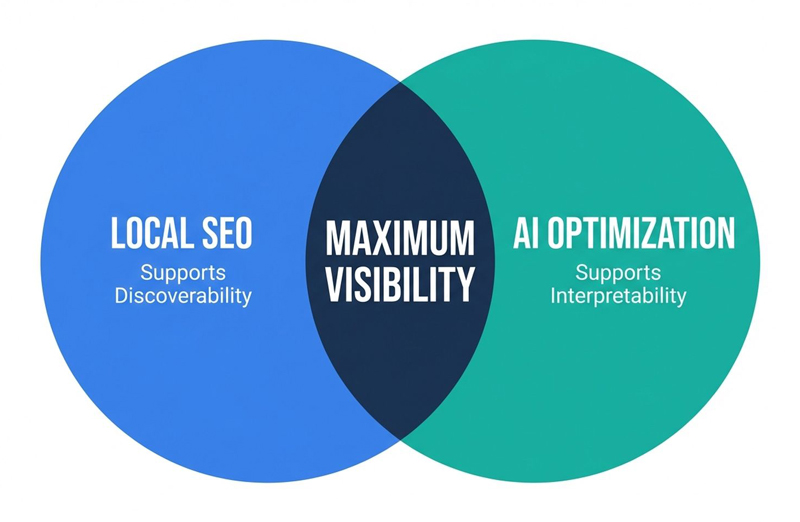
Think of it like this: local SEO supports discoverability, while AI search optimization supports interpretability. Both are required to maintain visibility across increasingly dynamic local discovery surfaces.
Addressing the AI Search Optimization Attribution Problem
Attribution concerns about AI search optimization are valid and should be addressed directly when explaining AI search visibility to clients.
AI-driven discovery often influences decisions without producing a direct click, making traditional attribution models insufficient. This is particularly true for local services, where conversion paths are offline or multi-touch. Rather than treating this as a blocker, it should be treated as a measurement evolution.
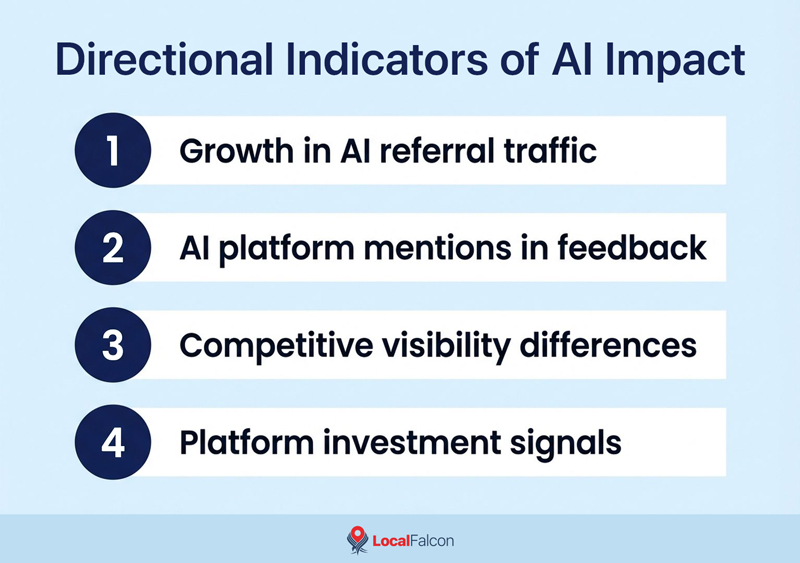
Directional indicators already exist:
- Growth in AI referral traffic where trackable
- Increased mentions of AI platforms in customer feedback
- Competitive visibility differences in AI-generated responses
- Platform investment signals that indicate commercial intent
The absence of perfect attribution does not negate the presence of impact. It simply requires a different evaluation approach.
AI Visibility ROI: How To Measure and Justify the Investment
The ROI of AI search optimization should be measured first by Share of AI Voice (SAIV) — the proportion of AI-generated answers to local queries where the brand or its locations are mentioned. Secondary metrics include consistency across the location network, alignment with Google Maps rankings, and competitive displacement.
Key measurement areas include:
Inclusion and Coverage
The first question is whether a brand or its locations appear at all in AI-generated responses for high-intent queries. Absence represents lost consideration, regardless of traditional ranking performance.
Alignment With Existing Local Metrics
Comparing AI visibility against Maps rankings and local performance data reveals gaps between algorithmic relevance and semantic clarity. These gaps identify where optimization efforts are most likely to produce impact.
Network-Level Consistency
For multi-location brands, measurement should focus on consistency across the location network. Uneven representation can weaken overall brand interpretation and reduce recommendation frequency.
Demand Protection
AI search optimization often prevents demand loss before it becomes visible in traditional metrics. Framing ROI in terms of demand protection rather than demand creation aligns more closely with executive decision-making.
How To Integrate AI Search Optimization Without Creating a New Program
One of the fastest ways to stall adoption is to position AI search optimization as a standalone initiative with its own timeline, tooling, and reporting structure. That framing makes it feel optional.
A more effective approach is to treat AI search optimization as an incremental integration into existing local SEO workflows, with clear phases and review points rather than a formal pilot window.
The goal is not to "test AI search" in isolation. The goal is to make local visibility resilient as discovery pathways multiply. In fact, as AI-powered features and increasingly dominant paid advertising take up more and more space in SERPs, optimizing for AI visibility is a key strategy for offsetting shrinking visibility in traditional local search.
Phase 1: Establish AI Visibility Context
The starting point for good AI visibility is not optimization, but rather understanding. Local brands need a clear view of how their locations are currently represented when AI systems respond to high-intent, category-level queries.
This phase focuses on:
- Identifying priority services and locations that drive meaningful demand
- Observing whether and how those locations appear in AI-generated responses
- Comparing AI visibility against existing Maps rankings and local performance data
- Identifying competitive displacement, not just absence
The output is a visibility map, not a score. It shows where AI-driven discovery already favors the brand, where it does not, and where competitive narratives dominate. This context becomes the reference point for all future decisions.
Phase 2: Improve Interpretability Where It Matters Most
Once gaps are visible, optimization becomes targeted rather than speculative. Instead of broad content initiatives, effort is concentrated on reducing ambiguity in areas that directly affect AI interpretation.
This typically includes:
- Clarifying service definitions at the location level
- Reducing duplicated or generic copy across multi-location pages
- Strengthening review signals around priority offerings
- Ensuring third-party listings and references align with on-site claims
This work often overlaps with existing local SEO maintenance, but with a different success criterion. The question is no longer simply "Does this help us rank?" but rather "Does this make the business easier for AI to understand and describe accurately?"
Phase 3: Monitor Visibility Shifts and Competitive Response
AI visibility fluctuates naturally across queries and platforms; short-term changes do not reflect long-term trends. Once optimizations are in place, the focus shifts to monitoring how AI visibility trends over time. Again, this is why measuring brand visibility with Share of AI Voice is so important.
Key signals include:
- Changes in frequency of brand or location mentions
- Expansion of visibility into new query types or service categories
- Reduction in competitor dominance for previously contested prompts
- Increased consistency across markets or regions
This phase is not about chasing daily fluctuations, but rather about identifying trend direction and stability. Short-term volatility is expected; AI visibility can fluctuate as systems update and competitors adjust. Stability should be assessed over weeks or months, not days.
Importantly, it also surfaces competitive responses. As AI visibility improves, competitors often begin to adjust their own content and signals, which provides further confirmation that the channel matters.
Phase 4: Review, Reallocate, and Scale
AI search optimization benefits from periodic review cycles. At each review point, leadership can assess:
- Where AI visibility improvements are sustained
- Which optimizations produced measurable change
- Where gaps persist despite strong traditional local SEO performance
- Whether effort should expand to additional services or locations
At this stage, the decision is no longer whether AI search optimization works. It becomes a resource allocation question. Where does incremental effort produce the greatest visibility protection or gain? This keeps investment flexible and grounded in evidence.
What the Investment Actually Consists Of
Reframing AI search optimization as an integration rather than a pilot also clarifies what is and is not required.
Visibility Intelligence
Local brands need ongoing insight into how AI represents their locations and services. This includes tracking presence, changes to Share of AI Voice over time, and competitive positioning, much like Google Business Profile rank tracking in traditional local SEO. The difference is that the output reflects inclusion and narrative clarity, not position alone.
Team Focus and Time
This work does not create new teams or additional headcount. Instead, it is a reprioritization of existing efforts: low-impact SEO tasks are reduced, while focus shifts toward improving clarity, consistency, and interpretability across existing assets. AI search optimization becomes additive to current workflows, not disruptive.
Content and Data Quality Improvements
The primary investment is improving interpretability. That includes refining existing location pages, tightening service descriptions, improving review signals, and correcting inconsistencies across third-party sources. Very little of this requires creating entirely new content. It requires making current content more precise and machine-readable.
Why This Structure Works Better
This approach avoids the "experimental side project" trap. AI search optimization becomes part of how local visibility is managed, reviewed, and improved, rather than a temporary initiative that ends before the impact is fully understood.
It also aligns with how local SEO teams already operate. Visibility is monitored continuously. Adjustments are made where gaps appear. Resources are allocated based on measured risk and opportunity. AI-driven discovery simply adds a new layer to that process.
The Strategic Decision
The question local brands have to address now is not whether AI search matters. That question has effectively been answered by adoption and platform investment. The real decision to be made is about timing.
Investing in AI search optimization while AI visibility patterns are still forming allows brands to establish presence at lower cost. Waiting shifts the burden to competitive displacement, which historically requires more effort and higher budget to overcome.
This reframes AI search optimization as a strategic visibility decision, not a speculative experiment.
How Local Falcon Can Help Build the Business Case for AI Search Optimization
Local Falcon provides hyperlocal visibility intelligence designed specifically for local brands navigating AI-driven discovery. Its platform allows teams to track where locations are appearing in AI-generated responses, identify gaps in coverage, and benchmark performance against competitors — simultaneously across multiple leading AI platforms, including:
- Google AI Overviews
- Google AI Mode
- Gemini
- ChatGPT
- Grok
Key capabilities include:
- AI Visibility Tracking: Monitor which queries your brand is mentioned for, where it is absent, and how visibility shifts over time.
- Network-Level Insights: Evaluate consistency across all locations, ensuring each is discoverable and interpreted accurately by AI systems.
- Competitive Benchmarking: See how competitors appear in AI responses and which gaps present immediate opportunity.
- Actionable Optimization Guidance: Prioritize improvements to existing content, structured data, and third-party citations to maximize interpretability and citation probability.
By combining measurement, benchmarking, and actionable guidance, Local Falcon helps both agency and in-house local SEO teams make a data-backed business case for investing in AI search optimization. Leadership teams can see concrete visibility gaps, projected gains, and incremental investment required — turning strategy into measurable action with confidence.