
As AI-powered search and recommendation tools become a primary way people discover local businesses, a new question has emerged for business owners and marketers: What is AI saying about your business — and how persuasively is it saying it?
This is where brand sentiment analysis for AI visibility comes in. Understanding and influencing how AI perceives and presents your brand is quickly becoming one of the most important tactics for driving local business growth.
What Is Brand Sentiment Analysis?
Brand sentiment analysis is the process of evaluating how a brand is perceived — whether the language and tone surrounding mentions of that brand skews positive, negative, or neutral.
Traditionally, this has meant scanning customer reviews, social media posts, and online forums to gauge public opinion. Businesses use these insights to identify reputation gaps, respond to customer concerns, and shape their messaging strategy.
But as AI search experiences, such as Google's AI Overviews, and AI assistants, like ChatGPT and Gemini, become go-to sources for local business recommendations, brand sentiment analysis has taken on a new dimension. It's no longer just about what customers are saying. Equally as important to understand is what AI is saying about your business when someone asks for a recommendation in your category and gets an AI-generated response that mentions it.
Traditional Brand Sentiment Analysis vs. AI Visibility Brand Sentiment Analysis
These two approaches to brand sentiment analysis share a common goal: understanding how your brand is perceived. However, they differ in what they measure and how they measure it.
Traditional brand sentiment analysis focuses on aggregating and interpreting customer-generated content, including reviews on Google and other platforms, comments on social media, and other mentions across the web.
Brand sentiment analysis tools in this space, such as Local Falcon's Reviews Analysis Reports, process large volumes of text and apply natural language processing to understand and classify customer sentiment. Businesses can then use the data to improve customer experience and manage reputation.
AI visibility brand sentiment analysis, on the other hand, looks at how AI models represent your brand when responding to user queries and prompts.
For instance, when someone asks an AI assistant "What's the best Italian restaurant near [landmark]?" or "Which HVAC company should I call in [city]?," the AI generates a response that carries its own implicit sentiment. It may recommend your business enthusiastically, mention it with caveats, or simply list it as an option. Analyzing that output for tone, framing, and persuasiveness is the essence of AI brand sentiment analysis.
For local businesses, this distinction matters enormously. You might have a strong local ranking and a 4.8-star rating on Google, but if AI tools are describing your competitor more favorably, you're potentially losing business because of AI brand sentiment that isn't actually persuading potential customers in your direction.
Does AI Brand Sentiment Mirror Traditional Brand Sentiment?
AI brand sentiment is often similar to traditional customer sentiment, and understanding why can help you influence both simultaneously.
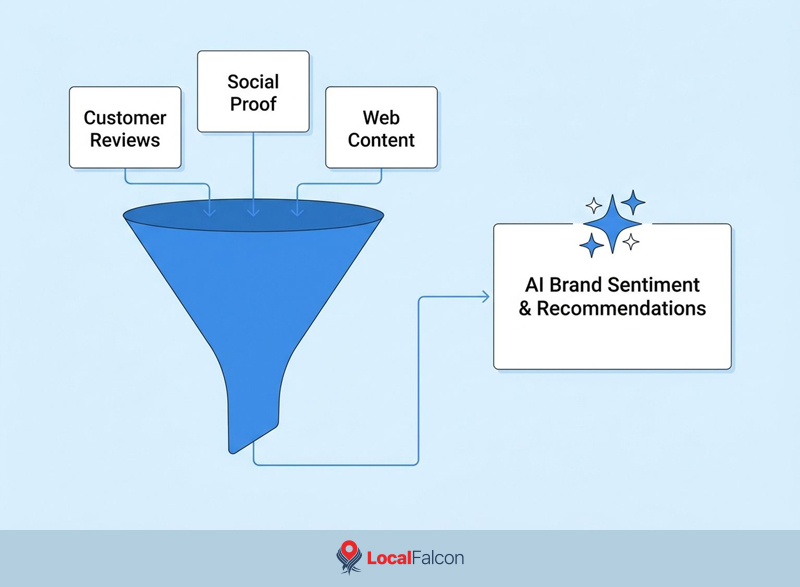
AI models are trained on and informed by a wide range of publicly available web content, and they frequently favor user-generated content like reviews and social media comments over a brand's own content. When AI recommends a business warmly, that framing is often a reflection of what the model has absorbed from real customer sentiment signals online.
This is actually good news for local businesses. It means that the same work you do to earn positive reviews, generate authentic social proof, and maintain a strong reputation across the web contributes directly to how AI perceives and presents your brand.
A business with hundreds of glowing reviews and positive comments on platforms like Reddit and Facebook is likely to enjoy both stronger AI visibility and more positive AI brand sentiment than one with thin or mixed reviews — because AI is analyzing that public brand sentiment when it formulates its own recommendations.
The key implication here is that improving your traditional brand sentiment is a strategy for improving your AI brand sentiment. But you also need to be able to measure what AI is actually saying about your business, so you know whether your efforts are working.
Why AI Brand Sentiment Matters for Local Business Growth
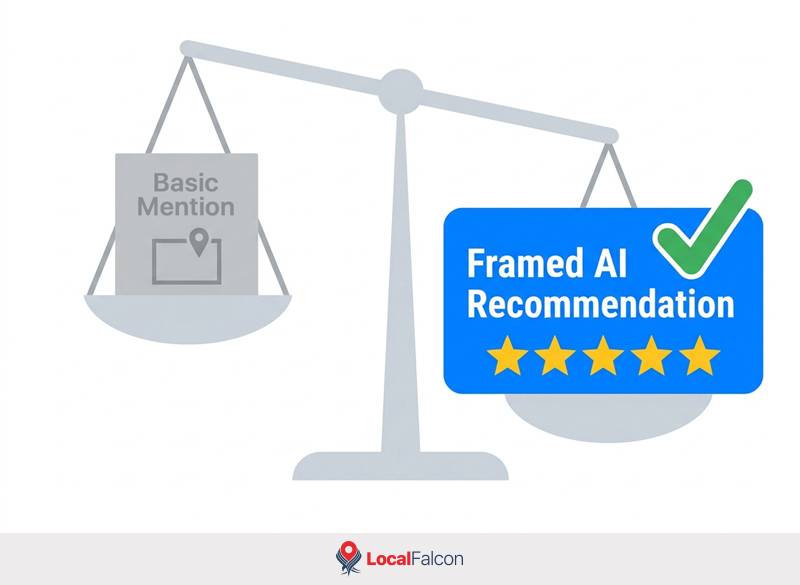
When AI tools mention or recommend a business, they don't just offer a ranked list of businesses like Google Search and Maps do — they frame the recommendation.
There's a big difference between an AI saying something like: "You might try this business in your area because it's nearby." and "This business is highly rated for its efficient, professional service and known for fast response times." The second response does far more to drive conversions because it addresses common concerns before the customer has even clicked through to a business listing, review platform, or website for more information.
In other words, positive AI sentiment creates a kind of pre-qualification effect. Customers arrive with trust already established because the AI's recommendation carried warmth and specificity. For local businesses operating in competitive markets, this can be the difference between a phone call and a scroll past.
This is also why monitoring AI sentiment needs to be an ongoing practice, rather than a one-time audit. AI models constantly update, new competitors enter the market, and your digital presence changes over time. What AI says about your business today may be totally different from what it says six months from now — especially if you want it to be and put in the work to change it.
How To Influence Your AI Brand Sentiment
Because AI sentiment toward local businesses is largely a reflection of publicly available signals, some of the most effective strategies for improving how AI talks about your business are grounded in fundamentals:
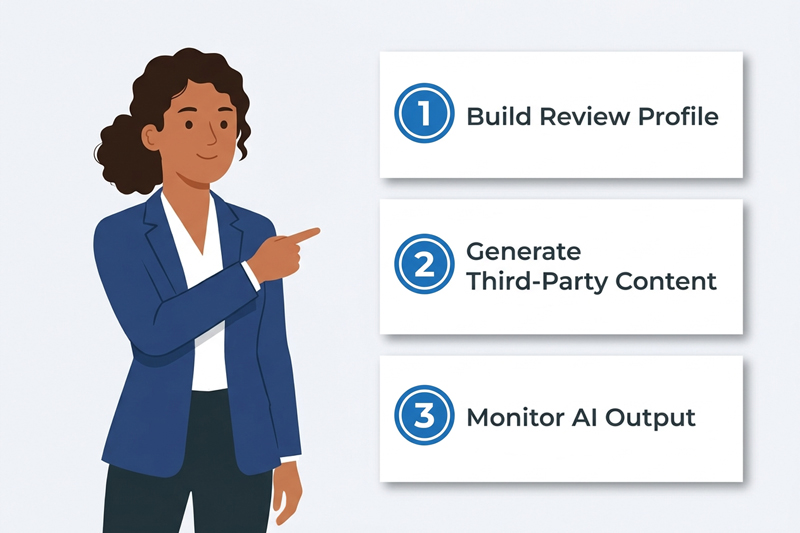
- Build and maintain a strong review profile: Volume, recency, ratings, and what reviews actually say all factor into how AI tools characterize a business. Actively encourage satisfied customers to leave detailed reviews, and respond thoughtfully to all reviews, including negative ones.
- Generate authentic third-party content: Local press mentions, blog features, and social media engagement all contribute to a broader web of positive brand signals that AI can draw on.
- Monitor what AI is actually saying: You can't improve what you're not measuring. Regularly track your AI visibility for the kinds of prompts your potential customers would use and evaluate the sentiment and accuracy of how your business is represented. Local Falcon lets you track AI visibility right alongside your Google Maps rankings.
Measuring AI Brand Sentiment at Scale
Whether you're managing a single location or hundreds, manually querying a few AI tools every now and then will never give you an accurate or actionable picture of your true AI visibility and AI brand sentiment.
You need to be able to monitor AI visibility and sentiment not only across geographic areas you serve, but also across a large volume and range of AI-style search queries and prompts relevant to your business and its customers.
This is where AI visibility tracking and AI brand sentiment analysis tools are indispensable. For example, Local Falcon offers AI brand sentiment analysis, designed specifically for local businesses and local SEO professionals, within every AI visibility Scan Report. This enables users to analyze how AI tools are representing their businesses across multiple locations and queries at scale, identifying sentiment patterns, tracking changes over time, and surfacing actionable insights that help improve AI visibility and sentiment together.
For agencies managing dozens or hundreds of client locations, or for enterprise organizations with wide visibility footprints, that kind of scalable analysis is the only practical way to stay on top of AI brand sentiment and translate those insights into real business outcomes.
The Bottom Line
AI platforms are increasingly the first touchpoint where customers learn about the existence of local businesses, and the sentiment embedded in those AI interactions shapes zero-click buying decisions.
Because of this, brand sentiment analysis for AI visibility is now an essential part of any local marketing strategy, whether it's for a single-location neighborhood restaurant or a multi-location contractor operating across dozens of service areas.
Businesses that understand what AI is saying about them, why it's saying it, and how to improve it will ultimately earn customer trust earlier in the buying journey, outperform competitors, and drive more revenue from AI-driven discovery.
Try running an AI visibility scan with Local Falcon today to start monitoring and analyzing AI brand sentiment.