
Local citations have traditionally helped search engines verify a business's identity, location, and contact information. Today, they also play a role in how AI search platforms discover businesses, evaluate their credibility, and decide which ones to recommend.
However, structured and unstructured citations serve different purposes, and their relative importance depends on where a business wants to earn visibility. Structured citations remain important for traditional local SEO, while unstructured citations, particularly mentions in credible third-party content, have become increasingly valuable for earning visibility in AI-generated answers.
Understanding the difference between structured citations and unstructured citations helps local businesses decide where to build their presence, which sources to prioritize, and how to measure the impact of their efforts.
What Are Structured and Unstructured Citations?
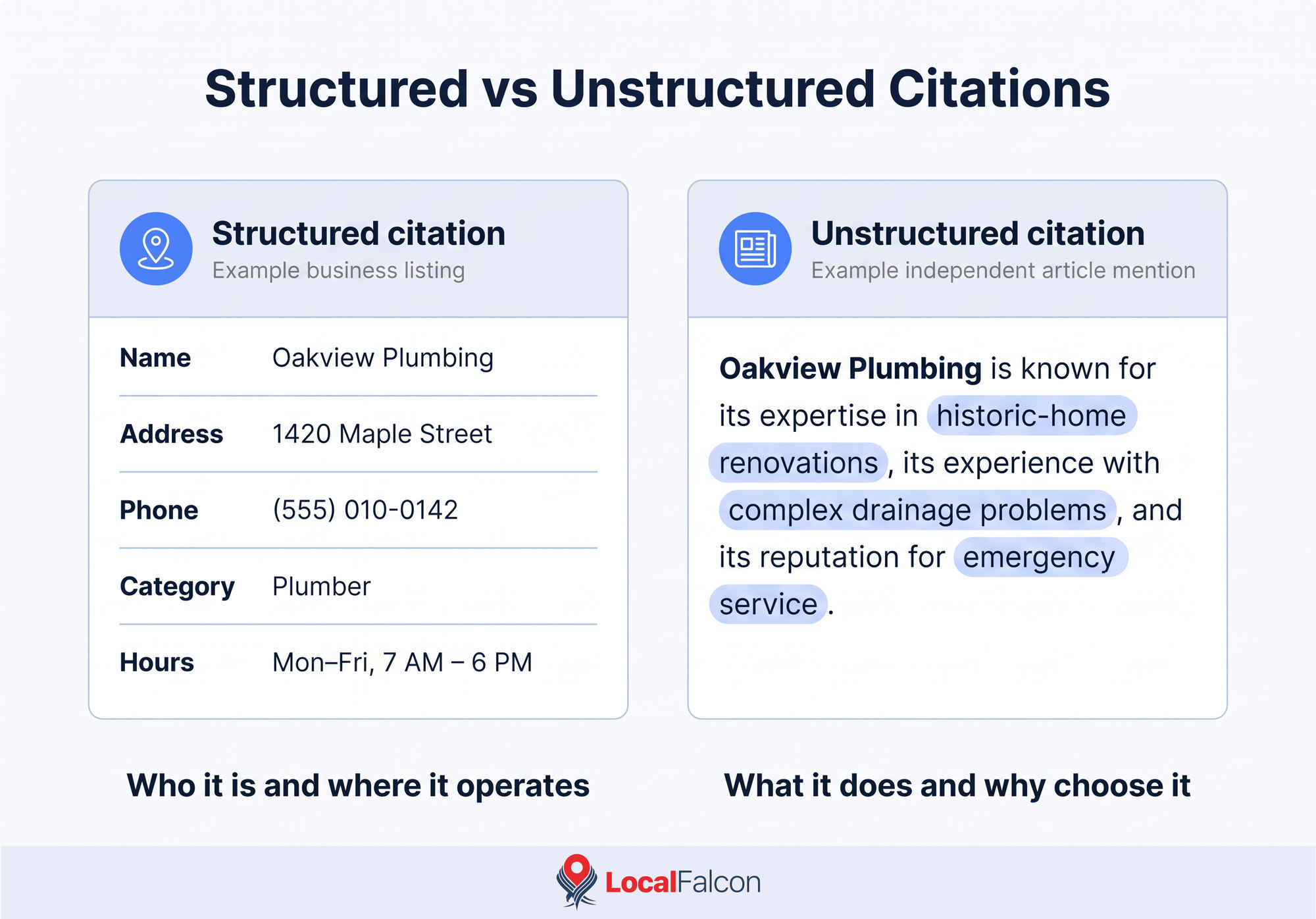
Structured citations are online business listings that display a business's name, address, phone number, and other identifying information in a standardized format. Common examples include Google Business Profiles, Yelp listings, and entries in industry-specific directories.
Unstructured citations are mentions of a business within other online content that is not presented as a standardized business listing. Examples include local news articles, blog posts, editorial reviews, community websites, and industry publications that mention a business by name.
Both local SEO citation types help establish a business's online presence, but they provide different signals to search engines and AI systems.
What Are Structured Citations?
Structured citations typically appear on platforms designed to organize business information into consistent fields. These platforms make it easier for search engines and other systems to identify a business and associate it with a particular location, category, and set of services.
Examples of structured citations include:
- Google Business Profiles
- Bing Places for Business listings
- Yelp business profiles
- Apple Business listings
- Chamber of commerce directories
- Industry-specific directories, such as those for lawyers, dentists, or home service providers
- Local business directories and association member listings
The information in these listings commonly includes a business's name, address, phone number (NAP), website URL, hours, business category, and services offered.
Accurate and consistent information across structured citation sources helps search engines reconcile business details across multiple sources. This is particularly important for businesses with multiple locations, where incorrect addresses, outdated phone numbers, or duplicate listings can create confusion.
What Are Unstructured Citations?
Unstructured citations occur when a business is mentioned in editorial or other online content rather than a standardized directory listing. They can appear in content published by journalists, bloggers, industry experts, customers, local organizations, and other third parties.
Examples include:
- A local newspaper article profiling a neighborhood restaurant
- A blog post comparing the best plumbers in a city
- An industry publication reviewing a home services provider
- A local organization's website mentioning a business sponsor
- A travel guide recommending a hotel near a local attraction
- A customer story published on a partner's website
- A forum discussion recommending a particular service provider
- A roundup of businesses serving a specific community
Unlike structured citations, unstructured citations do not need to include a complete address or phone number. A business name alone may qualify, although additional details and surrounding context can make the mention more useful.
The context matters because it can explain what the business does, which products or services it offers, where it operates, what it is known for, and why someone might choose it over a competitor.
Structured vs Unstructured Citations: Key Differences
The main difference between structured and unstructured citations is how business information is presented and what context accompanies it.
|
Characteristic |
Structured citations |
Unstructured citations |
|
Format |
Standardized business listing |
Mention within editorial or other content |
|
Common sources |
Directories, business profiles, association listings |
News articles, blogs, reviews, local websites, forums |
|
Typical information |
Business name, address, phone number, category, hours |
Business name, services, location, reputation, expertise |
|
Main SEO value |
Helps establish business identity and location information |
Helps establish relevance, reputation, and associations |
|
Traditional local SEO |
Important for business data consistency and local prominence |
Supports prominence and broader awareness |
|
AI SEO |
Helps AI systems discover and verify business details |
Provides contextual information that can inform recommendations and descriptions |
|
Level of control |
Often possible to claim and edit listings |
Usually depends on third-party publishers or contributors |
|
Best optimization approach |
Maintain accurate, complete, consistent listings |
Earn relevant mentions with accurate, useful context |
Neither citation type is universally more valuable than the other. Their relative importance depends on the search platform, the business's market, and the visibility goals it is trying to achieve.
Why Structured Citations Matter for Traditional Local SEO
Structured citations remain a foundational part of local SEO because they help search engines identify businesses, understand where they operate, and reconcile information from different sources.
Google's local ranking algorithms primarily consider relevance, distance, and prominence as the most important local ranking factors. Structured citations can support these factors by providing accurate business information and contributing to a business's broader online presence, although no individual directory listing guarantees higher rankings.
1. They Help Search Engines Verify Business Information
Search engines encounter business information across websites, directories, maps, and other online resources. Consistent details across these sources help systems determine whether different listings refer to the same business.
For example, a restaurant with the same name, address, phone number, and website across Google, Apple Maps, Yelp, and relevant local directories presents a clearer identity than one with conflicting information across those platforms.
Consistency does not mean every listing must contain identical fields. It means the information that appears should accurately reflect the business, with outdated details and duplicate listings addressed where possible.
2. They Support Local Relevance and Prominence
Business listings can reinforce a business's category, location, and services. Listings in relevant directories and industry associations can also contribute to its broader online presence.
However, citation quantity alone is not a reliable measure of local SEO strength. A small number of accurate, relevant listings is generally more useful than dozens of low-quality directory submissions that add little value.
3. They Help Customers Find and Contact Businesses
Structured citations have practical value beyond rankings. Customers may discover a business through Apple Maps, a professional directory, or a local chamber of commerce website without ever visiting its main website.
Incorrect hours, broken website links, and outdated phone numbers can cost a business leads and sales. Keeping important listings current helps ensure that customers can take the next step after finding the business.
4. They Establish a Reliable Foundation for AI Discovery
AI search systems also need reliable information about businesses, including their names, locations, categories, and services. Structured listings can help provide that information, particularly when a business appears across multiple relevant and trustworthy platforms.
However, accurate directory listings do not automatically earn a business recommendations in ChatGPT, Google AI Overviews, Gemini, or other AI search experiences. AI visibility also depends on whether the business is relevant to the user's request and what other available sources say about it.
For that reason, structured citations should be treated as one part of a broader local and AI SEO strategy rather than a standalone solution.
Why Unstructured Citations Matter for AI SEO
AI search introduces a different challenge for local businesses. Instead of simply returning a list of businesses that match a category and location, AI systems may synthesize information from multiple sources to recommend specific providers, compare alternatives, and explain why one business might be a good choice.
That makes the information surrounding a business's name especially important. Unstructured citations can provide details about a business's reputation, expertise, service quality, specialization, and suitability for particular customer needs.
1. They Provide Context That Business Listings Often Lack
A directory listing might establish that a company is a plumber serving a particular city. An independent article, however, might describe its expertise in historic-home renovations, its experience with complex drainage problems, or its reputation for emergency service.
That additional context can help an AI system associate the business with more specific customer needs. If someone asks an AI assistant to recommend a plumber experienced with older homes, mentions that establish this specialization may be relevant to how the business is evaluated.
This does not mean that every mention will influence an AI response. The source's relevance, credibility, wording, and relationship to the user's question all matter, and the precise weighting of these factors varies by platform.
2. They Can Influence Which Businesses AI Systems Mention
AI-generated recommendations can draw on information from a business's own website, third-party publications, directories, review platforms, and other accessible sources. When independent sources repeatedly associate a business with a particular service, location, or area of expertise, they can help establish that association.
Consider a customer asking an AI assistant to recommend the best independent coffee shops in a particular neighborhood. A shop's business profile may establish its location and category, while local food guides, neighborhood publications, and relevant reviews may provide additional reasons to include it in the recommendations.
This is why earning relevant third-party mentions is an important part of an AI visibility strategy. Businesses need to be discoverable, but they also benefit from credible sources that explain why they deserve consideration.
3. They Can Shape What AI Says About a Business
Being mentioned by an AI system is only part of the equation. The description accompanying that mention can affect whether a customer sees the business as a suitable option.
AI-generated answers may describe a business's specialties, pricing, service area, customer experience, or reputation. Third-party content can help establish these associations, particularly when the information is specific, accurate, and consistent with other credible sources.
For example, an AI assistant might describe a contractor as specializing in commercial roofing rather than residential repairs. If the contractor wants to attract residential customers, relevant third-party content that accurately discusses its residential work could help strengthen that association.
Businesses cannot dictate what an AI system says about them, and no particular unstructured mention guarantees a specific description. However, they can improve the quality and breadth of the information available for AI systems to draw upon.
4. They Help Establish Credibility Beyond a Business's Own Website
A business can publish detailed information about its products, services, and expertise, but its own claims are only one part of the available evidence. Independent coverage can provide additional context about its reputation and relevance.
For example, a law firm's website can describe its experience in employment law. An independent legal directory, a local news article discussing a relevant case, or an industry publication featuring one of its attorneys may provide additional evidence of its professional standing.
The value of a mention depends on the source and the content, not simply on whether it appears on a third-party website. Relevant editorial coverage and substantive recommendations are generally more useful targets than indiscriminate attempts to secure mentions anywhere online.
5. They Can Help Businesses Compete for Specific Customer Needs
AI search queries are often conversational and specific. Customers may ask for a business that accommodates a particular requirement, offers a specialized service, or has experience with an unusual problem.
Unstructured citations can help establish these specific associations when they describe a business's relevant expertise or capabilities. A general listing may identify a business as a dentist, for example, while a detailed article or professional profile may establish that it offers sedation dentistry for anxious patients.
Businesses should therefore think beyond earning mentions of their names. They should aim to earn accurate mentions that connect their names with the services, specialties, locations, and customer needs they want to be known for.
Are Unstructured Citations More Important Than Structured Citations for AI SEO?
Unstructured citations can be especially valuable for influencing the context, reputation, and associations reflected in AI-generated recommendations. However, it would be inaccurate to conclude that they are always more important than structured citations across every AI platform or query.
Structured citations help establish who a business is and where it operates. Unstructured citations can help explain what it does, what makes it relevant, and why a customer might choose it.
These roles complement one another. An AI system may need reliable business information to identify the correct provider, then use additional sources to evaluate its suitability for a particular recommendation.
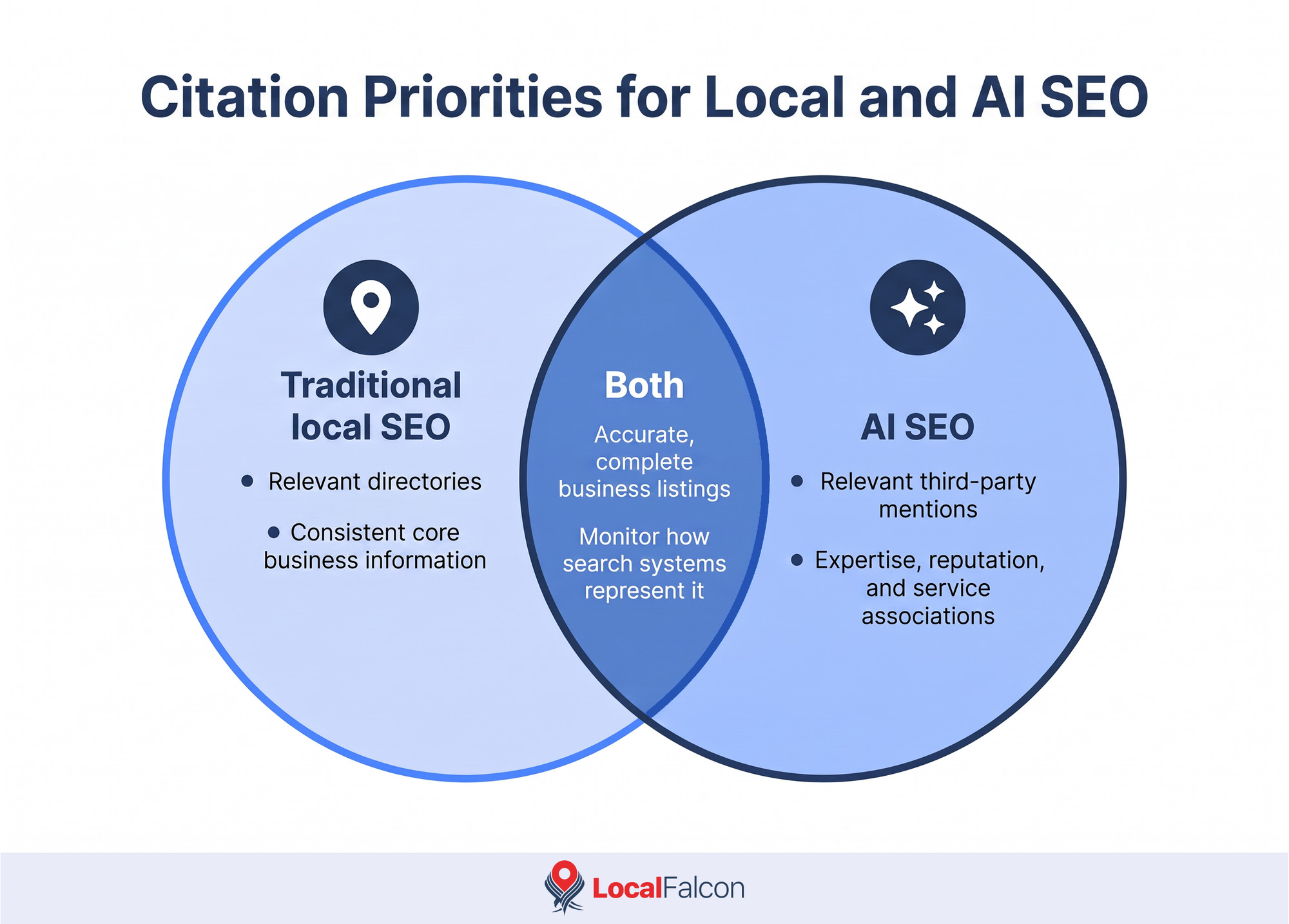
A good way to think about the distinction is:
- For traditional local SEO: Prioritize accurate, complete business listings, relevant directories, and consistent core business information.
- For AI SEO: Maintain those foundational listings while investing in relevant third-party mentions that establish expertise, reputation, and service-specific associations.
- For both: Ensure that information about the business is accurate and consistent, and monitor how search systems actually represent it.
The goal is not to choose one citation type over the other, but rather to understand where each type contributes to visibility and allocate resources accordingly.
How To Build Structured Citations for Local and AI SEO
Building structured citations starts with ensuring that customers and search systems can find accurate business information on the platforms that matter to them.
1. Audit Existing Business Listings
Start by identifying where the business already appears online. Check major map platforms, relevant directories, industry associations, and local business organizations.
Look for outdated information, duplicate listings, missing profiles, and inconsistencies that could make the business harder to identify.
2. Prioritize the Most Relevant Platforms
Not every directory deserves equal attention. Focus first on platforms that matter to customers in the business's market, followed by authoritative general directories and relevant industry-specific resources.
For most local businesses, this means reviewing:
- Google Business Profile
- Bing Places for Business
- Apple Business Connect
- Yelp, where relevant to the market
- Local chambers of commerce and business associations
- Reputable industry-specific directories
- Relevant local directories with genuine audience value
The appropriate list will vary by business type, location, and customer behavior.
3. Keep Core Business Information Accurate
Verify the business's name, address, phone number, website URL, and operating hours. Ensure that the primary category and additional business details accurately represent what the business offers.
For multi-location businesses, maintain accurate location-specific information rather than copying the same address or phone number across every profile. Correct duplicates and update listings whenever key business details change.
4. Complete Profiles Where Possible
Many structured citation platforms allow businesses to provide more than basic NAP information. Depending on the platform, relevant fields may include categories, services, attributes, descriptions, photos, and appointment or booking links.
Complete these fields accurately and use them to clarify the business's actual offerings. Do not add irrelevant categories or unsupported claims in an attempt to appear for more searches.
5. Review Citation Quality Regularly
Business information changes over time, and third-party platforms may retain outdated details. Schedule periodic checks to identify and correct problems, particularly after a relocation, rebrand, change in phone number, or expansion to additional locations.
How To Earn Unstructured Citations for AI SEO
Unstructured citations require a different approach because businesses generally cannot control when and how independent publishers mention them. The goal is to earn relevant, accurate coverage from sources that have a legitimate reason to discuss the business.
1. Pursue Relevant Local and Industry Media Coverage
Local news outlets, trade publications, and specialist blogs can be valuable sources of third-party mentions. Look for opportunities where the business has something genuinely useful to contribute, such as local expertise, original research, commentary on an industry development, or information about a community issue.
For example, a local HVAC company might offer expert commentary on preparing homes for extreme temperatures, while a hair salon might provide a quote for a news article on the local wedding season.
These opportunities can establish relevant associations while reaching audiences that may also become customers.
2. Develop Relationships With Local Organizations
Community organizations, professional associations, event organizers, and local business groups may publish member directories, event recaps, sponsor acknowledgments, or other content that mentions participating businesses.
Prioritize relationships that reflect real involvement and provide value to the community. A meaningful mention in a relevant local organization's content can be very valuable.
3. Create Content Worth Referencing
Original data, useful research, expert commentary, and detailed resources can give publishers a reason to mention a business. Content that answers a specific question or provides information unavailable elsewhere may be particularly useful.
For example, a roofing contractor could publish a report on winter roof damage trends in its service area. A veterinary clinic could develop an expert-reviewed guide to common pet health concerns, making it a useful resource for local organizations and relevant publications.
Keep in mind that publishing content does not guarantee third-party citations. Outreach, distribution, genuine expertise, and the usefulness of the material all influence whether other sources choose to reference it.
4. Build Relationships With Relevant Industry Publishers
Industry publications often cover specific problems, products, and professional specializations. Contributing expert commentary, participating in interviews, and supplying useful case studies can create opportunities for relevant mentions.
Focus on publishers whose audiences overlap with the business's target customers. A mention that accurately establishes a relevant specialty may be more useful than a generic reference in a publication with little connection to the business.
5. Encourage Genuine Reviews and Customer Stories
Customer reviews can provide useful information about service quality, product attributes, and customer experiences. Case studies and testimonials published by customers or partners can also explain how a business solves specific problems.
Encourage customers to share honest feedback through appropriate channels, and follow each platform's rules. Never fabricate reviews, incentivize misleading praise, or pressure customers to provide particular wording.
Reviews are not interchangeable with editorial citations, and their influence varies by platform. However, they can contribute to the broader body of information available about a business.
6. Look for Relevant Partner and Supplier Mentions
Businesses often have legitimate relationships with suppliers, distributors, contractors, professional partners, and other organizations. These relationships may create opportunities for accurate mentions on partner websites, project pages, case studies, or resource lists.
For example, a commercial contractor might be featured in a manufacturer's project case study. A business law firm might be mentioned in a partner's account of a successful collaboration.
The mention should reflect a genuine relationship and provide useful context. Avoid artificial link exchanges or arrangements designed primarily to manipulate search rankings.
7. Prioritize Relevance and Accuracy Over Volume
There is no universal citation count that guarantees local or AI search visibility. The value of a mention depends on factors such as the source's credibility, topical relevance, the specificity of the information, and how well it addresses the business's actual offerings.
Ten unrelated mentions are not necessarily more valuable than one detailed, relevant feature. Focus on earning coverage that helps customers and search systems understand why the business is a credible option for the needs it serves.
How To Monitor Structured and Unstructured Citations for AI SEO
Building citations without monitoring their impact leaves businesses with an incomplete picture of their visibility. They may know where their business is listed, but not which sources AI systems use when recommending them or their competitors.
This is where AI visibility monitoring comes in.
Local Falcon's AI visibility reports show the sources AI platforms link to when generating responses that mention a business or its competitors. This source intelligence provides a solid starting point for identifying the structured and unstructured citations that may be influencing AI-generated answers.
1. Identify the Sources AI Platforms Reference
Review the sources linked in AI responses that mention the business. Depending on the platform and response, these may include business listings, directories, review sites, local publications, industry resources, or other third-party content.
Separate the sources into structured citations and unstructured citations to establish which kinds of citations the AI platform is drawing from most when it discusses the business.
Remember that a linked source is evidence of what the platform cited in that response, not proof that the source caused the recommendation. AI systems can use information in different ways, and the sources they cite may vary between queries and over time.
2. Analyze Sources Cited for Competitors
A business should not limit its analysis to responses that mention its own name. Review the sources AI platforms cite when recommending competing businesses, especially those that repeatedly appear for high-value local queries.
For example, if competitors are frequently mentioned in local service guides, professional directories, or industry roundups, those sources may reveal opportunities for the business to earn relevant coverage of its own.
This analysis can also identify listings that need improvement or important third-party information that the business's website does not currently address.
3. Identify Citation Gaps
Compare the sources associated with your business against those associated with competitors. Look for relevant directories where your business is absent, publishers that frequently feature competitors, and recurring topics or specializations that appear in AI-generated recommendations.
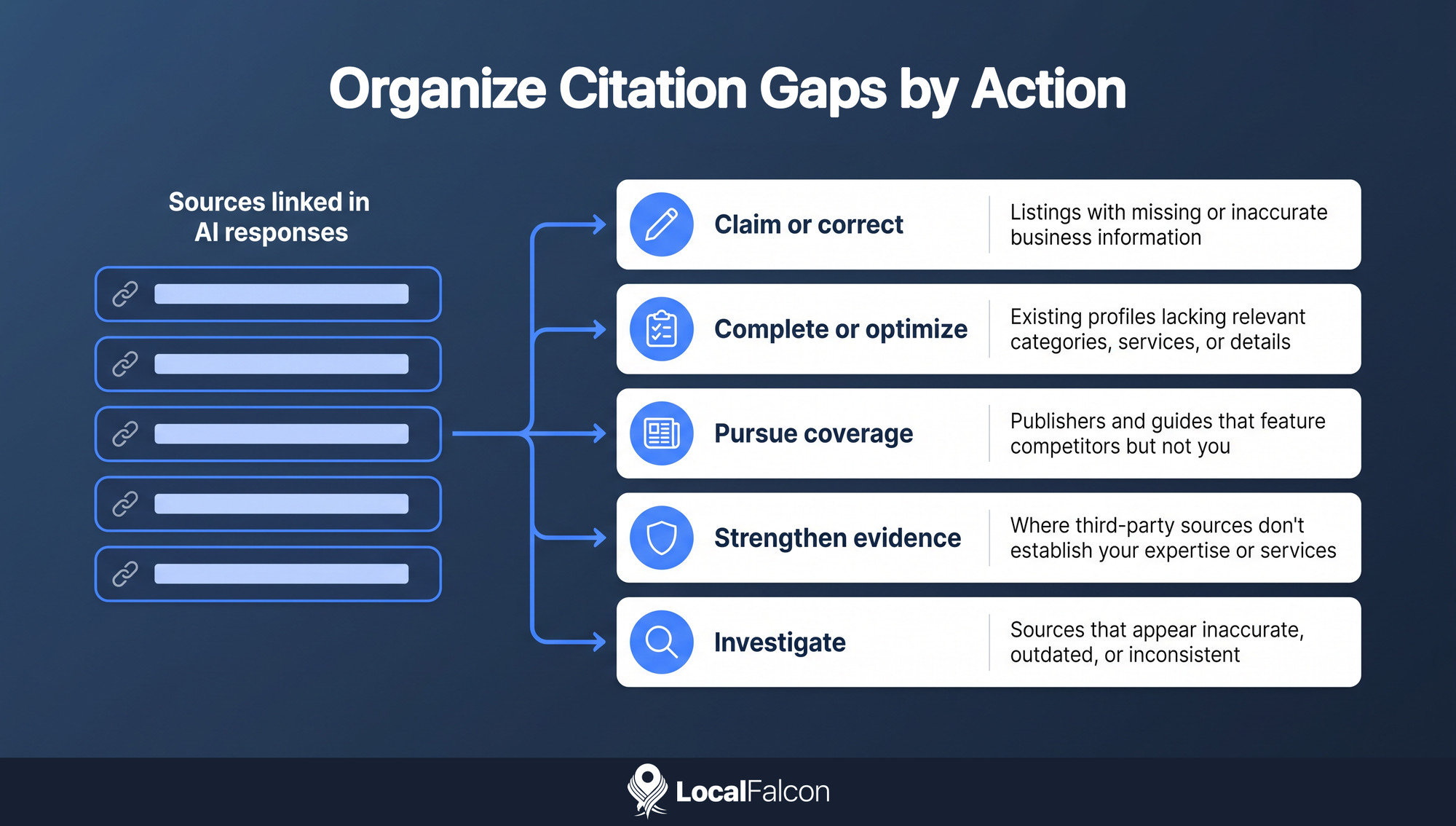
Organize these opportunities by the action required:
- Claim or correct: Listings with missing or inaccurate business information.
- Complete or optimize: Existing profiles that lack relevant categories, services, or other useful details.
- Pursue coverage: Relevant publishers, guides, and industry resources that feature competitors but not your business.
- Strengthen evidence: Areas where third-party sources do not clearly establish your expertise, services, or service area.
- Investigate: Sources that appear inaccurate, outdated, or inconsistent with the business's actual offerings.
This turns citation intelligence into a prioritized action plan rather than a simple list of URLs.
4. Track Changes Over Time
AI responses and their cited sources can change as platforms update their systems and new content becomes available. Revisit important queries regularly to see whether the business is being mentioned, which sources are cited, and how the descriptions of the business compare with those of competitors.
Track both visibility outcomes and the work undertaken to improve them. For example, record whether a business has gained a relevant editorial mention, corrected an inaccurate listing, or begun appearing in AI responses for a target service.
Do not assume that a new citation will immediately change AI visibility. Monitoring over time helps identify patterns, although changes in AI responses can have multiple causes.
5. Connect Citation Monitoring to Business Outcomes
Visibility is a means to an end, not the final objective. Businesses should also monitor relevant website visits, calls, inquiries, bookings, and sales wherever reliable attribution is available.
Use tracking links where appropriate, monitor referral traffic, and ask new customers how they discovered the business. These methods can help connect citation-building efforts with actual customer acquisition, even when attribution across AI platforms remains incomplete.
Local Falcon's AI visibility reports help identify which sources to investigate and which citation opportunities to prioritize. Combining those insights with traditional local rank tracking and business-level conversion data provides a more complete view of performance.
A Practical Citation Strategy for Local and AI SEO
Businesses do not need to treat building structured and unstructured citations as separate, competing campaigns. A coordinated approach can improve the accuracy of business information while building the broader reputation and context that help customers, ranking algorithms, and AI systems alike evaluate a business.
Use the following workflow to get started:
- Audit structured citations: Identify missing listings, duplicates, outdated information, and inconsistent business details.
- Establish a baseline for AI visibility: Monitor relevant queries and track when the business and its competitors appear in AI-generated responses.
- Review cited sources: Identify the directories, publications, review platforms, and other resources linked in those responses.
- Prioritize citation gaps: Correct inaccurate listings and identify relevant third-party sources where additional coverage could be valuable.
- Build citations strategically: Improve existing profiles and pursue legitimate editorial mentions, industry coverage, partner features, and community references.
- Reassess visibility: Monitor changes in AI mentions, linked sources, business descriptions, and local search performance.
- Measure business impact: Where possible, connect visibility improvements with qualified traffic, inquiries, bookings, and sales.
The specific priorities will vary by business and market, as well as the current state of the business's citations. A business with inconsistent listings should address those problems first, while one with a strong directory presence but limited AI visibility may need to focus more heavily on relevant third-party coverage.
Conclusion: Build Citations That Support Both Local and AI Visibility
Structured and unstructured citations serve complementary roles in local and AI SEO. Structured citations help establish accurate business information across directories and map platforms, while unstructured citations can provide the context, reputation, and service-specific associations that help AI systems describe and recommend businesses.
The most effective local citation-building strategy combines accurate, optimized listings with relevant, credible third-party mentions. Rather than building citations indiscriminately, businesses should identify the sources that matter in their markets, understand how those sources appear in AI-generated responses, and prioritize improvements based on measurable opportunities.
Local Falcon's local AI visibility tracking makes that process more actionable by showing the sources AI platforms link to in a response that mentions a business or its competitors. Use those insights to identify citation gaps, guide outreach, improve existing listings, and monitor whether your efforts are helping your business earn visibility where customers are searching.
Frequently Asked Questions
What is the difference between structured and unstructured citations?
Structured citations are standardized business listings that typically include a business's name, address, phone number, website, and other details. Unstructured citations are mentions of a business within editorial or other content, such as news articles, blog posts, reviews, and industry publications.
Are structured or unstructured citations more important for local SEO?
Structured citations are an important part of local SEO because they help establish consistent business information across directories and other platforms. Unstructured citations can also contribute to local prominence and reputation, so businesses should maintain accurate listings while earning relevant third-party mentions.
Are unstructured citations more important for AI SEO?
Unstructured citations can be particularly valuable for establishing the context, expertise, and reputation reflected in AI-generated recommendations. However, structured listings still help AI systems identify businesses and verify key details, so neither citation type should be ignored.
Do unstructured citations need to include a backlink?
No. An unstructured citation can mention a business without linking to its website and still provide value, especially when it comes to providing useful context for AI to draw from, although a link can help customers discover the business further and allow publishers to direct readers to additional information.
How many citations does a local business need?
There is no universal number of citations required to rank well in local search or appear in AI-generated recommendations. Businesses should prioritize accurate listings on relevant platforms and earn credible third-party mentions that support their services, location, and reputation rather than chasing a specific citation count.
How can I find out which citations AI platforms use?
Review the sources linked in AI-generated responses that mention your business or competitors. Local Falcon's AI visibility reports help identify these sources, making it easier to discover relevant directories, publications, and other citation opportunities to investigate.
Can citations guarantee AI search visibility?
No. Citations are one part of a broader set of signals and information that AI platforms may use to generate responses. Business relevance, source credibility, website content, reviews, query wording, and platform-specific systems can all affect whether a business is mentioned and how it is described.
How often should businesses audit their citations?
Review important listings whenever business information changes and conduct periodic audits to catch outdated details or duplicates. For AI citations, monitor important queries regularly so you can identify changes in cited sources, competitor visibility, and opportunities to improve your online presence.