
Search results are more dynamic than they've ever been. Queries that once led users to a list of 10 blue links, sometimes accompanied by Google Maps results, now frequently return AI-generated answers from Google's AI Overviews, AI Mode, ChatGPT, Gemini, Perplexity, and other AI search platforms and features.
For local businesses, this gives rise to important new strategic questions: what does visibility look like when there may be no ranked list of URLs or businesses, at least in the traditional sense, at all? And, how can we optimize for AI visibility alongside traditional rankings?
Understanding the distinction between traditional SEO and AI SEO, and more specifically, traditional local SEO and AI SEO, is crucial for brands looking to maximize search visibility as search continues to evolve. It has direct implications for how local brands invest their time, what they measure, and how they interpret success.
What Traditional SEO and Traditional Local SEO Are Trying to Accomplish
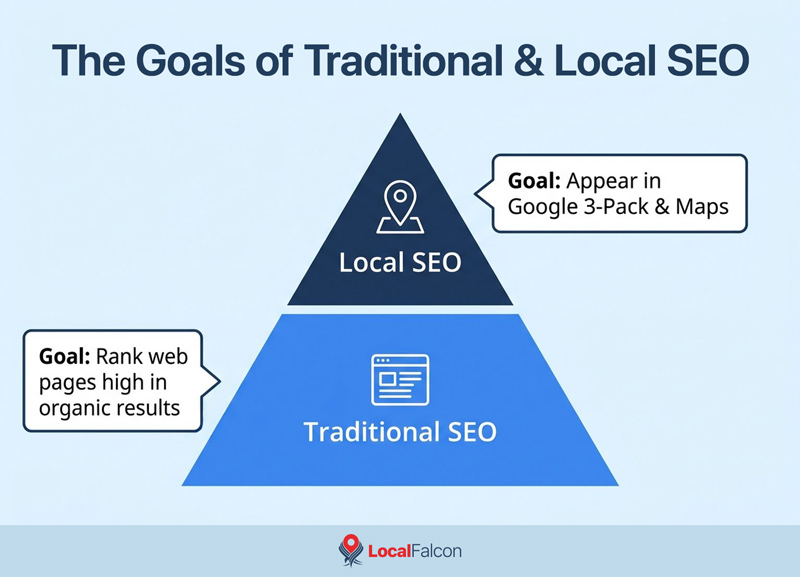
Traditional SEO has a clear, singular objective: get web pages to rank as high as possible in organic search results. The signals that drive those rankings are well-documented: content quality and relevance, strong on-page SEO, technical site health, backlink authority, and E-E-A-T (Experience, Expertise, Authoritativeness, and Trustworthiness).
Traditional local SEO operates on top of that foundation with a distinct additional goal: getting a business to appear in the Google 3-Pack (the map pack results on Google Search) and on Google Maps. This requires its own set of practices: Google Business Profile optimization, local citation building, review management, and geographic relevance signals. A business can have a perfectly optimized website and still lose in local search if its GBP is neglected or its citation data is inconsistent.
Success in traditional SEO, including local SEO, is measured by rankings: average position in organic results and, more importantly for most local businesses, map pack rankings. The most meaningful metric at the local level is Share of Local Voice (SoLV), a measure of how often a business appears in the local pack for a given set of queries across a geographic area. SoLV transforms rankings from a single-point snapshot into a picture of overall local visibility, showing where a business dominates and where competitors are outranking it.
What AI SEO Is Trying to Accomplish
AI SEO, on the other hand, is not about ranking a page. It's about getting a business mentioned, cited, and recommended within AI-generated responses. Those responses come from Google's own generative AI Search features (AI Overviews and AI Mode) as well as standalone platforms like ChatGPT, Gemini, and Perplexity, which millions of users now consult as a first stop rather than a search engine.
In a local context, this matters because AI answers to local queries do not present a ranked list of options with equal footing. They generate a conversational recommendation, often describing businesses in qualitative terms derived from reviews, third-party content, and whatever else the AI finds indexed about them.
Google has been explicit, in its own published guidance on optimizing for generative AI features in Search, that the same signals driving traditional rankings contribute to AI visibility on its platform. Strong E-E-A-T, well-structured content, and authoritative web presence all apply. In that sense, AI SEO on Google is an extension of traditional SEO rather than a departure from it.
However, It's entirely possible for a business to have strong organic or map pack rankings, yet invisible within AI-generated results. This makes it crucial for brands to measure both traditional and AI search visibility.
Measuring Traditional SEO vs. AI SEO: A Fundamental Difference
Measurement is where traditional and AI SEO diverge the most.
Traditional local SEO is literally built on rankings. Average organic position, local pack rankings, and SoLV are all precise, repeatable metrics that can be tracked over time and benchmarked against competitors. They tell you where you stand in a structured, ordered system.
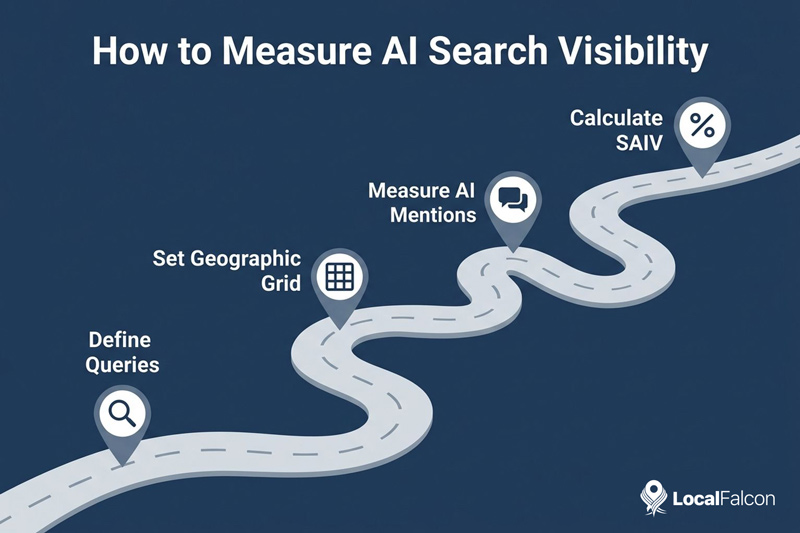
AI SEO has no equivalent of a standard ranked position. Sure, you can measure the sequence of mentions and give brands a sort of pseudo ranking, but ultimately a business either appears in an AI-generated answer or it doesn't. The best metric for measuring this is Share of AI Voice (SAIV), a metric that captures how often an AI mentions a business across a defined set of queries.
For local businesses, SAIV becomes especially actionable when applied geographically: running the same queries across a grid of location points in a target market and measuring AI mention rates at the hyperlocal level. This mirrors how local pack rankings are measured with geo-grid rank tracking tools like Local Falcon, and it reveals the same kind of geographic variation. AI visibility for a given business can differ substantially across a city or metro area depending on how the AI perceives local relevance and prominence at each point.
Sentiment: The Dimension Traditional SEO Doesn't Have
Perhaps the most important distinction between traditional and AI SEO is sentiment, which exists only in AI-generated results.
A position in the local pack or organic results doesn't carry any sentiment behind it. The listing appears; the user decides whether to click. AI-generated answers are not neutral. They characterize businesses using language drawn from reviews, mentions, and web content, and that characterization is part of the answer a potential customer receives before they ever visit a website or make a call.
An AI platform might describe one business as consistently praised for responsiveness and value, while describing a competitor as having variable customer experiences. Both businesses were mentioned. Only one received a recommendation that builds trust. This is why, in the context of AI search optimization vs. traditional SEO, sentiment is not a soft metric. It's central to what results AI visibility actually produces.
For local brands, this means tracking SAIV alone is not sufficient. Understanding how the AI describes your business, whether the characterization is accurate and positive, and how it compares to how competitors are being framed, is now a core part of the measurement picture. Improving AI sentiment typically means addressing the underlying sources the AI draws from: reviews, messaging across owned and third-party content, and the overall brand narrative that exists about your business across the web.
AI SEO vs Traditional SEO: Which Should Local Brands Focus On?
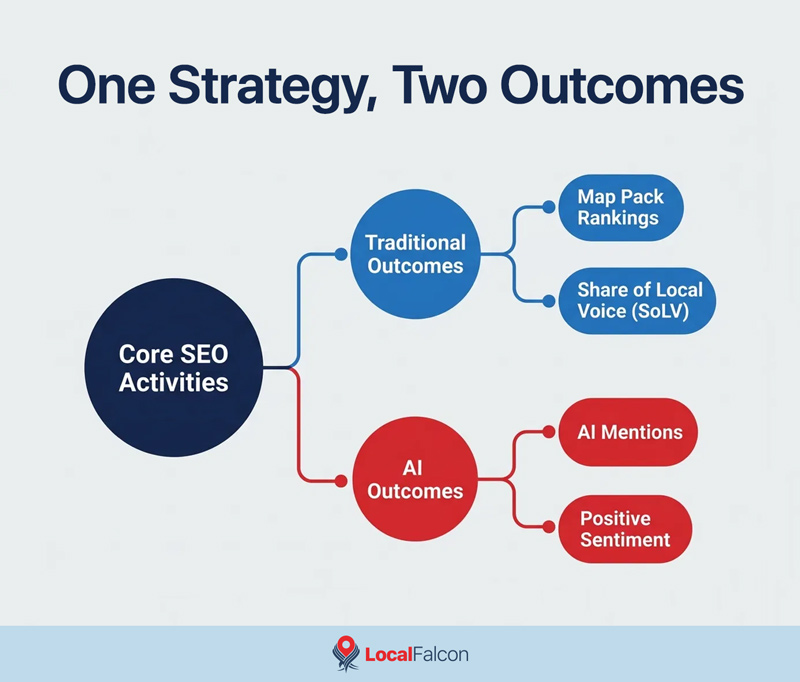
For brands with brick-and-mortar locations or service areas, local SEO remains essential. Local pack visibility and organic rankings still drive significant traffic and leads, and the practices that produce those results, including GBP optimization, review management, citation building, and content marketing, feed AI visibility at the same time.
What has changed is that those practices now serve two measurable outcomes instead of one. The actual SEO work overlaps substantially, but there's a major difference in what you measure and how you interpret it: rankings and SoLV for traditional visibility, SAIV and sentiment for AI visibility. Tracking both with Local Falcon gives you a complete picture of where a brand actually stands in local search today.
FAQs on AI Search Optimization vs Traditional SEO
What are the key differences between traditional SEO and AI SEO?
Traditional SEO focuses on ranking in organic blue-link results and, for local SEO, the local pack. AI SEO focuses on getting your business mentioned and recommended in AI-generated answers. They also differ in measurement: traditional SEO uses rankings, local SEO uses SoLV on top of rankings, and AI SEO measures success by Share of AI Voice (SAIV) and sentiment.
Does traditional local SEO still matter now that AI search is growing?
Yes. Local pack rankings still drive substantial traffic and leads, and the foundational elements of traditional local SEO, including GBP optimization, reviews, citations, and content, also feed AI visibility. The two are complementary, not competing priorities.
How do I measure my business's AI search visibility?
The primary metric is Share of AI Voice, which measures how often an AI platform mentions your business across a defined set of queries. For local businesses, this is most actionable when applied geographically across a grid of location points, mirroring how geo-grid tools like Local Falcon track local pack rankings.
Why does sentiment matter in AI SEO but not in traditional SEO?
Traditional search results are neutral. Your web page or listing appears and the user decides whether to click on it. AI answers actively characterize businesses using language drawn from reviews, comments, and other web content. Two businesses can both appear in an AI answer, but one may be framed as a clear recommendation while the other is described with caveats.
Can a business rank well traditionally but have poor AI visibility?
Yes. Strong organic or map pack rankings do not guarantee presence in AI-generated results. AI systems draw on a wide range of signals that don't correlate directly with traditional ranking factors, so measuring both independently is the only way to get an accurate picture of total search visibility.