
Running SEO for a Fortune 500 company is nothing like running SEO for a mid-sized business. The scale is incomparable, the organizational complexity is immense, and the stakes — lost rankings translating directly into lost revenue across hundreds or thousands of locations — are magnified at every turn. Yet even within the most sophisticated enterprise SEO tools and strategies, there are gaps. Local visibility is often one of them.
This overview covers the SEO strategies for Fortune 500 companies that define how the world's largest enterprise organizations compete for search visibility, with a focus on why local SEO deserves a dedicated seat at the enterprise table — and how teams can build the visibility intelligence infrastructure to execute it well.
The Scale Problem: Why Fortune 500 SEO Is a Different Discipline
Enterprise SEO doesn't just mean doing more of what smaller companies do. It means solving problems that smaller companies never encounter. Fortune 500 organizations typically manage thousands of web pages across multiple domains, subdomains, and even international properties.
These brands also operate within organizational structures where SEO recommendations must pass through legal, compliance, IT, regional marketing, and executive layers before implementation. A technical fix that might take a solo operator an afternoon can take weeks or months at enterprise scale.
Add to this the weight of legacy technology — CMS platforms and site architectures that have evolved over decades, often carrying significant technical debt — and you have an environment where even the best enterprise SEO strategy can be slowed to a crawl by execution complexity.
This is why Fortune 500 SEO strategies are distinguished not just by their strategic sophistication, but by their operational infrastructure: the governance frameworks, cross-functional workflows, and enterprise SEO performance monitoring systems that keep a sprawling strategy moving in the same direction. Understanding this context matters, because it shapes every tactical decision that follows.
Who needs Fortune 500-level SEO strategies?
Any enterprise operating at significant scale — whether or not they appear on the Fortune 500 list itself — faces the same fundamental challenges. This applies to industry-leading organizations across sectors including:
- Retail and e-commerce
- Healthcare systems and hospital networks
- Pharmaceutical and life sciences
- Banking and financial services
- Insurance
- Logistics and supply chain
- Transportation and mobility
- Quick-service and fast casual restaurant chains
- Hospitality and lodging
- Telecommunications
- Real estate and property management
- Automotive dealership groups
If your brand manages dozens, hundreds, or thousands of locations — or competes for search visibility across multiple markets simultaneously — the strategies in this guide apply to you.
Impeccable Technical SEO as the Foundation
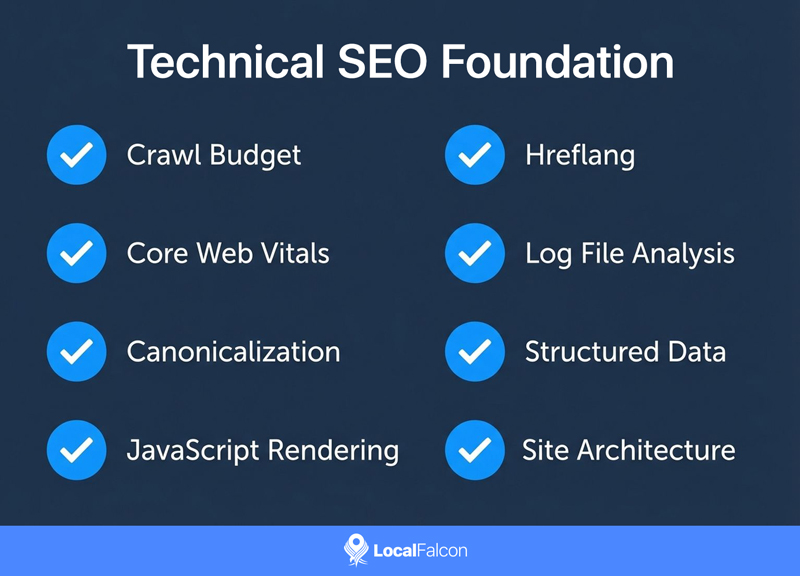
No content strategy, link building campaign, or local optimization effort will reach its potential on a broken foundation. Fortune 500 companies invest heavily in technical SEO precisely because the downside risk is so large. At this level, technical SEO isn't a one-time checklist — it's an ongoing discipline spanning:
- Crawl budget management and indexation control
- Core Web Vitals and page experience optimization
- Canonicalization and duplicate content management
- JavaScript rendering and client-side SEO
- Hreflang implementation for international properties
- Log file analysis and server-side diagnostics
- Structured data markup and schema implementation
- Site architecture and internal linking at scale
These technical elements are the infrastructure that makes everything else possible.
At enterprise scale, this means automation. Managing technical health across thousands of pages requires systematic monitoring, automated alerting, and developer workflows that can absorb SEO requirements without grinding to a halt. Change control processes are essential: a site migration or platform update that disrupts indexation can cost millions in lost organic traffic overnight.
The practical takeaway for enterprise teams is that technical SEO requires dedicated resources and a direct line to engineering. It cannot be a quarterly project — it requires continuous oversight.
Content at Scale: Breadth, Depth, and E-E-A-T
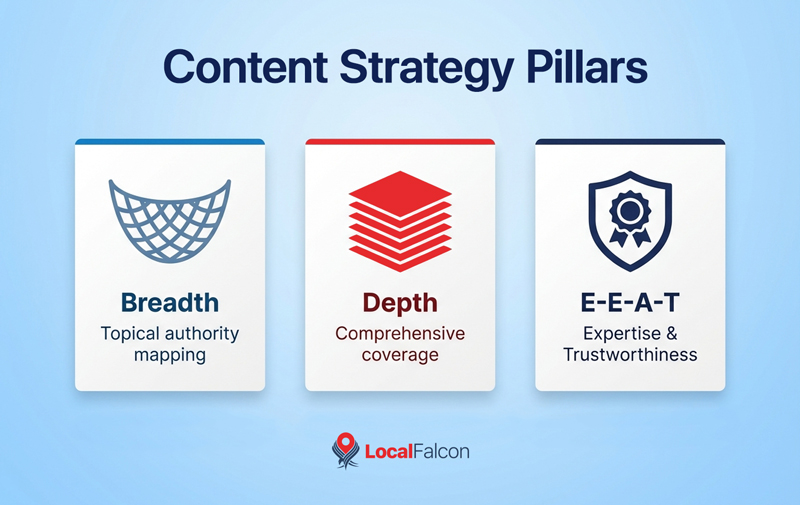
Fortune 500 companies are expected to demonstrate Experience, Expertise, Authoritativeness, and Trustworthiness (E-E-A-T) across every piece of content they publish, and Google holds large, authoritative brands to a high standard.
This means content strategy at the enterprise level goes far beyond volume. It requires topical authority mapping, audience segmentation, editorial governance, and a relentless commitment to quality across every market and business unit.
Global content calendars managed across regional teams, AI-assisted content workflows for consistency and efficiency, and content formats spanning long-form editorial, video, interactive media, and structured data all contribute to the kind of breadth that reinforces brand authority in competitive search landscapes.
Critically, this content must extend to local markets. Each location your brand operates in represents an opportunity to publish locally relevant content — service area pages, location-specific blog posts, community engagement content — that signals relevance to both search engines and the customers in those trade areas. A national brand that publishes one set of generic content for every market is leaving significant local search visibility on the table.
Keyword Strategy: Broad Authority and Hyperlocal Relevance
Fortune 500 SEO strategies operate across multiple layers of keyword strategy simultaneously. At the national and global level, this means targeting high-competition, high-volume head terms that reinforce brand authority in core business categories. At the regional and local level, it means granular research into the specific terms, questions, and search behaviors of customers within each trade area.
Traditional keyword strategy — targeting a mix of high-value short- and long-tail terms based on search volume, competition, and intent mapping — remains essential. But enterprise teams are increasingly layering in AI-style keyword approaches: understanding how conversational queries and prompt-style searches are formulated, how AI-generated answers pull from certain types of content, and what it takes for a brand to appear in those responses.
Local keyword strategy requires its own dedicated process. Search behavior in Chicago is not identical to search behavior in Houston. The specific services customers search for, the competitive landscape, and even the seasonal patterns of search demand can vary significantly by market. Enterprise teams that invest in market-by-market keyword research and build hyperlocal content around those insights compound local visibility advantages across every location in the portfolio.
Link Building and Digital PR: How Fortune 500 Companies Use Media Coverage for SEO
One of the most significant SEO advantages Fortune 500 companies have is their natural link acquisition velocity. Major brands attract editorial mentions, news coverage, analyst reports, and industry citations simply by operating at scale. But the most sophisticated SEO strategies for Fortune 500 companies don't leave this to chance — they actively engineer it.
Digital PR efforts that generate high-authority, contextually relevant backlinks from tier-one publications are among the most durable link building strategies available. A product launch covered by the Wall Street Journal, a sustainability report picked up by Reuters, a research study distributed through wire services and cited by dozens of trade publications — these are not just PR wins, they are SEO assets that compound over time.
Enterprise link building also encompasses strategic partnerships, supplier and distributor relationships, industry association memberships, and sponsorship programs — all of which can generate authoritative inbound links when managed with SEO in mind. The key is cross-functional alignment: PR teams, communications departments, and SEO teams must share a common understanding of link value and build collaborative workflows that capture every earned media opportunity.
What makes digital PR more important than ever for Fortune 500 companies is that its influence now extends well beyond traditional search rankings. AI search platforms — Google AI Overviews, AI Mode, Gemini, ChatGPT, Claude, and others — are trained on and continuously informed by the web's most authoritative content. When a brand is consistently cited, discussed, and described in high-authority publications, that narrative shapes not just how Google's traditional algorithm perceives the brand, but what AI says about it.
A customer who receives an AI-generated answer about the best company in a given category isn't just seeing a ranked list of links anymore — they're receiving a synthesized description that reflects the cumulative weight of everything authoritative sources have published about that brand.
For Fortune 500 companies, this means that digital PR is no longer just a tool for link acquisition and organic SEO. It's a tool for shaping brand narrative at the AI layer, influencing the language, associations, and reputation signals that AI draws on when it describes, recommends, or compares your brand to a competitor. A robust digital PR strategy that generates consistent, positive, high-authority media coverage is one of the most powerful levers an enterprise team has for controlling how AI represents the brand in search.
Citation Management and Local Authority
For Fortune 500 companies with physical locations, citations, especially mentions of the brand's name, address, and phone number across directories, review sites, data aggregators, and other local business platforms, are foundational to local search authority. At scale, this becomes a substantial data management challenge.
Inconsistent citations across hundreds or thousands of locations erode local search credibility. A wrong address in a major data aggregator can cascade across dozens of downstream directories, confusing both search engines and customers. Enterprise citation management requires systematic auditing, a single source of truth for location data, and automated distribution workflows to maintain accuracy at scale.
System-wide local authority is built on this kind of data integrity. Every location in the portfolio benefits when the brand's location data is clean, consistent, and comprehensive across the web.
Don't Overlook Local SEO: The Enterprise Opportunity Many Brands Miss
Here is the uncomfortable truth about many Fortune 500 SEO strategies: the local layer is often the weakest link. Brand footprint integrity — the consistency and quality of how each location presents itself in local search — is genuinely difficult to maintain when you're managing hundreds or thousands of Google Business Profiles, each of which has its own category optimization requirements, review streams, photos, and post activity.
But this difficulty is exactly why local SEO represents such a significant opportunity for enterprise brands that get it right. Local search visibility, particularly in Google Maps and the Local Pack, is where proximity-based customer intent converts. A customer searching for a service near them is frequently ready to act. Capturing that visibility at the local level, multiplied across every location in the portfolio, translates directly to revenue.
Optimizing at the local level means treating each Google Business Profile as its own SEO asset: complete and accurate business information, strategic category selection, actively managed reviews, regular photo updates, and location-specific posts. It means monitoring local rankings not just for brand keywords but for the full range of category and service terms customers use in each trade area. And it means identifying where the brand is hitting proximity walls — markets where physical presence limitations are capping visibility — and using that intelligence to inform expansion decisions and other strategies such as paid advertising.
Trade area visibility saturation — the degree to which a brand captures search visibility across the full addressable geography of each market it serves — is a metric that should be on every enterprise local SEO dashboard.
Review and Reputation Management at the Location Level
Online reviews are one of the strongest local SEO ranking factors. The volume, recency, velocity, and average rating of reviews on a Google Business Profile influence where that listing ranks in local search results. At the enterprise level, this is a portfolio management challenge: ensuring that review generation, monitoring, and response workflows are operating consistently across every location.
Reputation management at enterprise scale requires clear protocols for review response — both for positive reviews and, even more critically, for negative ones. Unanswered negative reviews signal to both customers and search engines that a location is poorly managed. A systematic approach to reputation management — ideally one that surfaces review activity to local managers while maintaining brand-voice consistency in responses — is essential for brands that want to protect their local SEO standing across the portfolio.
Automated review sentiment analysis is also increasingly essential at this scale. Manually reading through thousands of reviews across hundreds or thousands of locations to identify patterns is simply not feasible — but the intelligence buried in that feedback is genuinely valuable.
At the enterprise level, review sentiment is a source of competitive and operational intelligence that feeds directly back into local SEO strategy. Automated sentiment analysis surfaces recurring themes across the portfolio: service issues that keep appearing in specific markets before they escalate into a broader reputation problem, consistently praised attributes that the brand can lean into more deliberately, and areas where the brand needs to catch up to or differentiate itself from competitors.
Cross-Functional Collaboration: The Organizational Architecture of SEO Strategies for Fortune 500 Companies
One of the most critical factors in Fortune 500 SEO success is organizational alignment. SEO at this level is not a single-team function. It requires genuine coordination between HQ marketing, regional and local marketing teams, IT and engineering, PR and communications, legal and compliance, and — in many cases — external agencies with specialized expertise.
Local teams understand their markets. HQ understands the brand. IT controls the technical environment. Agencies bring specialized depth and external perspective. None of these can execute great SEO in isolation. The brands that win in search are typically those that have invested in the governance structures, communication channels, and shared KPI frameworks that keep all of these stakeholders aligned around common visibility goals.
This is particularly important for local SEO, where execution often depends on local managers taking action — responding to reviews, updating business hours, adding photos — that no centralized team can do for them at scale. Training, tooling, and clear accountability frameworks are what close that gap.
Common pitfalls to watch out for when implementing SEO strategies for Fortune 500 companies
Even the most resource-backed SEO programs can fall into traps that erode performance over time. Here are some of the most common potential pitfalls to watch out for — and what they look like in practice:
- Over-reliance on automation: Automated workflows require human oversight — without it, content, citations, and review responses can drift in quality and brand voice in ways that are hard to unwind at portfolio scale.
- Siloed teams: When HQ, local teams, IT, PR, and agencies operate without shared goals, technical recommendations stall, local execution lags, and no one has a complete picture of performance.
- Treating local SEO as an afterthought: Optimizing the corporate website without investing equally in each location's Google Business Profile, local content, and citations leaves significant search visibility — and revenue — on the table.
- Assuming the competition is static: A position held today can be lost tomorrow to a new entrant, a better-optimized local independent, or an algorithm update — continuous monitoring is non-negotiable.
- Ignoring emerging markets: Trade areas where the brand has limited or no physical presence often represent untapped demand that a competitor will capture if you're not watching.
- Set-and-forget keyword strategy: Search behavior evolves, and keywords that drove traffic two years ago may no longer reflect how customers search today — especially as AI-style conversational queries become more prevalent.
- Underestimating proximity constraints: No amount of optimization fully compensates for geographic distance from the searcher, making it essential to identify where proximity walls exist and act on that data.
Competitive Intelligence: From Brand-Level to Trade Area
Knowing where your brand stands in search is one thing. Knowing where each of your locations stands within its own competitive environment is another — and when it comes to SEO for Fortune 500 companies, both matter. Enterprise SEO strategies that focus only on broad brand-level competitive monitoring miss what's happening on the ground in individual markets, where the real revenue is won and lost.
The competitive reality of local search is humbling for many large brands: a well-run regional chain or a single highly optimized independent can outrank a Fortune 500 company in Google Maps simply by accumulating more reviews, publishing more locally relevant content, and building stronger signals of local authority.
Enterprise scale is not a competitive advantage in local search — local relevance is. That means competitive intelligence must extend into each trade area, tracking not just peer enterprise brands but the full competitive set that customers actually encounter when they search.
This is where cross-portfolio benchmarking becomes a genuine strategic asset. Rather than evaluating each location in isolation, enterprise teams can use portfolio-wide visibility data to identify which markets are performing strongly, which are underperforming relative to the competitive environment, and which strategies are scaling effectively across regions and formats.
When store-level visibility data is analyzed across the full portfolio, it stops being a collection of individual reports and becomes a system of enterprise intelligence — surfacing patterns, flagging vulnerability, and informing where marketing investment and operational attention will move the needle most.
Local Falcon's campaign and benchmarking capabilities are purpose-built for this kind of analysis, giving enterprise teams the granular, location-specific data they need at the individual store level while also enabling the portfolio-wide view that turns those measurements into strategic decisions.
Tracking AI Search Visibility: The New Layer Many Fortune 500 SEO Strategies Are Still Missing
Perhaps the most significant gap in many Fortune 500 SEO strategies today is the absence of systematic AI search visibility tracking. Google AI Overviews, AI Mode, Gemini, ChatGPT, Claude, and other AI-powered search surfaces are increasingly capturing the attention — and clicks — of high-intent searchers. Brands that aren't monitoring their presence in these responses are operating without visibility into a rapidly growing share of search activity.
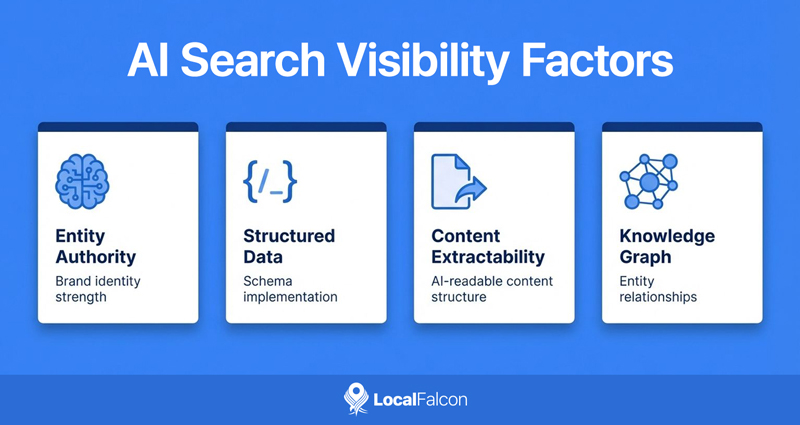
AI platforms don't rank brands the way traditional search engines do. They cite brands based on entity authority, structured data quality, content extractability, and knowledge graph relationships. Fortune 500 brands with strong, consistent digital identities are better positioned to appear in AI-generated responses. But this positioning needs to be measured, not assumed.
For enterprise teams that want granular visibility intelligence into how their brand and individual locations are surfacing in AI search, Local Falcon has emerged as a leading platform for AI visibility tracking.
Alongside its powerful local rank tracking capabilities for Google Maps and Google Business Profile — where its grid-based ranking visualization gives teams unprecedented clarity on how visibility shifts across each trade area — Local Falcon now provides enterprise teams with the AI search monitoring tools they need to understand where their brand appears and where competitors are capturing more Share of AI Voice (SAIV).
Physical Expansion as an SEO Strategy
There is a ceiling to how much enterprise local SEO can do when the underlying proximity problem is a lack of physical presence. A brand with no location in a fast-growing market cannot fully compete in local search there, regardless of how well-optimized its nearest location is. Proximity to the searcher remains one of the most heavily weighted factors in local search ranking.
Forward-thinking enterprise teams include local SEO visibility data in their real estate and expansion decision-making. Trade area analysis — identifying markets where search demand is high and brand visibility is limited due to geographic distance — provides a data-driven rationale for physical expansion that connects directly to revenue opportunity. When a brand opens a new location in a market where it was previously hitting a proximity wall, it doesn't just gain a new revenue source — it unlocks a new layer of local search visibility that benefits the broader brand footprint.
The Long-Term Outlook: Constant, Never-Ending Optimization
Perhaps the most important thing to understand about Fortune 500 SEO is that it is not a project with an end date. It is a permanent operational function. A brand that reaches the top of the search results today can lose that position tomorrow — to a competing enterprise, to a well-optimized local independent, to an algorithm update, or simply to the passage of time as content ages and competitors improve.
This is true at the national level and at the local level. A Google Business Profile that ranks first in a local market today requires ongoing attention — reviews, updates, competitive monitoring — to stay there. Content marketing strategies that generate strong organic traffic today require continuous investment to maintain relevance as search intent evolves.
The SEO strategies for Fortune 500 companies that sustain long-term performance are those built around continuous rank tracking, granular visibility intelligence, and a culture of ongoing optimization.
Tools like Local Falcon provide the persistent monitoring infrastructure that lets enterprise teams catch visibility shifts early — whether in traditional Google Maps rankings or AI search — and respond before a competitor captures the ground they've worked hard to gain.
Winning in search at the Fortune 500 level requires not just the right strategy, but the commitment to execute, measure, and adapt it indefinitely. That's what separates enterprise SEO strategies that compound over time from those that stall.
Looking to strengthen your enterprise local SEO strategy? Local Falcon provides the rank tracking, AI visibility intelligence, and trade area analysis tools that enterprise teams need to monitor and optimize their brand footprint at every level, with credit packages crafted especially for enterprise brands and agencies that work with them.