
Google AI Overviews now appear on a substantial share of search queries, and for many local businesses, they're the first thing a potential customer sees before they ever reach a traditional result (i.e., a Google Business Profile listing or blue-linked website). If your brand isn't part of that summary, you're invisible at the exact moment someone is deciding who to call or visit.
Improving visibility in Google AI Overviews isn't a matter of guesswork or one-off tweaks to a page. It requires understanding what sources AI Overviews pull from, tracking whether your brand is showing up, and systematically closing the gaps between you and the competitors who are. This guide walks through exactly how to do that.
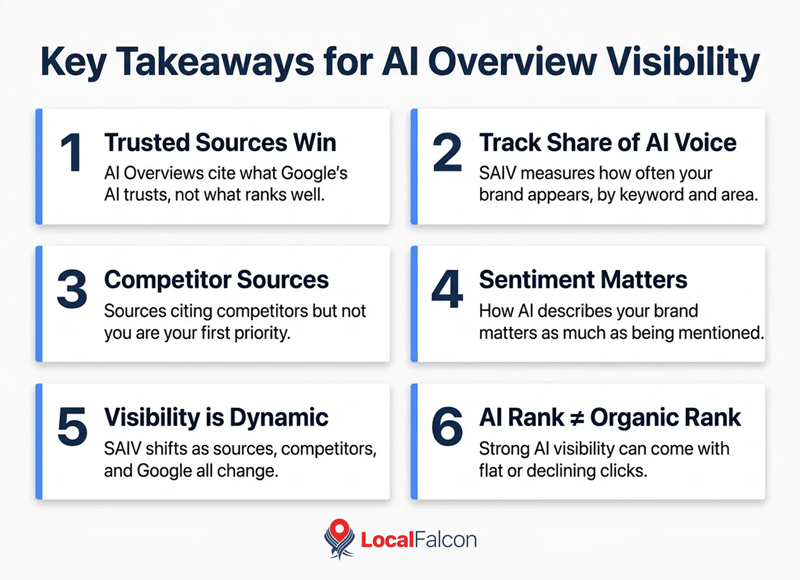
Key Takeaways
- Visibility in Google AI Overviews depends on what sources Google's AI trusts and cites for a given query, not just how your website ranks organically.
- Share of AI Voice (SAIV) gives you a concrete, trackable number for how often your brand appears in AI Overviews, replacing guesswork with data.
- Analyzing the sources cited for your business and your competitors tells you exactly where to focus optimization efforts.
- Mentions alone aren't enough. How AI Overviews characterize your brand matters as much as whether you're mentioned at all.
- AI Overview visibility shifts constantly, so ongoing monitoring is as important as the initial optimization work.
- Does ranking in Google AI Overviews guarantee organic visibility? No. The two are related but distinct, and strong AI Overview visibility can come with flat or even declining organic clicks.
Visibility Isn't the Only Metric That Matters
It's tempting to treat inclusion in AI Overviews as the finish line, but a brand can be mentioned frequently in AI Overviews and still lose customers if the way it's described works against it.
Google AI Overviews synthesize information from multiple sources into a single answer, and the language used in that synthesis carries real weight. A qualified, hedging description (think: "some reviewers report mixed experiences") does far less for your business than an unambiguous recommendation, even if both technically count as a mention. This is the difference between brand visibility and sentiment, and treating them as the same thing is one of the more common mistakes local brands make when they start tracking AI search performance.
The two metrics need to be tracked together. High visibility with poor sentiment can be worse than low visibility, because your brand is being actively framed in a way that discourages action rather than simply going unmentioned.
So, when you're working to improve visibility in Google AI Overviews (or any other AI search engines), make sure you're also optimizing to strengthen sentiment, rather than just blindly chasing more mentions.
How To Improve Visibility in Google AI Overviews: 5 Steps
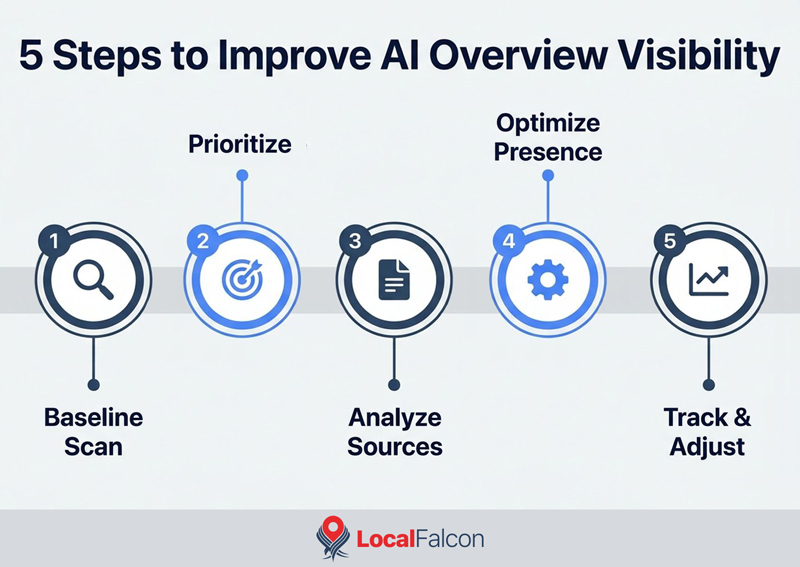
Here's a summary of the steps covered below:
- Run a baseline AI Overview visibility scan across your locations and target queries
- Identify high- and low-performing queries and locations, and prioritize accordingly
- Analyze the sources Google AI Overviews cite for your business and your competitors
- Optimize your presence on the sources that carry the most weight in your market
- Track your AI Overview visibility on an ongoing basis and adjust as results shift
Step 1: Run a Baseline AI Overview Visibility Scan
Before optimizing anything, establish where you currently stand. Run AI visibility scans specifically for Google AI Overviews across your locations and the queries that matter to your business, whether that's a single storefront or a large multi-location footprint.
The metric to establish here is Share of AI Voice (SAIV), which measures how often your brand appears in AI Overviews for a given keyword and geographic area. It replaces subjective impressions with a number you can track over time. Each scan gives you a SAIV score for that location and query combination, which becomes the baseline every future optimization gets measured against.
Multi-location businesses should expect uneven results here. It's common to find some locations performing well in AI Overviews while others barely register. That gap is your starting roadmap.
Step 2: Identify High and Low Performers and Prioritize
Once you have baseline data, look for patterns rather than treating every location or query the same way. Low SAIV locations are obvious priorities, but don't overlook the locations already performing well. Those are your internal case studies.
When AI Overviews consistently surface a particular location, there's usually a reason: stronger review volume, more complete third-party coverage, better-developed location content, or a combination of all three. Whatever it is, that pattern is replicable. Study what's working there and apply the same approach to underperforming locations.
Prioritize based on where the potential gain is highest relative to the effort. A location with near-zero AI Overview visibility in a competitive, high-value market deserves attention before a location that's already performing reasonably well in a lower-priority area.
Step 3: Analyze the Sources Driving AI Overview Citations
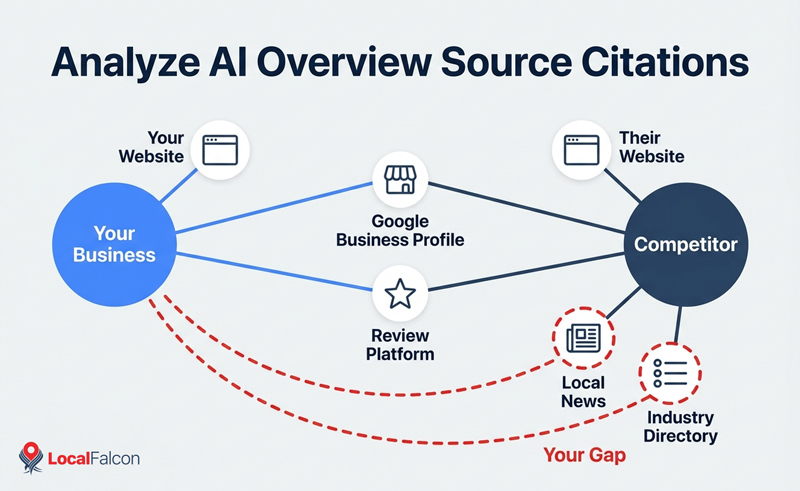
This is where AI Overview ranking optimization diverges most from traditional SEO. When Google's AI generates an overview for a query related to your business, it draws from specific sources, and you can see exactly which ones.
Local Falcon's AI visibility Scan Reports show all the sources cited for your business and for competitors within the same results. You can click into any data point on the map to see the sources behind that specific AI Overview, and review the full source list across your scan area to understand broader patterns.
This data tells you where Google's AI is placing its trust in your category. You might find that AI Overviews consistently cite a specific review platform, an industry directory you're not listed in, or a local publication that recently featured a competitor. Each of these insights is specific and actionable. The sources fueling a competitor's visibility that you're absent from are exactly what you need to focus on first.
Step 4: Optimize Your Presence on the Sources That Matter
With source data in hand, direct your effort to the places that actually influence what appears in Google AI Overviews for your market, rather than spreading optimization thinly across everything.
Your own website and location pages are often high-priority sources. Each location should have a dedicated page with accurate, specific information, hours, service details, and content that answers real questions customers in that area are asking. Thin or overly templated location pages don't compete well against the more specific source pages that AI Overviews tend to favor.
Your Google Business Profile needs to be complete and current, since Google's Gemini AI model draws local business information directly from GBP for its AI search features. Outdated information, missing categories, and sparse descriptions can all reduce your citability.
Reviews matter in both volume and recency. AI Overviews tend to favor businesses with a steady stream of recent, substantive reviews over those with a large but aging review count. A consistent review-generation process beats periodic campaigns.
Third-party coverage, including local news, industry publications, and blog features, strengthens the external authority Google's AI uses to validate a citation. A single legitimate mention in a relevant publication often carries more weight than several low-authority directory listings. If competitors are being cited from external publications you're absent from, that's a signal to invest in digital PR.
Step 5: Track AI Overview Visibility on an Ongoing Basis
AI Overview visibility isn't static. The sources Google's AI trusts can shift, competitors publish new content, and Google itself adjusts how AI Overviews surface local results. Any of these can move your SAIV up or down without any change on your part.
Running scheduled AI visibility scans gives you the data to catch these movements early. When SAIV drops, you want to know quickly so you can investigate whether a source you relied on changed, a competitor strengthened their presence, or something else shifted. When SAIV improves, understanding why lets you reinforce what's working elsewhere.
Treat this data the way you'd treat traditional rank tracking: review it on a set schedule, respond to meaningful changes, and let the trends inform your broader content and outreach strategy.
Best Practices for Improving Visibility in Google AI Overviews
Beyond the step-by-step process, a few standing practices consistently support stronger AI Overview visibility over time.
Focus on long-tail, question-based queries rather than broad keyword targets
AI Overviews frequently respond to multi-part, conversational questions rather than single terms, so content built around specific customer questions performs better than generic keyword pages.
Structure content for extraction
Break pages into scannable sections with clear headings, and make sure each section can stand on its own as a self-contained answer. Google's AI pulls specific passages, not entire pages, so a paragraph that only makes sense in context is a paragraph that's unlikely to get cited.
Keep content current and relevant
Outdated statistics, old hours, and stale location details reduce your citability. Refresh high-priority pages on a regular schedule rather than leaving them untouched after publication.
Make sure Google's crawlers can actually reach the content you're optimizing
Check robots.txt and any noindex tags to confirm important pages aren't being blocked, avoid rendering key content in a way that requires JavaScript to load, and fix broken links or redirect chains that could disrupt crawling. None of the source and content work above matters if Google can't access the page in the first place.
A current sitemap submitted through Search Console helps here too, since it gives Google a faster, more reliable path to your location and service pages.
Build authority through legitimate third-party mentions rather than manufactured signals
Guest content, expert roundups, and local press coverage all contribute to the kind of external validation AI Overviews weigh heavily.
Monitor sentiment alongside visibility on an ongoing basis
A business that maintains strong SAIV but never checks how it's being described can end up with a growing visibility problem it doesn't know it has.
Wrapping Up
Improving visibility in Google AI Overviews comes down to treating it as a measurable, ongoing discipline, just like traditional SEO. Start with a baseline, understand the sources driving citations in your market, close the gaps systematically, and keep tracking as results shift.
Local brands that build this into a regular process, rather than an occasional check-in, are the ones that will stay visible as AI Overviews continue to shape how local customers find and choose businesses.
Frequently Asked Questions
What are Google AI Overviews?
AI-generated summaries that appear above traditional search results, pulling information from multiple sources to answer a query directly.
Does ranking in Google AI Overviews guarantee organic visibility?
No. AI Overview inclusion and traditional organic rankings are related but separate. A brand can be well represented in AI Overviews but rank poorly in traditional organic search results.
How is optimizing for AI Overviews different from traditional SEO?
Traditional SEO focuses on ranking position. AI Overview optimization focuses on being mentioned, recommended, and cited as a trusted source within a synthesized answer.
What is Share of AI Voice (SAIV)?
A metric measuring how often your brand appears in AI-generated responses for a given keyword and area, used as the core benchmark for AI Overview visibility.
How long does it take to see results from AI Overview optimization?
It varies by market and competition, but most brands see measurable SAIV movement within a few weeks of consistent source and content optimization, with continued gains as third-party coverage and reviews accumulate.
Can Local Falcon help me improve visibility in Google AI Overviews?
Yes. Local Falcon runs AI visibility scans specifically for Google AI Overviews, giving you SAIV scores by location and keyword, the sources AI is citing for your business and competitors, and sentiment analysis, so you can prioritize and track optimization efforts with real data.