
Most brands understand by now that visibility inside AI platforms is no longer optional. It's how a growing share of potential customers find businesses, compare options, and make decisions, and it's currently the fastest growing channel in search.
Of all the AI search platforms, ChatGPT is one of the most well known and widely used, which makes it a critical source of AI visibility for brands, especially local and multi-location businesses. Many people looking for "near me" options now ask ChatGPT for business recommendations instead of opening Google Maps or Apple Maps first.
Any serious AI search optimization strategy has to account for how a business is represented on ChatGPT specifically, both in terms of visibility and sentiment. That means brands need a tool that shows them how ChatGPT talks about their business and their competitors. Plenty of tools do this, but they don't all offer the same level of granularity or functionality. Below are some of the best ChatGPT tracking tools for generative engine optimization (GEO) available right now.
ChatGPT Tracking Tools for Generative Engine Optimization (And Who They're Best For)
1. Local Falcon (Best for Local Businesses With Physical Locations or Service Areas)
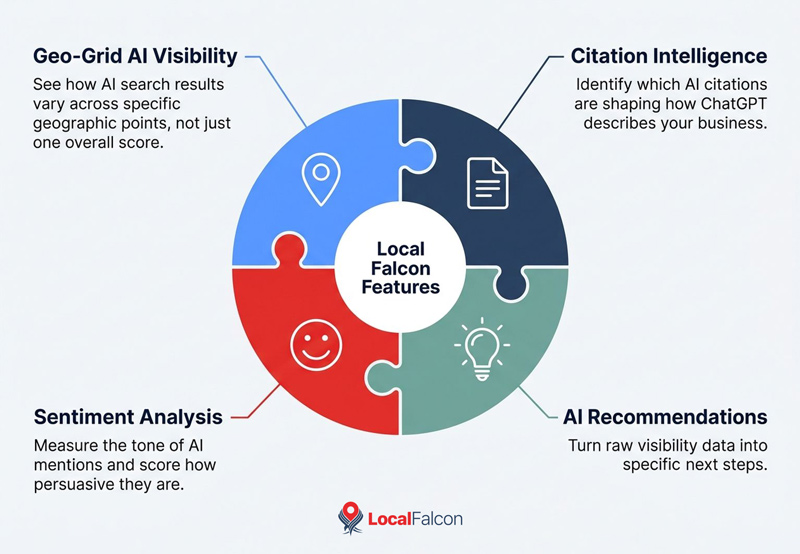
Local Falcon is the only ChatGPT GEO tool built around localized, geo-grid AI visibility and AI brand sentiment tracking. Instead of a single national or global brand-level snapshot, it shows how a business performs in AI search across specific geographic points, which makes it far easier to prioritize optimizations for local businesses, especially multi-location brands, franchises, and local enterprises with dozens or hundreds of storefronts or service areas.
A business might rank strongly in ChatGPT recommendations in one metro and barely register in another, and that kind of nuance gets lost in tools that only report an overall visibility score.
Beyond geo-grid AI visibility tracking, Local Falcon includes source information that shows which AI citations are shaping how ChatGPT describes a business, along with sentiment analysis and scoring that reveals the tone of those mentions and quantifies their persuasiveness, rather than only telling you whether they happened.
Local Falcon's AI visibility reports also offer AI-generated analysis and optimization recommendations, translating raw visibility data into specific next steps rather than leaving marketers to interpret dashboards on their own.
For local brands, those with physical storefronts or service areas, one of the biggest advantages of Local Falcon is that it lets businesses track ChatGPT performance alongside traditional Google Maps and Apple Maps rankings, plus other leading AI search platforms, all from the same account. There's no cap on how many platforms can be tracked on any plan, which matters for brands trying to build a complete picture of visibility across both traditional local search and the newer AI-driven layer sitting on top of it.
For a local SMB, multi-location business, or agency offering local SEO and GEO, Local Falcon's unique combination of geographic granularity, citation intelligence, and cross-platform tracking is difficult to find anywhere else.
2. Profound (Best for Digital-First Global or National Brands)
Profound is one of the more established names in enterprise AI visibility tracking, though it can be somewhat limited in functionality depending on the plan you choose. The good news for those looking to track generative engine optimization performance on ChatGPT is that its entry-level Starter plan tracks ChatGPT, but that's the only platform it tracks. Multi-engine coverage, competitive benchmarking, and content tools don't unlock until a higher tier.
While it can be great for large-scale national or global enterprise brands looking to understand their AI search performance at a high level, Profound lacks the geographic granularity that brands with a local presence need. Tracking happens at the country or regional level, with no native way to break performance down by city, neighborhood, or service area. That makes it a poor fit for local businesses trying to understand how they show up in specific, hyperlocal markets, but a reasonable option for large, digital-first brands that care about overall brand-level performance on ChatGPT rather than how they perform in any one location.
3. Semrush (Best for Integration With Traditional SEO)
Semrush folds ChatGPT visibility tracking into its broader AI Visibility Toolkit, which can be paired with its traditional SEO tools inside the Semrush One bundle. This is useful for teams that already use Semrush for traditional SEO functions, like keyword research, site audits, and backlink tracking, and want AI visibility data sitting in the same dashboard instead of a separate platform.
It's important to understand that this is general website SEO integration, not local SEO. Semrush's toolkit reports on brand mentions, share of voice, and sentiment across ChatGPT and a handful of other AI platforms, but it doesn't offer the geo-grid style AI visibility, sentiment, and citation tracking that local and multi-location businesses typically need.
4. Otterly (Best Budget Option)
Otterly's entry-level Lite plan is one of the cheapest ways to start tracking ChatGPT visibility, offering a limited number of tracked prompts across a handful of AI search platforms. It's a straightforward tracking tool without the additional GEO features, like optimization recommendations or sentiment breakdowns, that come with more full-featured platforms.
For a business or freelancer that just wants a basic read on whether and how often ChatGPT mentions them, Otterly is an accessible way to get started without a significant financial commitment. Teams that need deeper analysis, more tracked prompts, or broader platform coverage will likely outgrow the entry tier fairly quickly.
5. Writesonic (Best for Pairing AI Visibility Tracking and Content Creation)
Writesonic combines GEO insights for ChatGPT and other answer engines with AI-generated content creation, making it a fit for teams that want to move directly from spotting a visibility gap to producing content meant to close it. The platform tracks brand mentions, competitor benchmarking, and citation sources, then lets users generate optimized content without switching to a separate tool.
This pairing of tracking and content creation is the main draw. Teams that already lean on AI-generated drafts for blog posts or landing pages may find real value in keeping that workflow connected to AI search visibility data. Businesses that only need monitoring, without the content generation layer, may find the added functionality is more than they need.
Wrapping Up
ChatGPT quickly moved from a novel generative AI tool to a main discovery channel, and businesses that want to understand and improve their presence on ChatGPT need the right tracking tool for their situation.
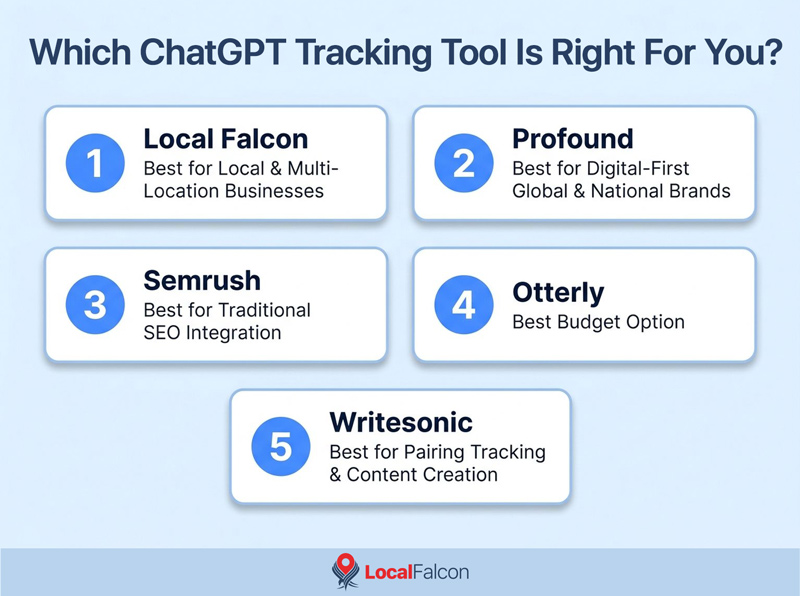
Local and multi-location businesses will get the most value from a tool like Local Falcon, which offers geo-grid granularity that generic platforms don't provide. National and global digital-first brands may lean toward Profound or Writesonic, while teams already invested in traditional SEO software might prefer keeping everything inside Semrush. Budget-conscious teams just getting started can use Otterly to dip a toe in before committing to something more robust.
Ultimately, the right choice comes down to how local the business is, how much budget is available, and whether tracking needs to be paired with local SEO, general website SEO, or content production.
ChatGPT Tracking Tools for Generative Engine Optimization: FAQs
What is generative engine optimization (GEO) for ChatGPT?
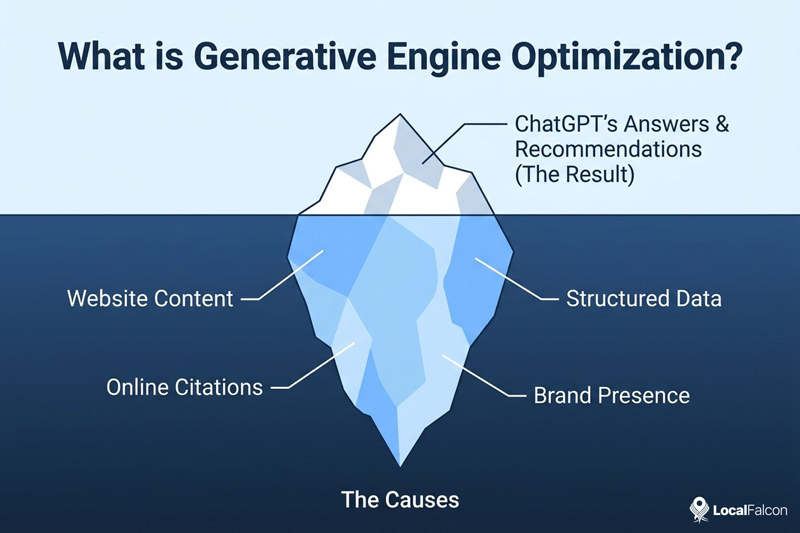
GEO for ChatGPT is the practice of optimizing a business's online presence, from its website content to its citations across the web, so ChatGPT is more likely to mention, cite, or recommend it in response to relevant user questions. The goal is to influence how favorably and how often a business shows up inside ChatGPT's generated answers.
Why do I need a specific tool to track ChatGPT performance?
ChatGPT doesn't offer businesses a native dashboard showing how often or how favorably they're mentioned in responses. Dedicated ChatGPT tracking tools for generative engine optimization simulate real user queries and report back on visibility, sentiment, and citations, giving businesses the visibility they can't get by manually testing prompts themselves.
Is Local Falcon only useful for tracking ChatGPT?
No. While Local Falcon offers strong ChatGPT visibility and sentiment tracking with geo-grid granularity, it also tracks other AI search platforms alongside traditional Google Maps and Apple Maps rankings, with no limit on how many platforms or prompts can be tracked on any plan.
How often should I track my brand's ChatGPT visibility?
Most businesses benefit from checking ChatGPT visibility on a weekly or bi-weekly basis, since AI-generated answers can shift as models update, as competitors publish new content, or as a business's own site and wider brand footprint change. Local and multi-location businesses tracking multiple markets often check more frequently, since performance can vary significantly from one location to the next and AI recommendations are highly dynamic.
Does ChatGPT visibility affect traditional SEO rankings?
Not directly. ChatGPT visibility and traditional Google or Bing search rankings are measured separately and rely on different signals, though there's overlap in the underlying factors, like content quality, structured data, and third-party citations, that influence both. A business can rank well in traditional search and still be largely invisible in ChatGPT's answers, which is exactly why dedicated tracking matters.
What's the difference between visibility and sentiment in ChatGPT tracking?
Visibility measures whether and how often a business is mentioned in ChatGPT's responses to relevant prompts. Sentiment measures the tone of those mentions, whether ChatGPT is describing the business favorably, neutrally, or unfavorably. A business can have strong visibility but poor sentiment, which is why the more capable ChatGPT tracking tools for generative engine optimization report on both rather than visibility alone.