
Type "best accountant near me" into Google AI Mode or ChatGPT and you won't get ten blue links. You'll get a written answer, usually with a handful of businesses named and a short list of sources behind them. Those sources are citations, and which ones show up play a significant role in determining who gets considered by potential customers.
For local businesses, this is quickly becoming the new front door. If AI engines are citing your competitor's Google Business Profile and directory listings instead of yours, you're losing visibility before a customer ever sees a website.
A local AI citation strategy is how you fix that: identifying which sources are actually driving AI-generated answers in your category and location, then building authority on those specific sources instead of guessing.
Key Takeaways
- AI engines cite specific sources when answering local queries, most often Google Business Profiles, business websites, and directories like BBB and Yelp.
- Strengthening your citations doesn't just win the click, it increases your odds of being named in the AI-generated answer in the first place.
- Citation sources fall into two real tiers of control: your website is the only source you fully control, while GBP and directories are shared control, since the platform can change the rules at any time.
- No citation source is truly uncontrollable. Third-party mentions like local news or Reddit threads can be influenced through digital PR and genuine community engagement.
What Are Local AI Citations?
Local AI citations are the specific sources an AI engine references, and often links to, when it answers a location-based question. When someone asks an AI tool to recommend a business, recap what a company offers, or compare local options, the answer engine pulls from a range of data sources to generate that answer, and it frequently cites specific sources where the information came from.
For local queries, a fairly consistent pattern shows up. Google Business Profiles tend to dominate, followed by business websites, then a mix of directories and platforms like BBB, Yelp, and Facebook. Third-party mentions, like a LinkedIn article or a Reddit thread discussing a business by name, show up too, just less often.
Picture a Google AI Mode visibility scan for a local accounting firm. Across a batch of AI-generated responses, you'd likely see Google Business Profile listings cited for several different accountants in the area, business site pages cited for firms with strong on-site content, and directory listings from BBB or Yelp filling in the rest. Every so often, a Reddit thread where someone asked for tax accountant recommendations gets pulled in too. That's the local AI citation landscape for that category and location, and it's rarely identical for the next one.
What Is a Local AI Citation Strategy and Why Does It Matter?
A local AI citation strategy is the deliberate practice of influencing which sources AI engines cite when they talk about your business. Instead of hoping for the best, you work to make sure a growing share of AI-generated answers point back to sources you actually control, whether that's your website, your Google Business Profile, or another directory listing you actively manage.
This matters for two reasons. The first is about getting mentioned at all. AI engines lean on citation-worthy sources to decide who even makes it into an answer. A business with a thin, outdated, or barely-claimed presence across the web gives an AI engine little to work with, and little reason to name it over a competitor with a fuller, more current footprint. Strengthening your citations increases your odds of being recommended in the first place, not just of being clicked on afterward.
The second reason is what happens after the recommendation. A lot of AI-generated answers result in zero-click outcomes, where a customer reads the response, picks a business, and takes action without ever clicking a link. But plenty of customers still want to look closer before committing, especially for higher-consideration purchases like a law firm, a contractor, or a dentist. Those customers click through to the cited source.
If that source is one you own, you control the story: your services, your reviews, your calls to action. If it's a citation you don't control, or worse, one that you do control but that has outdated or incomplete information, you've handed that customer to whoever is cited more thoroughly. Put together, a strong citation presence improves your chances of being named and your odds of winning the customer once you are.
Where Local AI-Generated Answers Actually Come From
The level of control businesses have over their local AI citations can generally be broken down into three tiers, based on how much control businesses have over them.
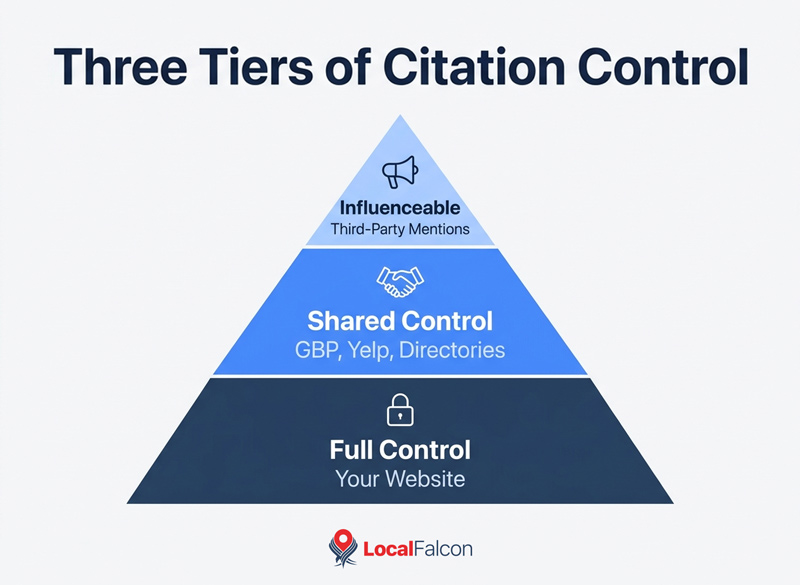
Full control
This is your website, and only your website. It's the one source where you control the platform itself: the structure, the content, the design, what stays up and what comes down. Nobody can change the rules on you overnight. Because it's the source with the most control, it's also where the return on effort is most direct, and it should be the foundation of any local AI citation strategy.
Shared control
This is a much bigger category than it might seem: your Google Business Profile, Yelp, industry-specific directories, and any social profiles you claim and manage. You can fill these out completely, keep them updated, and respond to reviews, but you're operating inside a platform you don't own. The platform can change its display format, its ranking factors, or its guidelines and policies at any time, and your listing exists at its discretion.
Still, a fully optimized, active profile on any of these sources is far more likely to get cited than a claimed-but-neglected one, and neglecting them means ceding ground to competitors who haven't.
Third-party mentions (can influence)
This is the category most businesses write off as uncontrollable: a local news article, a Reddit thread, a roundup post from a local blog, a LinkedIn discussion. But we believe that there is no truly uncontrollable source. Every one of these mentions exists because someone, somewhere, decided your business was worth writing about, comparing, or recommending. That's influenceable.
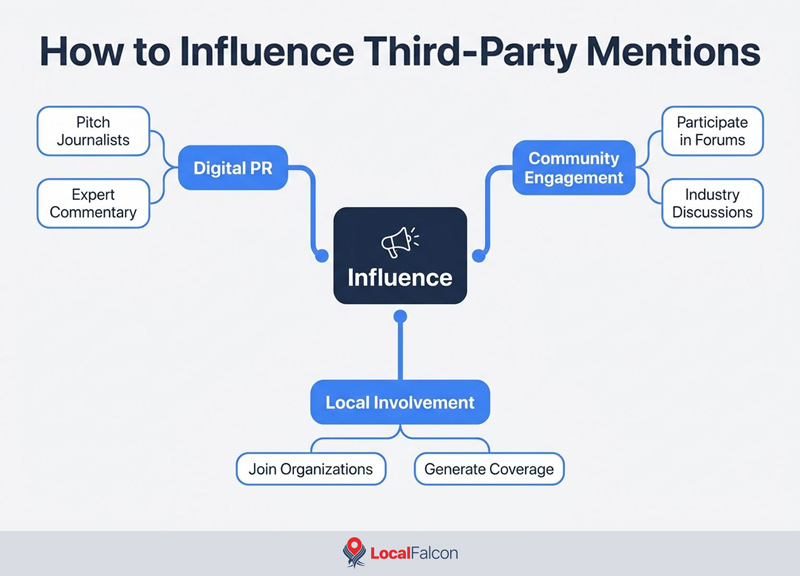
Digital PR, community engagement, expert commentary, and simply being a business worth talking about all increase the odds that third parties mention you in places AI engines are reading. A business that pitches a local reporter, engages authentically in relevant online communities, or gets quoted as an industry expert is actively shaping citations it doesn't technically own.
How To Build a Local AI Citation Strategy
Understanding the control tiers is one thing. Turning that understanding into results is another. Here's how to put it into practice, source by source.
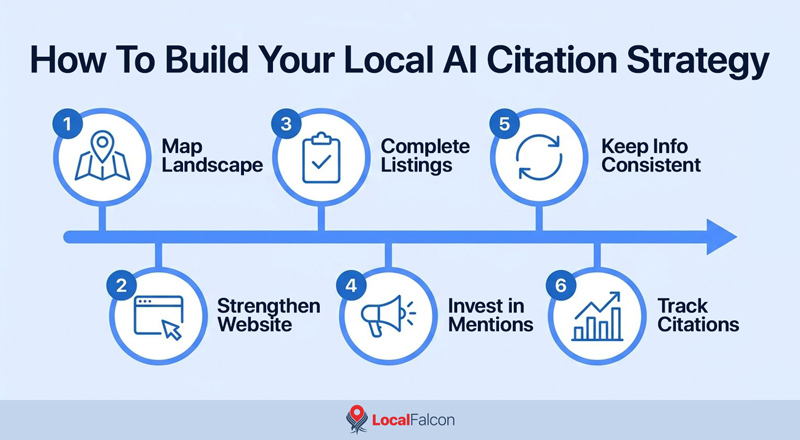
Start by mapping your current citation landscape
Before you can improve anything, you need to know what AI engines are already citing when they answer questions about your category and location. Run a set of realistic local queries, the kind a real customer would type, through Google AI Mode, ChatGPT, and other AI search tools your customers are likely using. Note every source that gets cited, not just for your business, but for competitors too. This tells you which source types actually carry weight in your specific market, since the mix varies by industry and location.
Audit and strengthen your full-control source first
Your website needs location-specific content that clearly answers the kinds of questions customers are asking AI tools, not just generic service pages. This is the foundation of how you get local business content cited by AI, since AI engines favor sources that are current, detailed, and unambiguous about what a business does and where it operates.
Claim and complete your shared-control listings
First and foremost, your Google Business Profile should be complete: accurate categories, updated hours, a full service list, recent photos, and a steady stream of posts and reviews with responses.
After that, focus on any other directories that actually showed up in your citation mapping, rather than spreading yourself thin across every possible directory out there. A fully filled-out profile with recent reviews and consistent business information beats five half-finished ones.
Invest in the mentions you don't directly own
Pitch local journalists on stories where your expertise is relevant. Participate genuinely in community forums and industry discussions where your category gets talked about. Get involved in local organizations that generate coverage. None of this guarantees an AI citation, but it increases the surface area AI engines have to work with when they're forming an answer about your business or your category.
Keep information consistent everywhere
AI engines cross-reference. If your business name, address, phone number, or service details differ across your website, GBP, and directory listings, that inconsistency can quietly undermine how confidently an AI engine cites any single one of them.
Track your citations on an ongoing basis
This is the step most businesses skip, and it's the one that turns a citation strategy into something that actually compounds. AI-generated answers shift as engines update their models and as competitors improve their own presence.
You need a way to track AI citations for your business consistently, across multiple AI platforms and multiple query variations, so you can see which sources are winning citations, which of your competitors are gaining ground, and where your own content needs work.
This is exactly the kind of data Local Falcon's AI visibility tracking tools are built to provide, giving you a real-time view of what's being cited right now, instead of a one-time snapshot that goes stale in a month.
Building Momentum, Not Just Presence
A local AI citation strategy isn't a checklist of tasks you complete once. It's an ongoing effort to understand what sources are shaping the AI-generated narrative around your business and category, then consistently strengthening your position on those sources, whether they're fully in your control or not.
The models keep updating, and your competitors aren't standing still either. A citation advantage you build today can erode in a few months if nobody's watching for it. The businesses that keep tracking, adjusting, and reinforcing their presence are the ones that keep showing up in the answers customers actually see. The ones that treat this as a one-time project won't notice they've fallen behind until a competitor's already taken their spot.
FAQs
How do I know which sources AI engines are citing for my business?
Run realistic local search queries through Google AI Mode, ChatGPT, and other AI tools your customers use, and note which sources show up in the answers. Local Falcon's AI search visibility scans and citation intelligence automate this, showing you exactly which sources are winning citations across multiple platforms and queries.
Is Google Business Profile the most important local AI citation source?
It's typically the most frequently cited source for local queries in Google's AI search ecosystem, but it's shared control, not full control, since Google can change how it's displayed or ranked at any time. Your website is the only source you fully own.
Can I influence citations from sources I don't control, like news articles or Reddit?
Yes. Digital PR, community engagement, and expert commentary all increase the odds of earning third-party mentions in places AI engines pull from, even though you don't own those platforms.
How often should I check my AI citations?
Regularly, ideally weekly. AI-generated answers and citation patterns change quickly as models update and competitors strengthen their own presence, so ongoing tracking is what keeps a citation advantage from eroding.
Does a strong citation presence guarantee I'll be recommended by AI?
No, but it improves your odds. AI engines favor sources that are current, detailed, and consistent, so a stronger presence increases the likelihood of being named and recommended with a clickable citation.