Understanding how to compare brand visibility with competitors in AI search is an essential part of local search optimization. But comparing AI visibility to competitors isn't as straightforward as checking Google rankings. AI search works differently, and so does the measurement.
This guide walks you through the right metrics to use, what to look for, and how to track and benchmark your brand's AI visibility against competitors on an ongoing basis — using Local Falcon's AI visibility tools built specifically for local brands.
Why AI Search Visibility Is Different for Local Brands
In traditional local SEO, performance revolves around a couple of key metrics: keyword rankings and map pack positions. It's easy to compare rankings and local pack performance to competitors using metrics like Local Falcon's Share of Local Voice (SoLV) and Average Rank Position (ARP)/Average Total Rank Position (ATRP).
AI-driven search experiences, on the other hand, including tools like Google's AI Overviews, ChatGPT, Gemini, and other generative AI platforms, aren't quite as straightforward, especially when it comes to understanding how to compare brand visibility with competitors in AI search.
Instead of returning a ranked list of Google Business Profiles or blue links, AI models generate conversational responses that mention, describe, and recommend businesses based on each user's specific context and a wide range of brand signals. This makes them far more dynamic and less predictable than traditional local search rankings.
Your brand might be mentioned prominently in one query and completely absent from another similar one — or even absent from an answer to the same query performed by a different user or at a different time.
It's also important to understand that strong traditional local SEO performance does not translate directly into strong AI visibility. For example, a competitor might appear more prominently in AI-generated results and get recommended by AI for a specific service even if their traditional rankings aren't as good as yours.
AI search can surface your business to high-intent consumers in a natural, persuasive way. But if your competitors are being mentioned more often, or more favorably, you could be losing customers without even knowing it.
That's why comparing your AI visibility to competitors needs to be part of your local marketing strategy.
What Metrics Should You Use To Compare Brand Visibility With Competitors in AI Search?
Before you can meaningfully benchmark your AI visibility versus competitors, you need to understand which metrics actually matter. Not all measurements translate from traditional local SEO, and some new ones are specific to how AI search works.
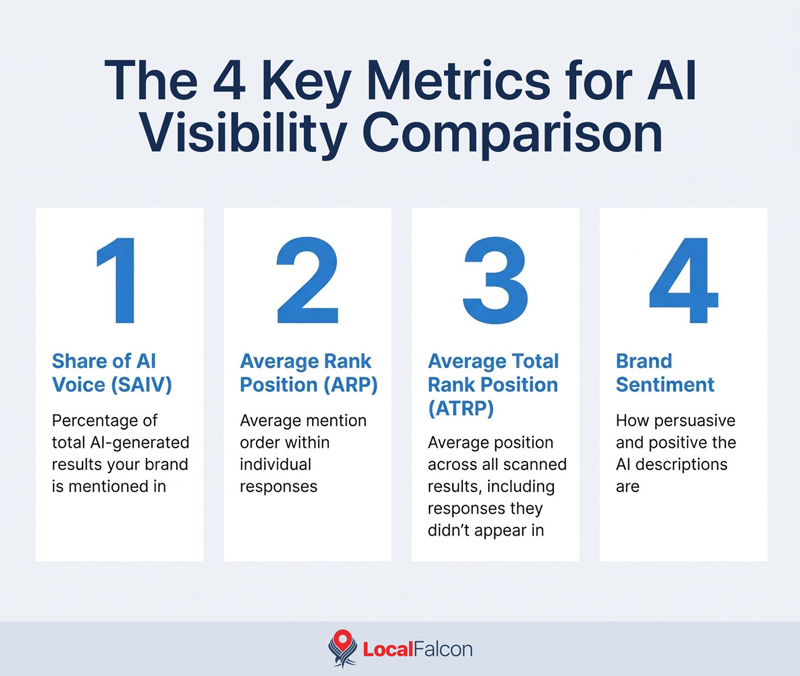
Share of AI Voice (SAIV): The Most Important Metric
Because AI-generated responses are inherently variable — the same query can produce different results depending on the platform, phrasing, location, time of day, and user context — you need a metric that accounts for that variability. Share of AI Voice (SAIV) does exactly that.
SAIV measures what percentage of total AI-generated results your brand is mentioned in across all scanned queries. Rather than showing you how over you rank in Google's 3-Pack in the scanned area, it tells you how often you're included in AI-generated local search results for the query.
This percentage-based view is far more meaningful than any single spot check of AI search results because it reflects your overall presence across a number of AI-generated recommendations — and it gives you a repeatable way to compare brand visibility with competitors in ai search.
If your SAIV is 42% and your nearest competitor's is 67%, that gap tells you something actionable: they're being surfaced by AI far more consistently than you are, and you have clear ground to make up.
When benchmarking AI visibility against competitors, SAIV should be your primary reference point.
Average Rank Position (ARP) and Average Total Rank Position (ATRP)
ARP and ATRP give you a secondary layer of insight. They indicate, on average, at what position in AI responses your brand is mentioned — first, second, third, and so on.
This is worth paying attention to because prominence matters. A business mentioned first in an AI recommendation potentially carries more weight with consumers than one tacked on at the end of a list.
However, it's important to understand that these are not "rankings" in the traditional local SEO sense. There's no stable #1 position to claim and hold in AI search the way there is in organic results. ARP and ATRP are averages across many variable responses, so they're best used as directional indicators of prominence rather than definitive standings.
Think of SAIV as telling you how often you're in the room, and ARP/ATRP as telling you where you're sitting.
Brand Sentiment and Buyer Persuasion
It's also important to understand that being mentioned in AI results is only half the battle. What AI says about your business matters just as much as whether it mentions you at all.
AI models don't just list businesses — they often describe them, framing them in a way that persuades customers in one direction or another. Phrases like "highly rated," "known for fast service," "frequently cited for poor communication," "popular with families" — these kinds of descriptors directly influence whether a potential customer chooses your business or a competitor's.
A brand with a lower SAIV but consistently positive, persuasive AI descriptions may convert better than a brand with high visibility paired with lukewarm or negative language. Just as you want to make your Google Business Profile more clickable to earn customers via Google Search and Maps, you want your AI sentiment to be more positive to persuade customers to choose your business through AI-powered search.
This is why brand sentiment is a critical part of any AI visibility comparison. When evaluating your AI search performance relative to competitors, don't just ask how often each brand appears — ask what's being said.
How To Compare Brand Visibility With Competitors in AI Search Using Local Falcon
Local Falcon's AI visibility tracking tools are built around the specific needs of local brands, and one of their most practical advantages is that competitor comparison is built directly into every AI visibility scan — you don't need to generate separate reports for each competitor you want to evaluate.
The "Brands Mentioned" Section in Every Scan Report
Each AI Visibility Scan Report in Local Falcon is generated per location, per keyword query. For instance, if you have one location and run scans for 10 queries, you get 10 reports. Two locations, 10 keywords: 20 reports. Each report captures what AI platforms are saying about your brand for that specific combination of location and query.
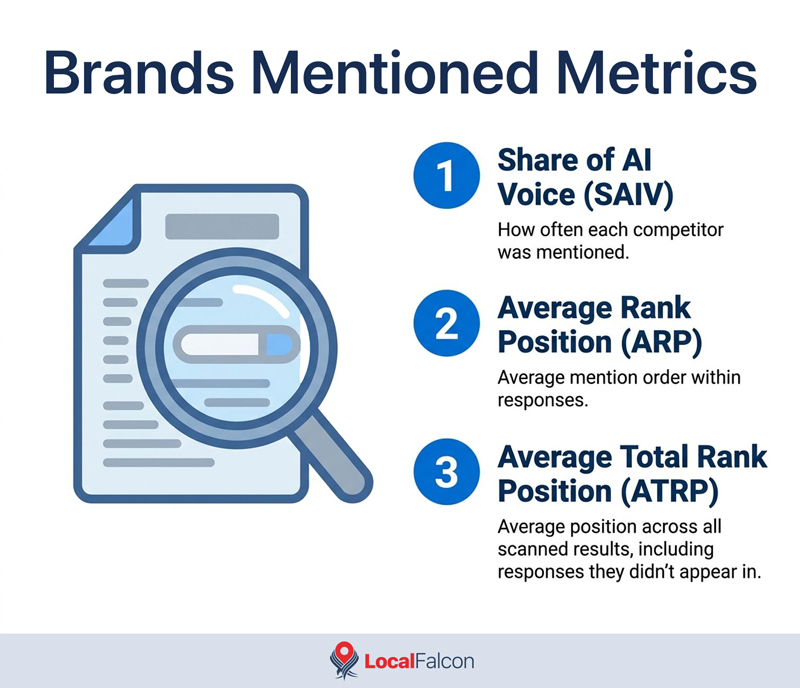
Crucially, every individual scan report includes a Brands Mentioned section. This section automatically surfaces every competitor that appeared in AI-generated results during that scan, along with their key metrics:
- Share of AI Voice (SAIV) — how often each competitor was mentioned across results
- Average Rank Position (ARP) — their average mention order within individual responses in which they appear
- Average Total Rank Position (ATRP) — their average position across all scanned results, including responses they didn't appear in
This means that from a single scan, you immediately know not just how your brand performed, but exactly which competitors are showing up alongside you (or instead of you), and how prominent they are. This is invaluable for prioritizing: if one competitor has a significantly higher SAIV than everyone else, that's the benchmark to focus on first.
The Competitor Report: Visual AI Visibility Comparison
Beyond the AI visibility data for competitors available in Scan Reports, Local Falcon auto-generates a Competitor Report for each scan. This report gives you the same comprehensive list of AI-mentioned competitors, but adds a powerful visual layer: you can click on any competitor brand to see their geo-grid AI visibility heat map.
The geo-grid format maps AI visibility across geographic points within your target area — showing where a brand is being surfaced by AI and where it isn't. This makes it easy to spot geographic patterns in competitor visibility that flat metrics alone wouldn't reveal. Maybe a competitor dominates AI results in one part of your service area but is barely present in another. That's an opportunity.
Being able to visually compare your own AI visibility heat map against a competitor's gives you a much more intuitive understanding of where you stand and where the real competitive gaps are — especially for businesses covering larger service areas or multiple neighborhoods.
AI Sentiment Metrics: Buyer Persuasion Score and Brand Phrases
Local Falcon also surfaces the sentiment side of AI visibility, which is where the picture of your AI search performance vs. competitors really gets complete.
The Buyer Persuasion Score (BPS) quantifies how persuasive your brand's AI mentions are — scoring them as positively persuasive, negatively persuasive, or neutral. This gives you a concrete, comparable number for sentiment rather than subjective impressions. You can compare your BPS to a competitor's and quickly see whether their AI mentions are doing more work for them in terms of actually convincing potential customers.
Complementing the BPS is the Brand Phrases section, which identifies the specific language AI consistently uses when talking about your business. This isn't just a sentiment label — it shows you the actual words and phrases being associated with your brand. Each phrase comes tagged with its sentiment, so you can see at a glance what narrative AI has built around your business and how that compares to what's being said about competitors.
Together, SAIV, BPS, and Brand Phrases give you a multi-dimensional picture of your AI visibility — not just how often you appear, but how prominently and how persuasively you appear.
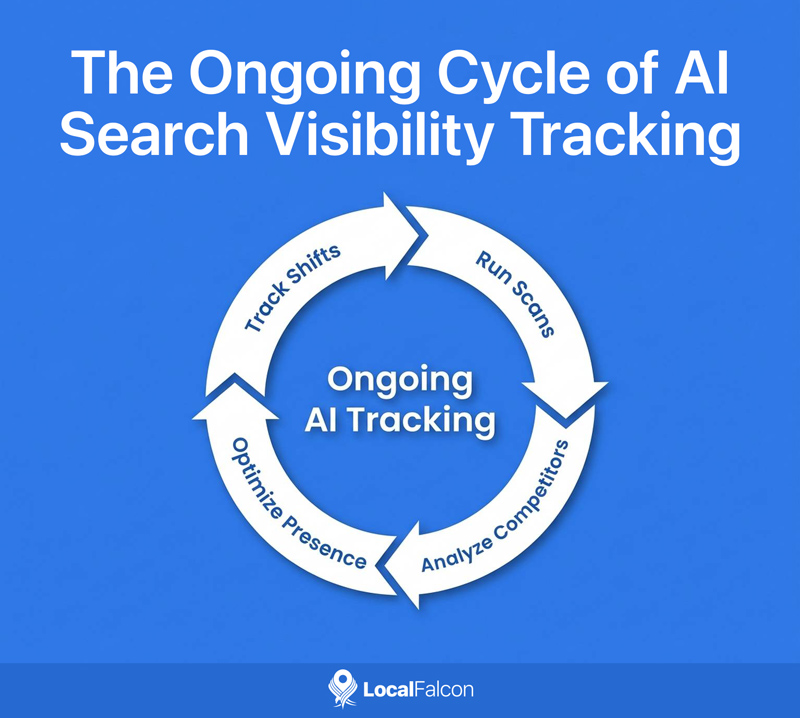
Why Ongoing Tracking Is Essential
A one-time AI visibility scan is interesting. Ongoing tracking is what actually moves the needle.
AI search results are not static. They shift as AI models are updated, as your online presence changes, as competitors adjust their strategies, and as consumer search behavior evolves. A snapshot from last month may not reflect what AI is saying about your business today.
More importantly, if you're investing in AI optimization, you need to track whether those efforts are actually improving your AI visibility over time. Without consistent monitoring, you're optimizing blind.
Running regular scans in Local Falcon lets you track trends in your SAIV, watch for shifts in competitor visibility, and catch negative sentiment changes before they compound. It also allows you to correlate specific optimization actions with changes in your metrics, so you can understand what's actually working for your business in AI search.
For brands with multiple locations, this becomes even more important: AI visibility can vary significantly from one location to another, and ongoing tracking helps you identify which locations need attention and which are performing well relative to local competitors.
Frequently Asked Questions
Is your brand visibility better than competitors in AI search?
Without AI visibility tracking, there's no way to know with certainty. The only way to find out is to run AI visibility scans and review the competitor data in your reports.
How do I benchmark AI visibility vs. competitors?
The most reliable benchmark metric is Share of AI Voice (SAIV). Compare your SAIV percentage against the SAIV figures for competitors surfaced in your scan reports. This gives you a proportional, apples-to-apples comparison that accounts for the inherent variability of AI search results.
How do I track competitor rankings in AI search results?
Traditional rank tracking tools aren't built for AI search. Tools like Local Falcon that offer AI visibility scans alongside Google Maps rank tracking will surface competitor mentions automatically in each scan, along with key AI visibility metrics, without requiring separate competitor-specific scans.
How often should I check AI visibility to get useful competitor comparison data?
It depends on how competitive your market is and how actively you're optimizing, but a consistent weekly or bi-weekly cadence gives you enough data to identify trends and measure the impact of changes. For fast-moving markets or during active optimization campaigns, more frequent scanning gives you tighter feedback loops.
Does AI search visibility affect actual customer decisions?
Yes — significantly. Consumers increasingly trust AI-generated recommendations, and the framing AI uses to describe a business directly influences click and purchase behavior. A brand with strong positive sentiment in AI results has a real conversion advantage over one with neutral or absent mentions.
Can I compare AI visibility across multiple locations?
Yes. In Local Falcon, each location generates its own Scan Reports with its own Brands Mentioned and Competitor Report data. This means you can compare brand visibility with competitors in AI search across your entire portfolio of locations and identify where competitive gaps are most pronounced.
Start Knowing Where You Actually Stand
Most local businesses are competing in AI search without any visibility (see what we did there?) into how they're actually performing — or how their competitors are doing. That information gap is itself a competitive disadvantage.
By tracking your brand visibility in AI search with Share of AI Voice and comparing your brand's visibility with competitors in AI search, you can move from guessing to knowing.
Local Falcon's AI visibility tools make that comparison automatic and ongoing, so you always have a current picture of where your brand stands relative to the competition in AI-generated search results.