
Whether it's a local credit union with just a handful of branches or a national bank with hundreds or even thousands of locations, effective local SEO for banks is what actually gets branches found in "near me"-style searches.
Ultimately, local SEO for banks builds trust, drives new memberships, and helps smaller banks compete with larger ones — or ensures global and national banks are equally visible across all the local markets they serve.
Why Local SEO for Banks Matters
Driving Branch Traffic and New Account Openings
Despite the rise of online and mobile banking, physical branch visits still play a decisive role in the customer journey — especially for high-stakes financial decisions. Opening a new checking or savings account, applying for a mortgage, setting up a business banking relationship, discussing loan options, or resolving a complex issue: these are moments where people want to walk into a branch and sit across from a human being.
Local SEO for banks is what connects that intent to your branch. When a prospective customer searches for "banks near me" when they move somewhere new or "best mortgage lenders in [city]" when they're ready to buy a home, they're often moments away from making a decision. Appearing prominently in Google's local pack, on Google Maps, or in other top local search results (like Google AI Overviews) means your branch gets considered. Not appearing there means you don't — regardless of how great your rates or services are.
This is especially important for attracting new-to-bank customers who have just moved to an area, recently graduated, started a business, or are switching banks after a bad experience elsewhere. These people are actively searching for a new financial institution, and they're ready to act. Local SEO for banks ensures your branches are visible at exactly those moments.
Helping Small Banks and Credit Unions Compete With the Big Players
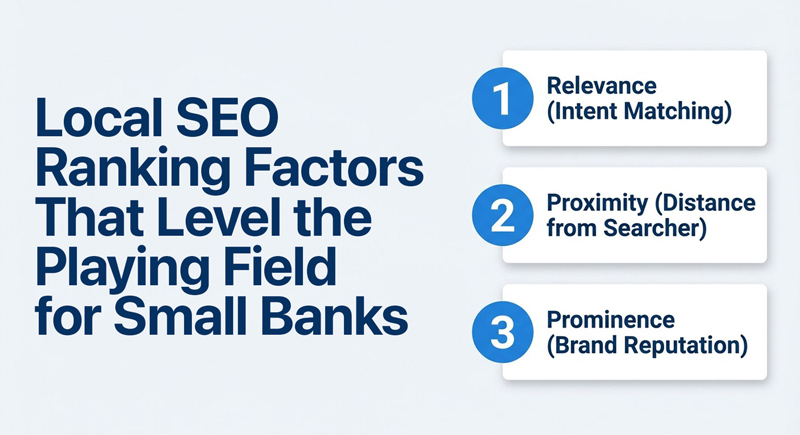
One of the most powerful aspects of local SEO for banks is that it levels the playing field in a way that traditional advertising simply cannot. A large national bank might have a multimillion-dollar marketing budget, but that doesn't automatically translate into dominating local search results in every market. Local SEO rewards relevance (intent matching), proximity (distance from the searcher), and prominence (reputation) — factors that a well-run community bank or credit union can absolutely compete on.
A credit union with three branches but fully optimized Google Business Profiles, an active review strategy, localized content on its website, and consistent citations across directories can outrank a national bank in the local pack. In fact, community banks and credit unions often have natural advantages here: stronger local ties, more personalized service that generates better reviews, and more authentic community involvement to write about. Local SEO turns those strengths into search visibility.
For smaller financial institutions, this is not just a marketing tactic — it's a growth strategy. Ranking above a national competitor in your local market means capturing customers who might otherwise have defaulted to the bigger brand simply out of name recognition.
Optimizing Branch Performance Across a National Footprint
For large regional and national banks, local SEO is less about survival and more about ensuring that every branch in their network is performing at its full potential. This is where the enterprise dimension of local SEO becomes critical.
Think of local SEO as a branch-level performance layer within a larger brand architecture. A national bank needs visibility saturation across every market it serves — meaning each branch should be discoverable, credible, and competitive in its specific geography. Without intentional local SEO management, branches in smaller or secondary markets often develop visibility gaps, where the brand is strong nationally but underperforms locally in ways that erode customer acquisition and revenue at the branch level.
Effective local SEO for banks at scale also ensures footprint integrity: the consistency of your brand's presence, information accuracy, and reputation quality across every location. Inconsistent NAP data (name, address, phone number), incomplete listings, and unmanaged reviews across dozens or hundreds of branches don't just hurt individual locations — they dilute system-wide authority and confuse both search engines and potential customers.
The banks that get this right treat local SEO as part of their broader brand governance, using it to enforce consistency, monitor performance by market, and identify which branches need attention before visibility problems become revenue problems.
Local SEO as a Reputation Management Strategy
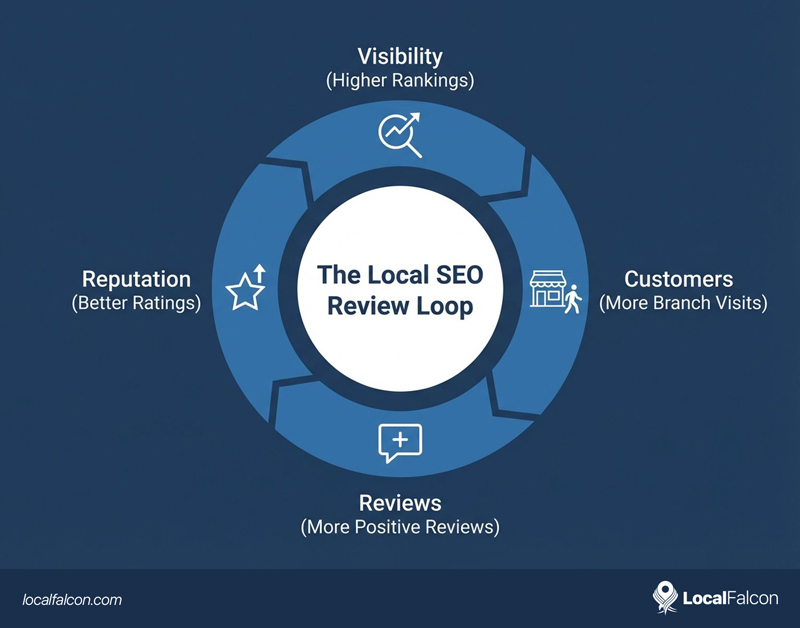
Reviews are not just a byproduct of local SEO — they are central to it. Google's local ranking algorithm weighs review quantity, recency, and quality heavily, which means your reputation is quite literally baked into your search visibility. For banks, where trust is arguably more important than in almost any other consumer industry, this creates a powerful loop.
Here's how that cycle works: strong local SEO practices increase your visibility, bringing more customers through the door. More customer interactions mean more opportunities to request reviews. A steady stream of positive reviews improves both your local ranking and your appeal to prospective customers who research before visiting. Better reviews attract more customers, who generate more reviews, which continue to lift your rankings — and so on.
But the value of reviews goes beyond rankings. Reviews are a rich source of operational intelligence. Patterns in customer feedback — comments about wait times, staff helpfulness, ATM availability, or the loan application process — give branch managers and regional leaders actionable data to improve the actual customer experience. And when that experience improves, the reviews improve with it. Local SEO for banks, done right, becomes a feedback engine for branch-level performance management, not just a marketing channel.
Actively monitoring, responding to, and learning from reviews is how banks close this loop. Responding to reviews — both positive and negative — also signals to prospective customers that the institution is attentive and accountable, which further builds the trust that the financial services industry depends on.
Local SEO and AI Visibility for Banks
Local SEO for banks now extends well beyond optimizing to rank in traditional search results. AI-powered search platforms — including Google AI Overviews, Google's AI Mode, Gemini, ChatGPT, Grok, and others — are increasingly becoming the first place people turn when they have a financial question or need to find a local finance-related service.
When someone asks an AI assistant "what's the best credit union near me?" or "which banks offer first-time homebuyer programs in [city]?," the AI's answer is shaped in large part by many of the same signals that drive local SEO: the strength and consistency of your listings, the quality and recency of your reviews, your citation presence across authoritative directories and other third-party publications and sites, and the quality of the content on your website and location pages.
However, tests have shown that AI visibility is even harder to earn than traditional rankings, meaning banks need to incorporate dedicated AI visibility optimization best practices into their local SEO strategies.
Even though AI-generated business recommendation lists rarely repeat, banks that invest in AI visibility as part of their broader local SEO strategy have a bigger influence on which institutions get recommended, what is said about them, and which sources are cited in AI-generated answers.
This is an increasingly important frontier of local SEO for banks, and institutions that treat it as an afterthought now will find themselves with an AI visibility gap that becomes progressively harder to close going forward.
Local SEO for Banks: Best Practices
1. Optimize Google Business Profile for Every Branch
Google Business Profile (GBP) is the foundation of local SEO, and for banks, each branch location needs its own fully optimized profile. This is non-negotiable. A GBP listing is often the first thing a prospective customer sees — and it appears directly in Google Search and Google Maps results.
Optimization goes beyond just claiming the listing. Every profile should have the correct and consistent business name, address, and phone number; accurate and complete business hours including holiday hours; the right business category (typically "Bank" or "Credit Union," with additional secondary categories as relevant); a thorough description that naturally incorporates relevant services and location-specific language; and a complete suite of services listed within the profile.
Photos matter more than most banks realize. Branches with high-quality, regularly updated photos of the exterior, interior, ATMs, and staff receive significantly more engagement than those without. GBP posts — used to highlight promotions, new services, or community events — are another underutilized tool for keeping profiles active and relevant.
Ongoing attention is essential. GBP listings can be edited by third parties, information can become outdated, and ranking positions shift over time. Tracking how each branch ranks in Google Search and Maps across its specific service area is critical for understanding where you're winning and where gaps exist.
Tools like Local Falcon make this kind of granular, location-level rank tracking straightforward, allowing you to monitor GBP performance across the geo-grid of a given branch's market and benchmark it against competitors.
2. Claim and Optimize Listings Across Major Directories
Google is the priority, but it's far from the only place people find banks. A comprehensive local SEO strategy requires a consistent, accurate presence across all major listing platforms.
Key platforms include Yelp (which remains a major review and discovery platform, including for financial services), Bing Places for Business (which feeds Microsoft's search ecosystem and Bing Maps as well as AI, especially ChatGPT), Apple Business Connect (which powers Apple Maps — critical given the iPhone's market share), and Tripadvisor (relevant in some contexts). Beyond these, industry-specific and locally relevant directories matter too: the Chamber of Commerce in each branch's city, local business directories, Better Business Bureau, and financial services aggregators.
The goal is not just presence but consistency. Every listing for the same branch must have identical NAP data, and inconsistencies across platforms confuse search engines and erode your local authority. Managing this at scale requires either a dedicated manual process or a listing management tool, especially for banks with large branch networks.
3. Create Unique Location Pages for Each Branch
Your website is a crucial local SEO asset, and each branch should have its own dedicated location page — not a generic "find a branch" entry in a branch locator, but a genuine, content-rich page optimized for local search.
A well-built location page includes the branch's full name, address, phone number, and hours (marked up with LocalBusiness schema — more on that shortly); an embedded Google Map; a description of the services available at that specific location; information about the local team or branch manager where appropriate; locally relevant content; and FAQs specific to that location or market.
These pages serve as landing destinations for both local search traffic and GBP clicks. They also pass link equity and content signals to search engines that reinforce the branch's relevance for local queries. Thin, templated location pages with minimal unique content are a missed opportunity — and a competitive disadvantage against any bank that takes the time to build them out properly.
4. Develop Localized Content
Content is another one of the best local SEO investments a bank can make, and yet it's where most banks underperform. Localized content signals genuine relevance to a specific community and market, and it targets the informational queries that prospective customers search before they're ready to visit a branch.
The types of content that work well for banks include blog posts and articles about locally relevant financial topics — housing market conditions in the area, local small business trends, student loan considerations for nearby universities, first-time homebuyer programs specific to the state or county, and local economic news. Community involvement content — sponsorships, events, charitable initiatives — is also valuable both for SEO and for reinforcing the brand's local ties.
FAQs are particularly powerful for local SEO for banks as well and should be featured prominently on location pages. Questions like "What documents do I need to open a checking account?" or "Does this branch offer notary services?" or "What are the mortgage rates at [branch location]?" directly match the kinds of searches prospective customers make. Answering them on-page captures that traffic and improves the page's relevance for related queries.
5. Actively Manage Reviews
Review management is an active discipline, not a passive one. Banks should have a systematic process for requesting reviews from satisfied customers — whether through follow-up emails after account openings, prompts on receipts or in-branch signage, or staff-led requests during positive interactions. The key is consistency: a steady cadence of new reviews signals to Google that a branch is active and well-regarded.
Monitoring reviews across Google, Yelp, and other platforms is equally important — especially for banks with multiple branches. Patterns in feedback reveal operational issues that, when addressed, improve both customer experience and future reviews. Tools like Local Falcon's AI-powered Reviews Analysis make it easier to surface these patterns at scale, turning review data into actionable branch-level intelligence rather than just a number on a dashboard.
Responding to reviews is non-negotiable. Every review — positive or negative — deserves a response, and those responses should be professional, personalized, and timely. For negative reviews especially, a thoughtful response that acknowledges the issue and invites the customer to resolve it directly demonstrates accountability in a very public way. It doesn't just address the unhappy customer; it signals to every future reader that this branch takes its service standards seriously.
6. Optimize for Technical SEO, Mobile, and Schema Markup
The technical foundation of your website directly affects how well your bank's local SEO performs. For banks, where a significant portion of search traffic comes from mobile devices — often from people looking up branch hours, directions, or contact information on the go — mobile optimization is essential. Pages should load quickly, render correctly on all screen sizes, and make it effortless to tap a phone number, get directions, or find hours.
Schema markup is a particularly important technical element for banks. Implementing LocalBusiness schema (specifically the BankOrCreditUnion subtype) on every branch location page gives search engines structured, machine-readable information about each location, including its services, hours, and geographic coordinates. FAQ schema on location pages and blog posts can generate rich results in search, increasing click-through rates. BreadcrumbList schema helps search engines understand your site's structure and can enhance how your pages appear in results.
Beyond schema, standard technical SEO best practices apply: clean site architecture, fast page load times, proper canonicalization, secure HTTPS, and an XML sitemap that includes all location pages.
7. Monitor Share of AI Voice
As AI-powered search becomes a primary discovery channel, banks need to actively monitor their Share of AI Voice — a measure of how frequently each branch or the broader brand is mentioned across AI platforms like Google AI Overviews, AI Mode, Gemini, ChatGPT, and Grok.
Beyond tracking whether the brand appears at all in AI, banks should monitor what is said about branches, whether information is accurate, and which sources the AI is drawing on when it references the brand or a specific branch. Local Falcon's AI visibility tracking reports include citation intelligence that identifies the sources being used to populate AI-generated answers about your brand and its competitors, surfacing opportunities to build more citations, earn more brand mentions, and correct inaccurate information before it gets repeatedly surfaced to prospective customers.
Banks that monitor and actively work to improve their AI visibility today are building a durable competitive advantage as AI continues to reshape how people discover and evaluate financial services providers.
8. Build Backlinks and Pursue Digital PR
Backlinks — links from other reputable publications and websites leading back to your website — remain a significant ranking signal in both traditional and local SEO. For banks, there are natural opportunities to earn high-quality, locally relevant backlinks that simultaneously build community presence and search authority.
Sponsoring local events, organizations, or charities typically results in a link from the sponsored organization's website. Partnering with local chambers of commerce, business associations, or community groups creates citation and link opportunities. Contributing expert commentary to local news outlets on financial topics — housing market analysis, small business lending trends, interest rate guidance — positions the bank as a community resource and often earns press coverage with links back to the website.
Digital PR and content marketing work together here. A well-researched local housing market report or a useful financial planning guide can attract links from local media, real estate websites, and community organizations — building authority that lifts the visibility of your location pages and the broader domain.
Press releases are another underutilized tool in this mix — announcing a new branch opening, a community initiative, a local hiring push, or a partnership with a regional organization can earn coverage and links from local news outlets, industry publications, and business journals. Distributing these through both wire services and direct outreach to local journalists keeps the bank on the radar as an active, invested presence in the community, which pays dividends in both brand visibility and local search authority.
9. Continuously Measure Performance Across All Channels and Locations
Measurement is what separates an effective local SEO strategy for banks from a local SEO guessing game. Banks need to track performance at the individual branch level, across each branch's specific market, and for the full range of relevant search queries, including category-level and geo-specific queries as well as traditional and AI-style search terms.
Traditional local search performance — primarily Google Search and Maps rankings, but also Apple Maps and organic search visibility — should be monitored on an ongoing basis, with reporting granular enough to identify exactly where within a branch's service area it is visible or invisible.
Grid-based rank tracking, as offered by Local Falcon, makes this kind of spatial analysis possible, allowing banks to see not just average rankings but the geographic shape of their visibility — identifying weak spots, tracking improvement over time, and benchmarking against competitors branch by branch.
AI visibility metrics should sit alongside these traditional metrics. As the share of searches that result in AI-generated answers grows, understanding your presence and accuracy in those answers becomes as important as tracking your position in the traditional local pack.
FAQs on Local SEO for Banks
What's the difference between general SEO and local SEO for banks?
General SEO improves a website's visibility in broad organic search results, while local SEO specifically targets geographically qualified searches — the "near me" and "in [city]"-style queries that drive people to a specific branch. For banks, local SEO is typically the higher-priority discipline because it targets people who are actively looking for a nearby branch and are close to making a decision.
How can you optimize Google Business Profile for banks?
Ensure every branch has its own fully claimed and complete GBP listing with accurate NAP data, hours, business category, services, and high-quality photos — then maintain it actively with regular posts, media updates, and review management. Tracking rankings in Google Search and Maps with a tool like Local Falcon helps you measure the impact of your efforts and spot where more optimization is needed.
Does each bank branch need a separate location page?
Yes — each branch needs its own dedicated, content-rich location page on your website, not just an entry in a generic branch locator. Unique location pages with locally relevant content, proper schema markup, and branch-specific FAQs are essential for ranking in local search for each branch's market.
How many reviews do banks need to rank on Google?
There's no universal number — it depends entirely on the competitive landscape of each branch's specific market. The best approach is to first check your business category review benchmarks, then benchmark against the top-ranking competitors in each local pack to understand what review volume and ratings you need to be competitive.
Do large banks need local SEO?
Absolutely — strong national or international brand recognition doesn't automatically translate into local search visibility at the branch level. Without deliberate local SEO, even major banks develop visibility gaps across their branch networks that quietly erode new customer acquisition market by market.
Final Thoughts
Local SEO for banks is not a one-time project — it's an ongoing local marketing strategy that compounds over time. From optimizing Google Business Profiles and building out location pages, to managing reviews, creating localized content, and monitoring AI visibility, each element reinforces the others, building a local search presence that drives branch traffic, earns trust, and generates new business consistently.
Whether you're a community credit union looking to punch above your weight against national competitors, or a national bank managing hundreds of branches across dozens of markets, the fundamentals are the same: show up where your customers are searching, present accurate and compelling information, and earn the kind of reputation that makes choosing your branch an easy decision.
Local Falcon is built specifically to help banks and the agencies that serve them do exactly this — providing granular, location-level rank tracking for Google Maps, AI visibility monitoring, and AI-powered visibility intelligence and review analysis that turn local SEO from a guessing game into a measurable, manageable growth channel. If you're serious about local SEO for bank branches, it's the place to start.