
Local businesses and even seasoned SEO professionals are increasingly turning to AI for guidance on earning visibility, both in traditional local search results like the map pack and organic rankings, and in AI-generated results like Google's AI Overviews and answers from platforms like ChatGPT.
These tools are fast, confident, and often genuinely useful, but AI can also get things wrong. It can misstate facts, cite outdated practices, or present opinion as certainty, and this happens especially in a field like local SEO that changes fast. So we decided to test it directly: how much of what AI recommends for local visibility actually holds up?
To find out, we gave the same prompt to three of the leading generative AI platforms, ChatGPT, Claude, and Gemini, asking each for a comprehensive checklist of what local businesses need to do to earn visibility in both traditional and AI-generated local search results. We then had Claude merge all three responses into a single list, removing duplicates and consolidating overlapping advice into one comprehensive local business visibility checklist.
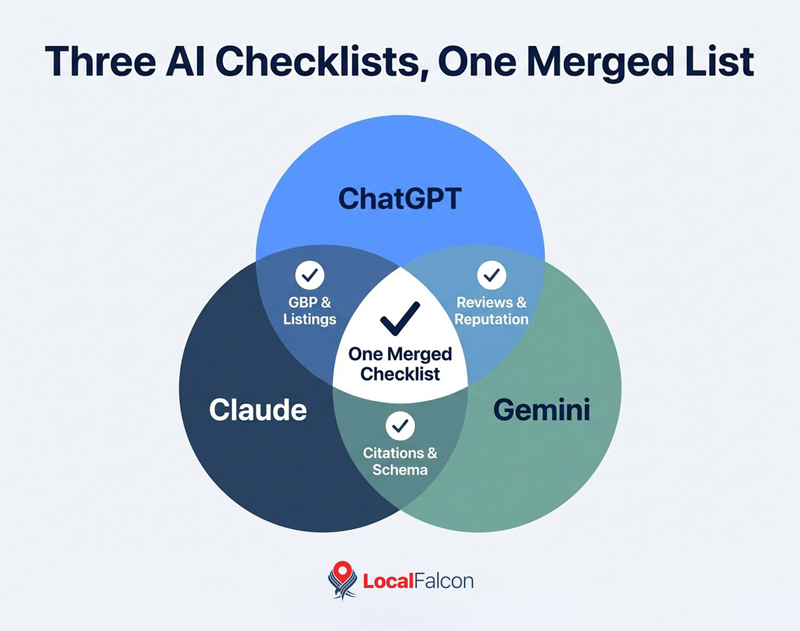
What we ended up with is the following list of recommendations spanning everything from Google Business Profile optimization to structured data to AI-specific monitoring. Below, we go through each one and confirm what's accurate, elaborate on what's incomplete, and analyze how well the local SEO checklist works as a starting point.
Breaking Down an AI-Generated Local Business Visibility Checklist: AI-Generated Recommendations vs Reality
Google Business Profile & Core Listings
- Claim and fully complete your Google Business Profile, including categories, services, attributes, and business description, since an incomplete profile weakens both map pack ranking and AI citation eligibility.
- Keep NAP (name, address, phone) identical across your website, GBP, and every directory listing, since inconsistency confuses both traditional algorithms and AI models pulling entity data.
- Post regularly to GBP (offers, updates, products) to signal an active, trustworthy business to Google's local algorithm.
This is all good advice. Claiming your GBP listing and filling out all the fields that impact local rankings is the first step towards earning visibility through traditional local rankings and AI-generated local search results, especially across Google's Search and Maps ecosystem.
It's also important to ensure key business information, especially NAP info, matches across GBP and other core listings and assets, including the owned business site, Apple Maps, Yelp, Bing Places, and others. However, it's worth noting that minor differences, such as abbreviating "Street" to "St." in an address, are not really a concern in the modern era of local search. Algorithms and AI models are smart enough to understand that the two mean the same thing.
Posting regularly to GBP is also a good way to keep your profile active and engaging, which not only contributes to local rankings via engagement signals, but also provides AI with up-to-date information on offers, promotions, etc., which increasingly matters as agentic commerce experiences roll out across Google.
Reviews & Reputation
- Actively generate reviews across Google, Yelp, and industry-specific platforms, since review volume and recency remain strong ranking signals.
- Respond to every review, positive or negative, since AI models increasingly summarize sentiment from review text when answering "best X near me" queries.
- Monitor and correct misinformation about your business anywhere it appears online, since AI systems synthesize answers from whatever data they find, accurate or not.
The first point here is mostly correct, though it fails to mention that the review score matters. It sort of goes without saying, but naturally a higher average review score leads to better rankings and AI visibility. It also leaves out review velocity, which is the rate at which new reviews come in. Overall, you want to maintain a steady stream of positive reviews over time rather than getting a burst of good reviews all at once, then nothing for months.
The second point is also good advice, as responding to all reviews, whether bad or good, is a long-standing local SEO best practice. However, it's important to understand that this isn't just because AI is reading reviews and their responses. Responding to reviews also serves to improve clicks and engagement on your listing, contributing to rankings, and to show potential customers you care about feedback and addressing issues, which can boost conversions.
The last point is also true. Managing your reputation beyond reviews is especially important when it comes to optimizing local businesses for AI search. Tracking your AI citations and tracing any bad information or negative sentiment back to the source, then taking steps to fix it, is key to ensuring your AI visibility is actually driving sales.
Citations & Structured Data
- Build and maintain citations on major data aggregators and niche directories relevant to your industry, since these feed both traditional local pack algorithms and the knowledge graphs AI tools draw from.
- Implement LocalBusiness schema markup (and relevant sub-types like Restaurant or Dentist) on your website, since structured data helps AI crawlers parse your business facts accurately.
- Add FAQ schema to key pages, since AI search tools frequently lift structured FAQ content directly into generated answers.
Yes, yes, and yes. This is all true, with the caveat that how much schema markup actually matters for AI search is hotly debated. It's been hyped up as a generative engine optimization hack, but the degree to which it affects performance in AI-generated local search results depends on who you talk to. That being said, it certainly doesn't hurt, and it's currently considered a best practice for optimizing websites for local and AI search visibility.
On-Site Content
- Create location-specific landing pages with genuinely unique content (not templated city-swap pages), since both Google and AI models penalize thin, duplicate location content.
- Answer the specific questions your customers actually ask, in plain language, since AI search tools favor content that directly and clearly resolves a query over content optimized purely for keywords.
- Keep service and pricing information current on-site, since outdated details get pulled into AI answers and can mislead prospective customers before they ever contact you.
These are all good ways to optimize on-site content for local and AI search. Creating unique local landing page content definitely matters for both ranking organically and getting cited by AI.
Answering customer questions directly, such as through FAQs, is also a good way to earn visibility for the types of long-tail, conversational queries customers are increasingly using in local-intent searches.
It's worth elaborating on the last point a bit, as well. Service and pricing info certainly does get pulled into AI-generated answers, influencing customer decisions, but it's also becoming increasingly important for agentic local commerce. Without accurate pricing and service details, agentic AI, such as Google's own agentic Ask Maps features, can get hung up when trying to facilitate local transactions for users.
Entity & Authority Signals
- Build topical authority through consistent, expert content in your niche, since AI models weigh perceived expertise (E-E-A-T signals) heavily when choosing which businesses to reference.
- Earn mentions and links from reputable local and industry publications, since AI systems treat third-party validation as a trust signal similar to backlinks in traditional SEO.
- Maintain an active, informative presence on relevant platforms (industry associations, local news platforms, community sites), since AI tools often synthesize answers from a wider web of mentions, not just your own site.
More good advice here. Google itself has recently stated the importance of demonstrating E-E-A-T for ranking across Google's search experiences, including generative search features.
Generative AI retrieves information in real time from the same search index as Google's traditional local ranking algorithms, but it casts a wider net via something called query fan-out, where it breaks down searches into related sub-queries to synthesize answers. So, when you have a depth and breadth of consistently strong, expert content, your business is more likely to appear in organic local search results and get cited in AI-generated ones.
Earning third-party mentions through digital PR also shapes visibility in AI search, and staying active across relevant platforms feeds into AI search performance as well.
Multi-Location & GEO Tracking
- Track keyword rankings by exact geographic location and search grid, not just citywide averages, since local visibility can vary block by block.
- Monitor how your business appears (or fails to appear) in AI-generated answers for relevant local queries, since this is now a distinct visibility channel separate from traditional rankings.
- Audit competitors' AI search presence periodically, since understanding who AI tools cite for your category reveals gaps in your own entity and content signals.
Again, this is all correct. Local businesses need to track their rankings in local and AI search across a geo-grid to understand their true visibility and optimize to improve Share of Local Voice (SoLV) and Share of AI Voice (SAIV).
It's also important to understand that visibility isn't everything when it comes to AI search. AI can mention a brand without necessarily giving it a strong recommendation, which is why tracking sentiment, including Buyer Persuasion Score (BPS) and Brand Phrases, alongside SAIV is important.
Of course, local and AI search performance don't happen in isolation, so understanding where your competitors have stronger visibility and sentiment, down to the hyperlocal level, is just as important as understanding your own performance.
Technical Foundations
- Ensure fast page load speed and mobile usability, since both Google's local algorithm and AI crawlers deprioritize slow or broken experiences.
- Use clear, crawlable HTML (avoid burying key info in JavaScript-rendered elements or images), since AI crawlers often have weaker JavaScript rendering than traditional search bots.
- Maintain an accurate, updated XML sitemap and robots.txt, since this affects how reliably both search engines and AI crawlers can discover and index your content.
Yep. All good technical advice for optimizing sites for traditional and AI-generated local search results.
So, Can AI Tell You How To Earn Local and AI Search Visibility? How the AI-Generated Local SEO Checklist Holds Up
Across all three local business visibility checklists, we didn't find a single outright error, and no recommendation actively contradicted established local SEO practices. What we did find were oversimplifications and gaps where AI left out details that matter.
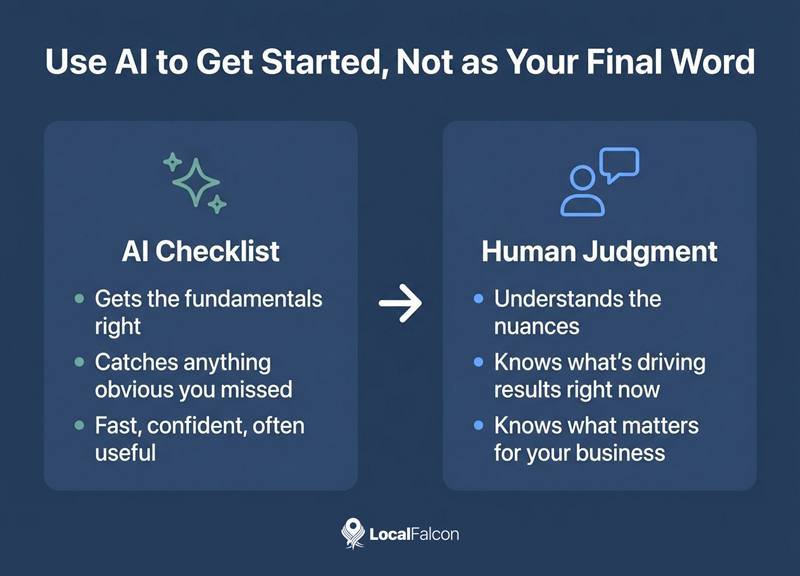
The verdict: AI can absolutely give you a solid starting checklist for local and AI search visibility. It gets the fundamentals right, and it's a reasonable way to make sure you're not missing anything obvious. But it can't replace the judgment of someone who understands the nuances, knows what's actually driving results right now, and can tell you which recommendations matter most for your specific business.
It's also worth noting that "no errors" doesn't mean "no risk of errors." We didn't catch any hallucinations in this particular test, but that doesn't mean they don't happen.
Tim Kahlert of Hypetrix ran a similar experiment and asked Claude for a local SEO checklist. Claude told him to use GBP Q&A, a feature Google removed years ago. It doesn't exist anymore, and Claude still recommended it as an active strategy.
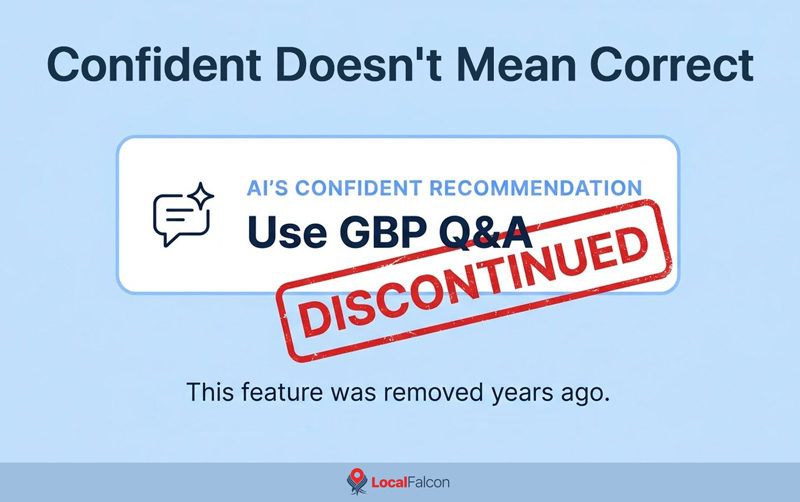
That's the risk with AI-generated SEO advice: it can sound completely confident while being completely wrong, and unless you already know the space well enough to catch the error, you won't know the difference. Use AI to get started. Just don't use it as your final word.