Local Falcon is a different way of visualizing ranking data in local search. Below is a list of answers to our most frequently asked questions. For even deeper learning, you can always check out our knowledge base as well.
Evaluates the quantitative aspects of a business's Google reviews, focusing on the frequency and total number of reviews. The RVS is composed of two equally weighted sub-metrics: Review Velocity and Total Reviews.
Review Velocity Measures the average number of reviews per month, with a maximum score achieved by maintaining an average of10 reviewsper month in the last 90 days.
Total Reviews Considers the cumulative number of reviews a business has received, with a minimum of 50 total reviews required to earn the maximum score.
Each AI Reviews Analysis Report is priced at $19 per location and includes analysis for you + 3 competitors.
What kind of strategic suggestions do Reviews Analysis Reports provide?
Local Falcon's AI Reviews Analysis Reports contain detailed insights drawn from every last word in customer reviews, so the strategic suggestions it provides could be related to anything that customers have mentioned.
For example, a report might suggest providing additional training, coaching, or mentorship to improve staff skills. Or, it could suggest implementing a client portal on your website to streamline communication.
There's really no limit to what tips the AI can provide — if reviews mention an issue, the AI Reviews Analysis will suggest ways to fix it to improve sentiment about your business!
What does "Unresponded to Reviews" mean in the Reviews Analysis Report?
The number of reviews which have not been responded to by the owner of the Google Business Profile. Please note: This total is considering just the most recent 100 reviews.
Do Reviews Analysis Reports include competitor analysis?
Yes, every AI Reviews Analysis Report includes analysis of your top three competitors' reviews. This allows you to quickly compare your review sentiments and identify opportunities to improve your business's offerings and service compared to competitors. Ultimately, this can go a long way towards helping you outrank them and achieve better overall visibility in local search.
What does "Review Velocity" mean in the Reviews Analysis Report?
Review Velocity measures the average number of reviews a business receives per month, with a maximum score achieved by maintaining an average of 10 reviews per month in the last 90 days.
Focuses on the qualitative aspects of a business's Google reviews, taking into account three key sub-metrics: rating percentage, responded to percentage, and review freshness.
Rating Percentage We use an exponential decay function to emphasize high ratings: 5 stars get 100%, 4.5 stars get 95%, 4 stars get 80%, 3.5 stars get 50%, and 3 stars or below get 0%.
Responded to Percentage Responding to every review, regardless of rating, shows that a business values its customers' feedback. The score rewards businesses that actively respond to a high percentage of reviews, with a 100% response rate receiving the maximum score.
Review Freshness Fresh reviews provide an up-to-date view of a business's quality. We use an exponential decay function to calculate the score: reviews from the last day get 100% weight, within a week get 80%, and those older than 30 days get minimal weight.
What does "Rating" mean in the Reviews Analysis Report?
The star rating on a Google Business Profile listing.
What does "Reviews" mean in the Reviews Analysis Report?
The total number of reviews for a Google Business Profile listing.
What does "Review Freshness mean" in the Reviews Analysis Report?
Gives more weight to recent reviews by using an exponential decay function. Reviews posted within the last day receive a weight of 100%, reviews within the last week closer to 80%, and reviews older than 30 days receiving a very small percentage.
What does "Reviews by Local Guides" mean in the Reviews Analysis Report?
The number of reviews posted to the Google Business Profile by a 'Local Guide', Google's program for active participants in the Google Maps community.
What does "Reviews Analyzed" mean in the Reviews Analysis Report?
The number of reviews analyzed in this report.
What does Local Falcon do?
Local Falcon is an agentic AI search and local SEO platform that tracks and improves brand visibility across generative AI answer engines and local search.
Local Falcon powers local SEO and AI SEO intelligence, visibility, and automation for Enterprise brands, Agencies, and Small Businesses by measuring local rankings (Google Maps and Apple Maps) and AI visibility (ChatGPT, AI Mode, AI Overviews, Grok, Gemini, and more), analyzing ranking and visibility data against competition, and makes and/or recommends changes to improve local rankings and AI visibility. It helps brands and agencies understand, optimize, and automate their traditional local search visibility and local AI search visibility on leading AI-powered search platforms.
Take action with Falcon Agent to make real changes to see real results.
Automate management of your Google Business Profile.
Analyze Google reviews and understand sentiment with the AI-powered Reviews Analysis tool.
Get AI-generated performance insights and optimization recommendations from Falcon AI.
Schedule ongoing reporting and visibility tracking for multiple locations and platforms with Campaign Reports.
Research local keywords for both traditional and AI search with the Local Keyword Tool.
Monitor Google Business Profile changes and performance metrics with Falcon Guard.
Analyze competitors with detailed Competitor Reports that compare rankings, visibility, and opportunities to increase share of voice.
Local Falcon gives you a single place to see how your business appears across local and AI search, and the tools to improve that visibility at scale.
What does ARP & ATRP mean?
In your Scan Reports, ARP = Average Rank Position and ATRP = Average Total Rank Position.
The difference is that the ARP is an average of only the pins that actually have a result (position 20 or less), while ATRP averages all the pins, even when a business is not found (20+).
This difference helps you compare if a business is ranking well across a wide area, or if they are ranking well in only a small area within the search grid.
What does "Reviews with Photos" mean in the Reviews Analysis Report?
The number of reviews on this Google Business Profile listing which include an image.
What exactly does Local Falcon track for my Google Business Profile?
Local Falcon tracks where your business appears in Google's local pack results (the Google 3-Pack) across your entire service area. Unlike basic rank trackers that check your average position from a single location, Local Falcon creates a geo-grid around your business and checks your rankings from multiple points, showing exactly where you rank well and where you don't at the hyperlocal level. Beyond GBP rank tracking, Local Falcon's Falcon Guard can also monitor your Google Business Profile for changes, wanted or unwanted, and tracks key GBP Performance Metrics, including clicks, calls, and direction requests.
What pricing plans are available?
To provide as much flexibility to our clients as possible, we offer four retail packages, four enterprise packages, annual packages for both, and a pay-as-you-go system. Credits in the annual packages do not expire until the end of your billing year, credits in the monthly package plans expire at the end of the billing month, and individual credit purchases do not expire and will stay in your account until they are used.
How accurate is Local Falcon?
As accurate as possible. While there's no one "right" SERP result, we wouldn't have released the tool if it wasn't providing accurate information. If you want more details, check out this article where we compare our scan to two other local rank trackers.
What is a Google Business Profile?
A Google Business Profile (GBP) is a free business listing on Google that allows you to manage how your business appears on Google Search and Maps. It includes your business name, location, hours, photos, services, products, reviews, and other important information that helps customers find and learn about your business.
What payment methods do you accept?
We can process payments through credit cards, ACH/Bank Accounts, Apple Pay, Google Pay, and Amazon Pay.
Does the local rank tracker work for all businesses?
Why are Local Falcon's results sometimes different from the ones I see in my browser?
Rankings are highly variable and dependent on many factors. These variables include whether or not you're logged into Google, if you're browsing "Incognito," whether or not the IP address has been used for similar searches, and more. Even the zoom level of your map can affect your final results. Local Falcon pulls data from "clean" Google searches that aren't influenced by previous search history; therefore, they may be slightly different. There is no "perfect" rank scan for local results, because everyone sees slightly different results in a real-world scan.
How do I use the Local Falcon Map Scan tool?
Using the Local Falcon Map Scan tool only takes a few simple steps. You can run scans manually with the Quick Scan tool, automate them with Campaigns, or even trigger them through the API. Here's how to get started with a Quick Scan:
Pro Tip: Ask Falcon Agent to help you run a scan and it can do this all for you.
Choose a Platform. Go to the Quick Scan tool and using the drop down, select the platform (Google Maps, ChatGPT, Google AI Overviews, Gemini, Grok, AI Mode, Apple Maps, and more) you want to check ranking/visibility for.
Choose a business and keywords. Select the business you want to analyze from your location list. Add at least one keyword to scan, though we recommend starting with 5-10 for better insights. (Tip: check the Suggested Keywords to discover search terms your business already ranks for as well as AI-generated ideas.)
Set your Map Scan Radius and Grid Size. Pick your grid size (the 9×9 grid is most popular) and choose a radius based on your market type:
Urban: ~2 miles
Suburban: ~5 miles
Rural: ~10 miles
Run your scan. Click "Run Scan" to start analyzing your local rankings.
View and share your results. When the scan finishes, open the Scan Report to see your rankings on the map grid. You can share it instantly by clicking the Share icon.
Automate your tracking (optional). Set up a CampaignScan for multiple locations or schedule a recurring Auto Scan from an individual Scan Report to automatically track visibility over time.
How do I cancel my account?
All subscriptions can be managed from this page. Your existing monthly credits will be available for use until the end of your billing cycle. If you have any individual credits left in your account, those will not expire and will still be available to you after the end of your billing cycle.
Note: By canceling your credit package, at the end of your billing cycle, your payment method will remain on file, and your Local Falcon account will downgrade to "pay as you go" (with no recurring monthly credit package charges). This is done in order to accommodate any Auto Scans you may have set up. In order to remove a payment method entirely, all packages must be in a state of cancellation or fully cancelled, and Auto Recharge needs to be disabled.
How much does Local Falcon's on-demand API cost?
Access to Local Falcon's on-demand API requires a subscription fee of $199 per month. There are also reasonable usage fees of $0.0032 per request or $3.20 for 1,000 requests. You can find full API pricing and usage fee details here.
If I change the address of the business on Google Business Profile (GBP) will the scan still work?
Once the address is officially updated on Google Business Profile, you can update the address in your account by navigating to your "Saved Locations" from the "Locations" drop-down and clicking the button with the pencil icon to enter a new address for your listing. This will ensure you continue to receive accurate scan results.
What information do you collect about me while using the site?
We will only ask for information that is necessary to be in compliance with the law. For example, we will need your address when upgrading your account to comply with tax regulations. All scan data is saved in your account for future reference and that information is kept on our servers. We are in compliance with GDPR and will not release any information about you or your account without your authorization or being compelled to by law.
What localities does this local rank tracker work in?
Local Falcon works everywhere in the world and with any language!
Do I need a Google API key to use Local Falcon?
No. You can use Local Falcon without signing up for any Google API keys.
Do you save scan results?
Every scan you perform is saved in your account. Numerous reports are available after each scan. Saved scan results can be found in the "Reports" drop-down menu in your Local Falcon Dashboard.
Can Local Falcon scan all locations for multi-location businesses at the same time?
Yes. You can group multiple locations together in a Campaign Scan to automate multi-location visibility tracking.
Can I scan my competitors' listings?
Definitely! You can initiate a visibility scan for any business, though our reports will show you exactly how your competitors rank as well when you run a scan for your own business.
What does "Reviews Per User" mean in the Reviews Analysis Report?
The average number of reviews posted by the individuals who posted a review on this Google Business Profile. This can be helpful to spot fake reviews.
Why are Local Falcon's results sometimes different from other rank trackers?
Other rank trackers make you choose a location, usually a zip or postal code, and then scan from one spot within that area. Since even a small amount of distance can lead to a different map ranking scan result, it's normal for slight differences to appear.
Do you have a yearly price?
Yes. In addition to our monthly subscription packages, you may also elect to purchase an annual package, where your credits do not expire each month (instead, this happens only once per year). In addition to this, annual and enterprise users will enjoy virtually unlimited access to Falcon Assist, Local Falcon's AI assistant.
The map is not loading at all when I try to run a scan. Why is there is a white space where the map should be?
You can always try loading the Map Scan page in another browser. If the map loads, then the issue is specific to one browser and you may need to change a setting. Here are some setting updates that may fix the problem:
Please contact us via the live chat or email us at account [at] localfalcon.com if you still do not see a map on the Map Scan page.
Do I have to always center the scan at my business location?
You are not limited to only scanning from the business location. You can drag the red center pin on the map to move it and begin scanning from any point you want. You can always re-center the point by clicking the "Center Map" button in the bottom right-hand corner of the map.
Rather than charge any type of flat fee, Local Falcon uses a flexible credit system, wherein each credit is equal to a map pin used in a geo-grid rank tracking scan. This allows you to tailor your scans and credit usage to perfectly suit your needs and budget, paying either monthly or annually depending on what makes the most sense for you and your business. You can find detailed credit package pricing information for all available plans on our pricing page.
Why does the scan geo-grid have different colored ranking pins seemingly at random?
Normally the best ranking position (the greenest) should be at the location of the business, and then the numbered positions should get higher as you radiate away from the center (shifting from yellow to orange to red the further away you get from the location).
If you see very irregular scan results, such as rankings that get better further away from the center point, this can indicate an error and we would be happy to take a look at the specific search.
Why is my Scan Report showing no results for my business?
If your business specifically isn't showing up in your Scan Report, it's possible you're either using the wrong scan settings or your business simply isn't visible in the scanned area.
If you're sure your scan settings are right and your business is visibile on the platform(s) you're scanning, it's also possible that there's a technical issue. There are millions of businesses with all kinds of different variables and, although we have done our best to account for the majority of them, there will always be some that don't fit the mold for whatever (technical) reason.
As always, we appreciate your continued use, and if you have any questions feel free to contact us at account [at] localfalcon.com.
Does Local Falcon offer a free trial?
Yes! You get 100 free credits when you create an account.
How much does Local Falcon's data retrieval API cost?
Local Falcon's data retrieval API is free with any credit package larger than the "Starter" monthly plan. The "Starter" monthly credit package, the lowest level of monthly plan required to gain access to the data retrieval API, costs $24.99 per month. You can also gain access by signing up for the "Starter" annual plan for $299.88 per year.
How much do Local Falcon credits cost?
Various credit packages are available, ranging from $24.99 to $199.99 when billed monthly (for 7,500 to 63,000 monthly credits) or $299.88 to $2,399.88 when billed annually (for 90,000 to 756,000 annual credits).
Local Falcon also offers enterprise credit packages ranging from $499 to $4,999 when billed monthly (for 157,000 to 1,570,000 monthly credits) or $5,988 to $59,988 when billed annually (for 1,884,000 to 18,840,000 annual credits).
What is Falcon AI?
Falcon AI is Local Falcon's built-in AI that analyzes your scan results and local search data to give you clear, actionable insights. It helps you identify potential issues with your Google Business Profile, highlights optimization opportunities, and suggests relevant citation sources to improve your local search visibility. Falcon AI analysis is also available in AI visibility reports, providing hyperlocal insights into how you can expand your visibility footprint across AI search.
What is a credit?
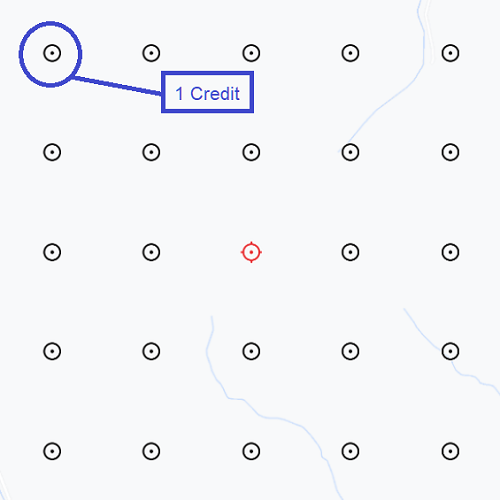
A credit in Local Falcon is defined as one data point, often referred to as a "map pin," used on the geo-grid during a scan. To put it simply, if you conduct a 5x5 grid scan, this grid will utilize 25 credits from your account, as each point on the grid represents one credit.
What is Share of AI Voice?
Share of AI Voice (SAIV) is a metric to quantify a brand's presence and prominence in AI-generated search results. SAIV measures how frequently a brand is mentioned when an AI summary is triggered for the given keyword across the area you searched, and brand mentions were detected within that summary (we do not factor AI summaries with no mention of any brand into the score).
A higher SAIV score indicates greater visibility for the given keyword and grid area, potentially leading to increased brand awareness, relevance and customer engagement.
Why doesn't the map have a geo-grid when I choose a business from my locations?
This occurs when the API was not able to find a center point for your listing because of a hidden address. To correct this issue, navigate to your "Saved Locations" from the "Locations" drop-down and use the pencil edit icon to manually set a center point.
How many credits will I need for Local Falcon?
To understand the number of credits you will need for Local Falcon, there are six variables to keep in-mind:
+ Grid Size (for example, a 7x7 grid is 49 credits).
+ Number of keywords you plan to scan (the average user typically scans about 10 keywords).
+ Number of locations you want to scan (keep in mind you may also want to schedule dedicated scans for competitor's listings as well).
+ Whether or not you would like to use Falcon AI for scan report analysis and recommendations (the average user adds Falcon AI on their listing scans, but not on competitors; also keep in-mind Falcon AI is just 25 credits per scan report).
+ The platforms you plan to track your rank on (Google, Apple Maps, AI search platforms).
+ The frequency of how often you want to run your scans (we recommend either weekly or bi-weekly to get a good trend analysis).
Once you've determined what makes the most sense, take a look at the packages on our pricing page. Keep in mind you may want to leave some extra room for experiments and one-off scans as well!
What's the best grid size for Map Scans?
The larger the grid you select, the more data points your Map Scan uses, which means you get more detailed data and more accurate ARP and ATRP scores.
In general, it's always better to use more data points, but each data point you use also adds to the cost of your Map Scan, which is why you may sometimes choose to use smaller grids, depending on your budget and the number of locations you want to run scans for.
For example, Map Scans using 11 x 11 grids offer a good balance between detail of data and cost, which is why this is one of the most popular grid sizes among Local Falcon users, especially those running lots of scans for multiple locations.
Is the Looker Studio integration for Local Falcon white-labeled?
Yes! If you are on the "Basic" subscription tier or higher, all of the data which appears in Looker Studio is white-labeled.
What scan radius should I use?
Broadly speaking, the more densely populated the area is, the smaller the radius should be. For a densely populated urban area, a radius of 1-2 miles or so is a good place to start. For a sparsely populated rural area, on the other hand, you might use a 10-mile scan radius. It also depends how far you think people are willing to travel or schedule a service from in your target market, which will come down to personal knowledge and experience.
Can I export all of my scans to a CSV?
Yes! There are many ways to do this; however, you'll need to run a scan at least twice in order to export in bulk or use Campaigns. You can also use this Looker Studio Template if neither of those cases are applicable to you.
How can I get started with the Looker Studio (formerly 'Google Data Studio') Integration for Local Falcon?
There are numerous applications for creating custom Local Falcon reports using Looker Studio, and getting started is simple! Our Knowledge Base has a step-by-step tutorial on how to get started: Using the Looker Studio Integration for Local Falcon.
What is the geo-grid?
The geo-grid is Local Falcon's signature feature that displays your rankings at specific points on an interactive map (the Scan Explorer). It shows exactly where your business appears in local map pack results or AI-generated search results for any keyword across your service area, helping you visualize your visibility patterns and identify areas for improvement.
What happened to "pay-as-you-go" pricing?
As-needed pricing is still available upon creating an account and logging into the portal, but we think you'll find the cost of our packages much more affordable than purchasing individual credits. Create an account today to learn more.
When should I disable certain data points in the scan geo-grid?
Disable any data points over large bodies of water or other irrelevant (unpopulated) areas, like big national parks, where people are not likely to be searching for your business. This will both save credits and ensure you are only looking at the most relevant data.
What scan frequency should I choose for Campaign Scans?
Weekly and bi-weekly scheduled scans are the most cost-effective options, as they offer a good balance between data frequency and credit usage. If budget is a concern, you may opt to run Campaign Scans on a monthly basis instead. You don't really ever need to run daily scans, except in very niche scenarios.
How many Local Falcon credits will I need?
There are six variables to keep in-mind when planning your credit usage:
+ Grid size (for example, a 9x9 grid is 81 credits).
+ Number of keywords you plan to scan (the average user typically starts scanning about 10 keywords).
+ Number of locations / listings you want to scan (keep in-mind you may also want to schedule dedicated scans for your competitor's locations as well).
+ Whether or not you would like to use Falcon AI for scan report analysis and recommendations (the average user adds Falcon AI on their listing scans, but not on competitors; also keep in-mind these are just 25 credits per report).
+ The platforms you plan to track your rank on (Google and Apple).
+ The frequency of how often you want to run your scans (we recommend either weekly, or bi-weekly to get a good trend analysis).
Once you've determined what makes the most sense, take a look at the packages, above. Keep in-mind you may want to leave some extra room for experiments and one-off scans as well :)
Another helpful tool for keeping an eye on credits as you schedule Campaigns and Scheduled Scans, is Local Falcon's Credit Explorer; a usage estimator that is available in your account.
Does the Looker Studio integration for Local Falcon incur any additional cost?
Nope! This is a free tool provided by the data nerds at Local Falcon. All you need is a "Starter" level subscription (or higher) in order to connect to Looker Studio.
How does Falcon AI work?
Falcon AI works by analyzing data from your Scan Reports and organic search results to provide hyperlocal insights on potential issues with your listings and visibility as well as suggestions for how to optimize and improve visibility, capturing a larger share of the market from competitors. Falcon AI also identifies relevant citation opportunities that can help you improve visibility in both traditional and AI search results.
How can I get support on the Looker Studio Integration for Local Falcon?
In addition to finding us on our live chat, or by emailing us directly, you can also use the step-by-step guide found over in our Knowledge Base. We've created a detailed article here: Using the Looker Studio Integration for Local Falcon.
What is the Map Scan radius?
The Map Scan radius is a search area defined by the distance from your business that your Map Scan covers (in all directions), as well as the number of data points you are using within the search area.
Changing these parameters allows you to see better, more detailed data on how your business ranks for different keywords at specific distances, so you can pinpoint exactly where your rankings for different keywords start to fall off.
What options are there if I keep running out of credits?
You can enable auto-recharge or upgrade to one of our retail or enterprise packages. We would also highly recommend you consider moving to an annual package, because you will get a full year's worth of credits immediately (and those credits do not expire until the end of your yearly billing cycle).
Pay-as-you-go credits purchased through auto-recharge have the benefit of not expiring. However, we're continuously adding new features, so your credits won't go to waste if you upgrade your monthly subscription!
If your needs exceed the number of credits in the available enterprise credit packages, you can email us at account [at] localfalcon.com for a custom pricing package.
What are Campaigns in Local Falcon?
Campaign Scans allow you to automate recurring local and AI search visibility rank tracking scans for one or more business locations, using fully customizable scan settings and delivering automated Campaign Reports to you and anyone else you want to keep in the loop each time a scan is completed.
What should my SoLV be?
The ultimate SoLV goal is always 100, but in most cases that isn't going to happen for a number of reasons.
We recommend running a few scans to see how far you currently reach (i.e., grid points where you have a SoLV above 0), then using that info set a goal on how far you want to reach in X number of months. Use that distance goal when setting up your reports, then strive to get your SoLV to as close to 100 as possible.
However, depending on how competitive the area is, getting your SoLV to 100 may not be possible. You could then use the Competitor Report to see who has the highest SoLV in the area and set the goal to surpass them.
Do I have to connect a Google Business Profile account to use Local Falcon's Suggested Keywords feature?
If you want to receive Suggested Keywords based on actual search terms and their volume of impressions, you must connect the Google Business Profile account you use to manage your business listing(s). If you don't, you will still receive AI-generated suggestions as well as suggestions based on your business locations' current Google Business Profile categories.
Can I share the results of a local ranking report?
Yes! It's easy to share the results of your Local Falcon scans. Just tap the "Share" button on the report page and choose how you want to share (URL, email, social, etc.). Sharing is available on all report types and for all account types. No login is necessary to view the results of a scan you share.
How should I group multiple business locations together for Campaigns?
Campaigns work best when you group together businesses that are in areas with similar population densities, such as businesses in rural areas and businesses in urban centers. You can also create Location Groups, and add those groups to a Campaign Scan.
What is Local Falcon's Suggested Keywords feature?
Local Falcon's Suggested Keywords feature provides relevant keyword recommendations for Map Scans. These suggestions are based on terms consumers use to find your business on Google. This feature also shows you the estimated monthly impressions your business is getting for those terms. You'll also receive additional AI-generated keyword recommendations thanks to Falcon AI, as well as ideas based on the business's currently suggested GBP categories.
Can I edit a Campaign after I create it?
Yes! You can edit the business locations and keywords, Campaign Scan schedule, and Campaign Report notification email, as well as toggle the Campaign on and off, at any time after you create a Campaign in Local Falcon. Grid Size and Scan Radius settings can be edited up until the first scan runs.
What are Local Falcon scan settings?
Scan settings are various parameters you can set for running Map Scans in Local Falcon to optimize your local rank tracking data visualization and Local Falcon credit usage.
Can I ask Falcon Agent anything?
You can ask Falcon Agent anything you want, but the AI agent is built specifically to respond to queries related to Local Falcon, local SEO, your scans, and your business, so you should stick to these topics in order to get helpful responses.
What scan settings can I change?
The main scan settings you can change for any business location are the scan radius and grid size, the keywords scanned for, and the scan frequency for Campaign Scans.
Can I edit reports I send to Looker Studio?
Yes! Any Local Falcon report you send to Looker Studio, including those generated using Looker Studio Templates, is fully downloadable, editable, and shareable.
Where do I find the Falcon AI tool?
Falcon AI is automatically turned on for all Scan Reports (including AI visibility reports) and you can turn it on or off at any time in your account preferences or scan settings.
To analyze a past Scan Report with Falcon AI, simply open up any existing Scan Report that has run in the last 48 hours and click the "Generate AI Report" button (indicated by the OpenAI icon).
Do I have to send Campaign Report notification emails after Campaign Scans?
No. You can choose not to send Campaign Report notification emails while creating a new Campaign Scan, or turn them off for existing Campaigns at any time.
Where can I find Suggested Keywords in Local Falcon?
Local Falcon's Suggested Keywords will appear in the keyword search bar drop-down when you go to the Map Scan tool and select a business location to run a scan for.
Can I run a Local Falcon Map Scan using multiple Suggested Keywords?
Yes. You can select as many keywords as you want from the Suggested Keywords and you can manually add as many other keywords as you want as well. From there you can run simultaneous Map Scans for all of them. Keep in mind that each scan will still cost the same number of credits.
What is a "credit" in Local Falcon?
One credit is one data point (we call the map pins used on the geo-grid "data points"). If you are running a 5x5 scan, you will use 25 credits.
How do I know if I'm using the optimal scan settings?
Many of the scan settings, such as grid size, scan frequency, and the keywords scanned for, will come down to preference. For scan radius, however, you want a majority of your data points to be green or yellow; if most of them are red, you'll want to use a smaller radius until you start ranking further away from your business location. Check out our blog post on choosing scan settings for more info.
How do I run a Map Scan for an Apple Maps location?
Running Map Scans for Apple Maps locations works exactly the same as doing so for Google Maps locations. You can run a one-off Quick Scan or set up a Campaign Scan to automate your Apple Maps rank tracking for multiple locations.
What does Local Falcon's Sales Enablement Tool do?
Local Falcon's Sales Enablement Tool finds and populates sales lead lists (in CSV files) with local ranking data and additional information pulled from the Google Business Profiles of sales leads. This enrichment provides the ability to outreach to prospective clients with personalized local ranking information.
What are Looker Studio Templates?
Looker Studio Templates are custom report templates we've built out for different types of Local Falcon reports, making it easier to instantly get the data visualization you need when you send reports to Looker Studio.
What should I do if I'm not sure what scan settings to use for a Campaign Scan?
We recommend running individual "baseline" scans for the business locations you want to run Campaign Scans for in order to get an idea of what settings to use. This will also help you determine which business locations make the most sense to group together in Campaigns.
How do I send a Local Falcon report to Looker Studio?
There are two ways to send reports to Looker Studio. You can either view and send any report directly from the report's screen in Local Falcon, or select a recent report to send using a Looker Studio Template.
What's the difference between Google Maps locations and Apple Maps locations?
Google Maps locations are businesses listed via Google Business Profile, while Apple Maps locations are businesses listed via Apple Business Connect.
In terms of relevance, Google Business Profile listings are much more widely used, as it's the preferred maps app for the majority of mobile users, regardless of device type. On the other hand, Apple Maps is the default maps app for iOS users, though many users replace the native Apple Maps app with Google Maps.
How much does Falcon Agent cost?
Falcon Agent is included free of charge with all credit package subscriptions. ($24.99 and up)
What Local Falcon report types are available in the Looker Studio integration?
All of them! In addition to the standard Local Falcon reports (Scan Reports, Competitor Reports, Trend Reports, Keyword Reports, and Location Reports), power users of Looker Studio can blend data to create custom outputs and reports.
How much does Falcon Guard cost?
Falcon Guard Costs $0.10 cents per location each month (minimum of $1, which covers 10 locations).
What is the Credits Explorer?
Local Falcon's Credits Explorer tool gives you a high-level overview of your credit usage, breaking down what types of scans your credits are going towards for a selected time period, including forecasting your credit usage for upcoming scheduled scans.
What is Falcon Agent?
Falcon Agent is Local Falcon's built-in AI agent for local SEO, available to answer all your questions and provide guidance related to Local Falcon, local SEO, your business location(s), and more. It can also perform actions directly on your Google Business Profile (e.g., reply to reviews, update business hours, publish posts, edit services and offerings) and within Local Falcon (e.g., run new scans, create campaigns, enable Falcon Guard).
What type of Local Falcon plan do I need to send Local Falcon reports to Looker Studio?
You must have a Starter Local Falcon subscription or higher in order to use the Looker Studio integration and all of its features.
Can I run Map Scans for Apple Maps locations in Local Falcon?
Yes, Local Falcon supports local rank tracking for Apple Business Connect listings. Running Map Scans for Apple Maps locations works exactly the same as doing so for Google Maps locations.
What are Location Groups used for?
Location Groups allow you to create groups of business locations that you plan to run scans using the same Scan Settings for. When setting up Campaigns and other types of scans, you can then simply select a Location Group instead of manually adding each business location.
Location Groups also make it easier to filter reports, as you can choose to filter by group in order to only view reports for certain sets or subsets of business locations.
What types of keywords does Local Falcon's Local Keyword Tool suggest?
It suggests two types: traditional local search keywords (for Google Search, Bing, etc.) and AI search keywords (for AI search platforms like ChatGPT, Google AI Overviews, etc.).
Traditional local search keywords tend to be around 5 words long, whereas AI local search keywords are longer and more conversational, typically phrased as complete questions.
How can I quickly find certain reports?
When you go to the hub for any report type, hit the "Filters" button and set parameters to filter the reports by. Once you set these filter parameters, you'll see all reports that meet those criteria in the hub.
How do I add an Apple Maps location to my Saved Locations?
Go to your saved locations and click the "Text Search" button, then toggle the platform selection to Apple Maps. After that, search for the business location by its name or address and click on it to instantly add it to your Saved Locations.
Alternatively, you can search for and add an Apple Business Connect location when setting up a new Quick Scan. Just click the "Search" button at the bottom of the locations drop-down to pull up the same text search box described above.
Who can use Falcon Agent?
Falcon Agent is available to all users in a limited capacity. However, users with any credit package subscription will enjoy virtually unlimited access to Falcon Agent, Local Falcon's agentic AI for all things local SEO.
Is there any way to make my Local Falcon credits roll over to the next month?
You can prevent your unused credits from going to waste by signing up for an annual credit package. That way, your credits only expire a year from the date you signed up for an annual subscription to Local Falcon.
Are annual subscription tiers the same as monthly subscription levels?
Although the same subscription tiers are available for both annual and monthly subscribers, annual subscriptions offer some additional features at lower tiers that monthly subscribers don't get access to.
How is the WYN score calculated?
It's based on a weighted algorithm that considers local search volume, commercial intent, and competition, adjusted for your local market conditions.
How do I know if I have enough credits for all the scans I want to run?
Go to "Credits Explorer" in the "Billing" drop-down from your account dashboard to see how many credits you have remaining and what your predicted credit usage is for upcoming scans.
If you don't have enough credits, the Credits Explorer tool will let you know and you can purchase more credits or change your subscription level accordingly.
How does Local Falcon track a brand's visibility in Google AI Overviews?
Local Falcon measures Share of AI Voice (SAIV). The tool will perform a search at every pin on your geo-grid, it will then record whether a Google AI Overviews result was present or not, and it will record whether your brand is mentioned/cited. Your SAIV score is the percentage of map pins where you're mentioned. We also display the AI Overviews response itself, and show you the sources Google chose.
Can I create subgroups of a Location Group?
Yes, you can create a subgroup to further segment business locations within Location Groups by choosing to file a new Location Group under an existing one when creating the new group.
How much does Falcon AI cost?
Using Falcon AI to receive AI-powered analysis and optimization recommendations for a scan always costs just 25 credits per report.
What does Falcon Guard monitor on my Google Business Profile?
Falcon Guard monitors critical changes to your Google Business Profile, including edits to business name, address, phone number, website, business hours, categories, latitude, longitude, business description, star rating, review count, store code and Place ID. Monitoring these fields helps ensure you are alerted when any changes have been made to your listing, whether they're authorized or unauthorized.
Who is the Sales Enablement Tool for?
The Sales Enablement Tool is ideal for agency and white-glove users looking for ways to personalize outreach emails and communication to improve their odds of converting leads into clients for services related to improving businesses' local search rankings.
What is local rank tracking, exactly?
Local rank tracking shows you how visible your business is across local search platforms, inlcuding Google Search and Google Maps (Google Business Profile rankings), Apple Maps (Apple Business Connect rankings), and even AI-powered search experiences (AI visibility). By measuring your rankings for specific keywords at specific locations, local rank tracking acts as your local SEO scoreboard, helping you spot trends, diagnose issues, and find new opportunities to improve visibility.
How much do Local Falcon's integrations cost?
Local Falcon's integrations, including the Looker Studio and Zapier integrations, are free with any credit package larger than the "Starter" monthly plan. This means you can gain access to these integrations with either the "Basic" monthly package, which costs $49.99 per month, or even the "Starter" annual plan, which costs $299.88 per year.
Can I filter individual Campaign Reports?
Yes, you can filter the data within individual Campaign Reports using Location Groups and subgroups to see only the data for certain business locations within that Campaign. You can then easily share these filtered reports with stakeholders by clicking the "Share" button.
How quickly will I be alerted by Falcon Guard if my listing is changed?
Falcon Guard provides two daily alerts when changes are detected. You'll be notified immediately via email and through the notifications section of your Local Falcon account whenever changes are detected, allowing you to decide whether to take action before the changes impact your business's visibility or reputation.
What types of changes to my Google Business Profile listing should I be concerned about?
While some changes come from legitimate sources like a coworker, customer, or even a suggestion from Google's AI, unauthorized "Suggested edits," such as moving your business's map pin miles away or altering your contact information, can hurt your visibility and customer trust. Falcon Guard will alert you to all changes.
Can I change the email address on my Local Falcon account?
Yes, and no, the email address can be changed, but it needs to be changed by a Local Falcon team member. If you wish to change your account email, please make a request via the "support" live chat, and we'll be able to make that change quickly.
Does Local Falcon offer annual subscriptions?
Yes! Local Falcon offers a number of annual credit packages, which are the most cost-effective way to use Local Falcon.
How do I filter reports using Location Groups?
There are two ways to do this. The first is by opening up a Campaign Report and selecting the group you want to filter for from the "Filter Campaign Data by Group" drop-down. The second is by going to the hub for any report type, clicking the "Filters" button, and setting a Location Group as one of your filter parameters.
Are there special annual Local Falcon credit packages available for enterprise clients?
Yes, Local Falcon offers a range of annual enterprise credit packages for large enterprises that need significantly more credits than our standard annual subscription packages offer.
What's the difference between Remote MCP and Local MCP?
Remote MCP is a cloud-hosted server managed by Local Falcon. It's fast, easy to set up, and requires no technical work.
Local MCP is a self-hosted option that gives developers full control by running the MCP server on their own machine or infrastructure.
How many listings can Falcon Guard monitor?
Falcon Guard can protect an unlimited number of locations. For just $1 per month, you can monitor up to 10 locations. Every set of 10 locations after that costs $1 more.
Do Local Falcon credits expire?
Credits for monthly credit packages expire at the end of each month and credits for annual plans expire at the end of each year. So, if you're on a monthly plan and find you're not using all your credits every month, consider upgrading to a yearly package to roll your credits over at the end of each month!
What is Google AI Overviews?
Google AI Overviews is an AI-powered Google Search feature that replaces traditional local business listings (like the Google 3-Pack) with AI-generated summaries, personalized recommendations, and contextual information drawn from multiple sources across the web. Instead of just showing business listings, it creates comprehensive overviews highlighting key attributes and answering common questions.
What is local AI visibility tracking and how does it work?
Local AI visibility tracking monitors how often and how prominently your business appears in AI-generated responses from platforms like ChatGPT and Google AI Overviews. Unlike traditional rankings where you have a specific position (1st, 2nd, etc.), AI visibility measures whether your business is mentioned, how it's described, and what sources AI cites when discussing your business.
How do Local Falcon grid points work for AI visibility tracking?
Each grid point represents a separate AI query sample. Since AI gives varying responses, Local Falcon uses multiple grid points anywhere from 9 (3x3) up to 441 (21x21) to collect enough samples for statistically meaningful insights about your business's AI mention rate and consistency in the local area.
What criteria can I filter reports by?
You can filter reports according to a wide range of criteria, including platform, business location, location groups and subgroups, scan type (i.e., manual, auto, or campaign), scan date, scan configuration (settings), and ARP, ATRP, and SoLV scores.
What are the requirements to connect Claude to Local Falcon using MCP?
Any Local Falcon Monthly or Annual Plan.
Can Falcon Guard monitor competitor listings?
Yes, Falcon Guard can also track changes made to competitor listings, giving you insights into any shifts in their profile that could impact your business in local search rankings. To monitor a competitor's listing, simply add the location to your Local Falcon account and activate the monitor in Falcon Guard settings.
Does the time of day when I scan matter?
Yes, it does. Your local rank can be different when your business is open vs closed.
What kinds of data can the AI access through MCP?
MCP-enabled tools can retrieve scan reports, keyword trends, grid ranking data, competitor comparisons, campaign reports, Falcon Guard alerts, GBP Performance Metrics, and more — anything your Local Falcon account has access to.
What is Local Falcon's Google AI Overviews tracking?
Local Falcon is the first comprehensive solution designed specifically to help businesses track and understand their visibility within Google's AI-generated search results at a local level. The tool monitors when your business appears in an AI Overviews response.
How can tracking Grok visibility help my SEO strategy?
Monitoring Grok visibility shows when your business is mentioned in real-time social recommendations and where competitors appear in AI-driven local search. This data helps you adapt your local SEO and AI SEO strategies to improve visibility in the expanding social-AI discovery ecosystem.
Why should I care about how my business appears in ChatGPT responses?
As AI assistants like ChatGPT become increasingly popular tools for everyday searches, including local business recommendations, understanding your visibility in these platforms is becoming crucial. Businesses that appear prominently in AI-generated responses gain an advantage in capturing customers who prefer conversational search interfaces.
What is MCP, and why does it matter?
MCP stands for Model Context Protocol. It allows AI tools like ChatGPT and Claude to securely connect to your Local Falcon account and access real-time scan data, rankings, competitor reports, and more, all to deliver smarter, context-aware SEO insights.
Why do AI platforms like ChatGPT & Google AI Overviews give different answers to the same local business question?
AI systems are designed to generate unique responses each time, even for identical queries. This variability is why our multi-sample approach (AI Visibility Grid) is crucial—by collecting 9 (3x3) to 441 (21x21) different responses, we can determine how consistently AI mentions your business and identify patterns in when you're included versus excluded.
How much does the Sales Enablement tool cost?
Local Falcon's Sales Enablement tool costs 1 credit per lookup. In other words, it costs 1 credit to pull detailed Google Business Profile information and local ranking data for 1 lead.
How much do pay-as-you-go credits cost in Local Falcon?
If you happen to run out of credits for the month or year and wish to purchase additional credits, you can do so on an as-needed basis from within the "Credits and Subscriptions" section of the Billing menu in your Dashboard. These pay-as-you-go credits cost $0.05 per credit and never expire.
Can I control what data the AI tools can access through the MCP?
Yes. Both MCP options are permission-based. You control what's shared and when. Nothing is accessed without your authorization.
Is my data safe with the MCP?
Yes. Whether you choose Remote or Local MCP, all connections are secure and encrypted. Your data is never shared with other users, and nothing is stored or used outside of your session unless you explicitly request it.
What can I ask my AI once MCP is connected?
You can ask things like:
"How far from my business do I rank for [keyword]?"
"What's changed on my Google Business Profile since last week?"
"What should I do to outrank this competitor?"
"How many competitors are in my area?"
The AI will pull real data from your account and provide answers based on your actual performance.
How is local AI visibility tracking different from traditional local rank tracking?
Traditional local rank tracking shows your numerical position in search results (1-20+). Local AI visibility tracking measures presence and prominence in conversational AI responses where there are no rankings—just inclusion or exclusion. It's about whether AI recommends your business and how favorably it's presented in AI-generated responses from platforms like ChatGPT and Google AI Overviews.
Do Relevant Citations always appear in the Falcon AI analysis?
The "Relevant Citations" section will appear any time the search engine results page (SERP) shows a result that can be considered a citations website on the first page of search results. If the section does not appear, it means that for that keyword at that time and location Google did not present a citations website on the first page of search results. For AI visibility reports, Falcon AI also suggests high-value citations sites for boosting AI visibility in the "Recommendations" section.
Do I need to be a developer to use MCP?
Not at all. If you use the Remote MCP option, the setup is simple and does not require technical knowledge. If you choose the Local MCP path, some developer experience is helpful for installation and configuration.
Why didn't my business appear in any Google AI Overviews results?
If your business wasn't mentioned in any Google AI Overviews, it could be due to a few reasons:
The keywords used didn't trigger Google AI Overviews results (they could be too short or general).
Your business isn't mentioned in the types of online sources Google AI Overviews pull from (e.g., Reddit, social media, and other third-party platforms).
Competitors have stronger content presence or more online authority for those queries.
What is Google's local pack?
The local pack, also known as Google's 3-Pack, is a prominent feature displayed at the top of Google's local search results, typically showing three Google Business Profile listings that match the user's search query. It's one of the most visible and competitive spaces for local businesses aiming to attract nearby customers.
Can I disable grid points in Campaign Scans?
Yes, Campaign Scan geo-grids are fully customizable for each location included in the scan. Simply click on any grid point (map pin) you want to disable when setting up or editing Campaigns.
How often should I track local rankings?
Ideally, you should track your rankings weekly or bi-weekly to stay responsive to any significant changes.
Can local rank tracking help me outrank larger competitors?
Absolutely. Local rank tracking provides insights that allow smaller businesses to compete effectively against larger companies.
How can I correlate GBP performance with changes to my location's business details?
The easiest way is to track both changes and GBP Performance Metrics with Falcon Guard, which automatically scans your GBP listing twice a day and keeps a record of all changes while also updating stats on the most important profile interactions, including calls, website clicks, and requests for directions.
How long does Falcon Guard show GBP Performance Metrics for?
Falcon Guard stores your locations' Google Business Profile performance data forever, allowing you to track performance over time, including for the past 7 days, 30 days, 3 months, 6 months, 12 months, and year-over-year (once we have enough data). You can also toggle between seeing daily and monthly metrics for the chosen timeframe.
Does MCP cost extra?
No. You simply need to be on the monthly "Starter" plan or higher.
Why does my old report display my current business information?
If you ran the scan before July 26, 2024, the business information displayed in reports (name, address, reviews) automatically updates to the most recent info. All reports from scans run after July 26, 2024 will display the business info as it appeared at the time of the scan.
What AI platforms does Local Falcon track my visibility in?
ChatGPT, Google AI Overviews, Google AI Mode, Gemini, Grok, and more coming soon!
What if I want to see GBP Performance Metrics in Falcon Guard, but I've already added my location to Local Falcon manually?
Just click the "Import From Google Account" button on the Saved Locations page and check the box next to the manually added location to make the connection.
Can I run new scans through AI once MCP is connected?
Yes. Once MCP is connected, you can run new scans through AI tools without visiting your Local Falcon dashboard.
Do past reports show old business information?
Yes, all reports for scans run after July 26, 2024 show the business name, address, and review score/number of reviews as they appeared at the time of the scan. Any reports from before then automatically update to display the most recent information.
How is my Google AI Overviews visibility different from traditional Google Business Profile rankings?
Traditional Google Business Profile rankings focus on how prominently your business appears in the local pack (Google's 3-pack) for location-based searches. These results are heavily influenced by GBP optimization and reviews, as well as a person's proximity to the business or use of relevant geographic keywords when they search.
Google AI Overviews visibility refers to whether or not your business is included in Google's AI-generated summaries, which are often based on broader web content like your website content, specific review feedback, and third-party mentions. Google AI Overviews can appear above the traditional local search results, making them even more prominent than the local pack when they surface.
What is ChatGPT and how is it changing local search?
ChatGPT is an AI assistant that's changing how people search for local businesses. Instead of typing queries into traditional search engines, users are asking ChatGPT for local recommendations, expecting comprehensive, immediate, and trustworthy answers. This represents a significant shift in how consumers discover and evaluate local businesses.
Are the GBP Performance Metrics the same in Local Falcon and in my GBP dashboard?
The stats for calls, website visits, and direction requests are the same, with a key difference being that Local Falcon lets you see data from further back in time. GBP only shows interaction metrics for a limited time, while Falcon Guard Reports show you the data forever.
Can I export or use my Local Falcon data outside the platform?
Yes! We offer several ways to access and use your Local Falcon data:
Direct Exports:
CSV & PDF exports - Download your scan data and reports for use in spreadsheets, presentations, or client reporting
Shareable URLs - Create public links to share specific scans or reports with clients and team members who don't have Local Falcon accounts
Integrations & API
API access - Pull your data programmatically into custom applications or internal dashboards
Looker Studio connector - Visualize your Local Falcon data alongside other marketing metrics in custom dashboards
Zapier integration - Automate workflows by connecting Local Falcon with 5,000+ other apps
MCP (Model Context Protocol) - Connect your Local Falcon data directly to AI assistants like Claude for advanced analysis and insights
Whether you need data for client reports, internal analysis, or automated workflows, these options ensure your Local Falcon data works seamlessly with your existing tools and processes.
What is the Local Falcon Local Keyword Tool?
The Local Keyword Tool helps you discover locally relevant keywords your customers are actually searching with, using AI to generate suggestions based on your location, business type, and local market conditions and trends. The tool also provides the AI's reasoning behind each keyword recommendation for added context.
Can I set a different radius or grid size for a location in a Campaign Scan?
Yes, you can modify the grid size and radius for each location.
How is AI search different from traditional search engines?
AI search is conversational and contextual, allowing users to ask questions in natural language and receive comprehensive answers rather than lists of links. Users can ask follow-up questions, compare options, and get detailed information all within a single conversation, creating a fundamentally different discovery experience than traditional search engines.
Is it easy to share GBP Performance Metrics from Falcon Guard Reports with clients?
It couldn't be easier! You can download the GBP Performance Metrics as a SVG, PNG, or CSV file and work them into your existing reporting according to your needs. You can also share a whole Falcon Guard Protection report, GBP insights included, with clients via a direct link, PDF, or CSV. This is much easier than extracting the stats from Google, which requires a complex technical process or an expensive third-party tool.
Can I customize the geo-grid for locations in Campaigns?
Yes, you can disable grid points for any location included in a Campaign Scan to customize the shape of its geo-grid, optimizing credit usage and data visualization. You can also choose a different scan radius or grid size for any location in your Campaign.
Do Campaigns use the same keywords for every location?
By default yes, but you can opt to associate specific keywords with specific locations if you don't want to scan all keywords for all locations.
How does tracking my ChatGPT visibility help me prepare for the future of local search?
As consumers increasingly adopt AI assistants for daily recommendations and navigation help, businesses that understand and adapt early will have a competitive edge. Local Falcon's ChatGPT rank tracking gives you a proactive way to monitor and respond to these shifts, positioning you ahead of competitors as the local search ecosystem evolves.
How does Local Falcon track ChatGPT rankings?
Similar to our other tracking services, Local Falcon uses a geo-targeted approach to show how your business appears in ChatGPT responses across your service area. The system helps you identify whether your business is being cited and what types of prompts generate local responses that include you or your competitors.
Can I discuss Campaign Reports with Falcon Agent?
Absolutely! Campaign Reports are fully connected to your Falcon Agent, allowing you to discuss specific reports and generate even more AI-powered insights and strategic recommendations to boost your Campaign's performance.
Does Local Falcon show which sources Google's AI uses for my business?
Yes, Local Falcon reveals which external sources and citations the AI references when generating results about your business. This transparency helps you prioritize which third-party platforms and review sites to focus on for better AI visibility.
What do I need to do to see GBP Performance Metrics in Falcon Guard Reports?
That's easy! All you have to do is ensure you have a Falcon Guard subscription ($0.10 per location you want to monitor), connect a Google Account to Local Falcon, and import the locations you manage from the account. Then, add one or more of those locations to Falcon Guard and it will take care of the rest, automatically updating GBP stats for the location twice daily according to its protection scan schedule.
What does a keyword's WYN score mean in the Local Keyword Tool?
WYN stands for Weighted Yield Number. The WYN score estimates how valuable a keyword is for your business based on local search volume, intent, competition, and trends.
What is the AI analysis section in Campaign Reports?
Falcon AI automatically generates Campaign Report analysis when you run a Campaign Scan, providing a high-level overview and actionable insights to improve performance for your local SEO Campaigns. The AI looks at aggregated data from all the Scan Reports generated for individual locations within a Campaign, identifying strengths, weaknesses, opportunities, and competitor insights across multiple locations.
How do I access Falcon AI analysis for my Campaigns?
Simply run a Campaign Scan in your Local Falcon dashboard (Falcon AI is automatically enabled, with the option to disable it). Once completed, Falcon AI's analysis will be instantly available within the Campaign Report, ready to help guide your local SEO strategy with actionable insights.
Can I use Local Falcon's MCP Server to build internal tools or dashboards?
Yes. Developers can use the Local Falcon MCP server to build custom dashboards, AI assistants, or internal automations powered by Local Falcon data.
Does Local Falcon have 3D Secure integration?
Yes, Local Falcon allows online credit card payments through the Stripe system using the 3D Secure protocol for two-factor authentication. This ensures that users in countries where 3DS authentication is required can sign up for Local Falcon and make payments without any issues.
Why should I track my Google AI Overviews visibility?
Google AI Overviews are AI-generated summaries that appear at the top of some Google Search results, especially for longer, more complex queries. When displayed, they are more visible than traditional local search results.
Tracking your visibility in Google AI Overviews helps you understand if (and how often) your business is being recommended in these summaries, giving you a competitive edge in understanding AI-driven search visibility and providing a more comprehensive view of your overall visibility in local search.
Can I automatically run scans using a list of keywords from the Local Keyword Tool?
Yes. You can launch a Quick Scan or create a new Campaign Scan directly from your keyword list, with the keywords prepopulated in the scan settings. You can also add keywords to an existing Campaign.
Does the Local Keyword Tool work for any business type or location?
Absolutely! Local Falcon's Local Keyword Tool uses any combination of seed keyword and location to generate hyperlocal keyword ideas tailored to your market. You can even use it to research keywords and competition for markets you're considering expanding into.
Can I build a list of keywords with the Local Keyword Tool?
Yes! You can add any of the suggested keywords to your list by clicking the "+" icon. You can even enter new search parameters to generate new recommendations and keep adding keywords until you have a comprehensive list you're happy with.
What kind of insights does Falcon AI provide for Campaigns?
Falcon AI identifies top-performing and underperforming locations, highlights successes and challenges, analyzes competitor rankings and keyword strategies, and offers strategic suggestions to improve local SEO efforts. It also categorizes specific issues by priority, making it easier to focus on the most impactful optimizations first.
How should I use the WYN score when choosing keywords in the Local Keyword Tool?
Use the WYN score to prioritize keywords with high potential value, which are those that have strong local demand and commercial intent but manageable competition. After building a keyword list, validate high-WYN keywords with a geo-grid scan to see where your business has a realistic chance to rank.
What's the difference between a seed keyword and suggested keywords in the Local Keyword Tool?
A seed keyword is what you type into the Local Keyword Tool to start the process of getting keyword ideas. The tool then uses AI to generate related keywords that people in your area are actually searching with.
As you build your keyword list, you can even use a suggested keyword as a seed keyword to generate a more targeted list of similar recommendations.
What is the Competitors Metric Insight section in Scan Reports?
The Competitors metric shows how many businesses appear in the scan area and how many are actually competing with you for top rankings. This helps you understand the true competitive landscape by distinguishing between all local listings and the smaller group that directly impacts your visibility.
Total Competitors: Every unique listing detected in the scan.
Active Competitors (SoLV > 0): Only businesses that show up in the top 3 at least once.
Is Falcon AI available in Campaign Reports?
Yes, Falcon AI is enabled by default for new Campaign Scans and will automatically generate a high-level analysis of performance for all locations and competitors found in your Campaign Report.
Can I see Google Business Profile Performance Metrics in Local Falcon?
Yes! You can see stats on the most important GBP interactions, including calls, website clicks (visits), and direction requests, directly in Falcon Guard Protection Reports.
Can I rerun a Campaign for some but not all locations or location groups?
Yes, you can.
You'll want to edit the Campaign settings to remove any locations which you don't want scanned on the next run.
After the next run you can add the locations back into the Campaign if you wish.
All share URLs/reports will stay working and accurate.
If this is going to happen frequently, we recommend you create multiple Campaigns to save time.
What is Grok and why is it important for my business?
Grok is an AI assistant built into the X social media platform that delivers instant answers to conversational user queries. Tracking your AI visibility in Grok helps you understand your presence in AI-driven social discovery, allowing you to reach customers at the precise moment they're seeking local solutions.
How does Local Falcon track my visibility in AI Mode?
Local Falcon uses advanced geo-grid rank tracking to map your AI Mode visibility across your service area. Each point shows how and where your business (and its competition) appears in these AI-generated answers, giving you a clear view of your coverage.
Can I do keyword research for competitors in the Local Keyword Tool?
Yes. By manually entering a competitor's location in Local Falcon's Local Keyword Tool, you can generate local keyword ideas for that market and analyze what terms might be worth targeting to compete more effectively, whether you're there now or looking at expanding into that market in the future.
What is Gemini and why is it important for my business?
Gemini is Google's flagship AI assistant and the AI model that powers it and other AI search features on Google. It's integrated across Search, Android, Gmail, and other Google apps and services. Tracking your business in Gemini shows how often and in what context your brand is recommended in AI-powered conversations within this digital ecosystem, helping you stay competitive in AI-driven local discovery.
How does Local Falcon track my visibility in Grok?
Local Falcon monitors when and where your business appears in Grok responses, mapping your visibility across your service area with geo-grid rank tracking. This helps identify coverage gaps and opportunities to increase your social-AI presence.
Can I track AI visibility and Google Business Profile visibility together?
Yes. Campaign Scans allow you to include both Generative AI Answer Engine & Local Search platforms in the same reports and analysis, giving you a unified view of your overall local search presence and visibility footprint.
When adding a tracking number to my Google Business Profile should I add it as the primary phone number or seconday?
You'll want to add it as the primary phone number and then move your business phone number as a secondary. This way the tracking number will capture usage properly while not impacting NAP consistency.
How does AI visibility tracking work in Campaigns?
When you create or edit a Local Falcon Campaign, you can select AI search platforms as visibility data sources. Campaigns will automatically schedule and run recurring scans for all selected platforms, collecting AI visibility data using the same Campaign Scan settings.
How does Local Falcon track my visibility in Gemini?
Local Falcon monitors your business mentions across Gemini AI responses, showing when your brand appears, which queries trigger inclusion, and how your presence compares to competitors. Geo-grid visuals map your Gemini presence across your service area for precise local AI search visibility insights.
How is Gemini visibility different from traditional search rankings?
Unlike traditional search results, Gemini generates conversational, AI-driven responses instead of listing links. Tracking Gemini visibility tells you whether the AI assistant recommends your business in conversations with users, not just whether it ranks on a results page.
What is SoLV Distance?
SoLV Distance measures how far away from your business you rank in the top 3 compared to how far your competitors rank in the top 3 from their locations. A higher SoLV Distance means your high-ranking visibility covers a wider geographic area. The goal is to match or exceed the competitor average to demonstrate strong local reach.
Your Distance: The average distance to all grid points where you rank in the top 3.
Competitor Average Distance: The same calculation averaged across all competitors.
What is a Trend Report?
A Trend Report is an automatically generated Local Falcon report that appears after you've run two or more scans using the same parameters (location, keyword, data source, radius, etc.). It charts how your visibility (and that of your competitors) changes over time using metrics like ARP, ATRP, and SoLV or SAIV, giving you an at-a-glance view of your local SEO performance trends over time.
Can I see which sources influence Gemini responses about my business?
Yes. Local Falcon identifies the websites, reviews, and content that Gemini references when generating answers. Understanding these sources helps you prioritize which assets to optimize for better AI SEO performance.
What is Local Falcon's AI Reviews Analysis tool?
The AI Reviews Analysis tool instantly analyzes Google reviews for your business and its top competitors. It provides an in-depth report on overall sentiment, highlighting what's working and what's not, giving you valuable insights drawn from specific feedback, and offering up strategic suggestions for how to get more positive reviews that could boost your ranking in local search results.
Can I see which sources influence AI Mode results?
Yes. Local Falcon identifies the websites, reviews, and content that AI Mode references when generating answers that include (or don't include) your business. This helps you understand which digital assets drive visibility and where to focus optimization efforts to improve AI search performance.
How is Grok different from traditional search or other AI assistants?
Unlike traditional search results and standalone AI assistants, Grok surfaces local information directly within X's social platform. It may recommend businesses based on trending posts and other local relevance signals drawn from X, making it a unique channel for capturing timely customer interest.
How can tracking AI Mode visibility help my local SEO strategy?
Monitoring AI Mode visibility gives you insights into your business's prominence in AI-powered local recommendations, as well as showing where competitors appear. This data supports AI SEO strategies, allowing you to fine-tune content, AI keyword targeting, and local SEO tactics to better align with AI-driven search behavior.
How is AI Mode visibility different from traditional Google Search rankings?
Traditional Google Search ranks your site in organic, blue-link results. AI Mode generates conversational answers and recommendations that may or may not include your business. Tracking AI Mode visibility tells you whether the AI mentions your brand, rather than its position in standard search results.
Can I see which sources influence Grok visibility?
Yes. Local Falcon identifies which web sources drive mentions of your business (or competitors) in Grok. These insights can help you optimize your wider digital presence as part of your AI SEO strategy.
What does Falcon Agent do?
Falcon Agent handles the day-to-day work of managing your local SEO presence. It replies to reviews, publishes posts, updates your Google Business Profile, runs rank tracking scans, and monitors your AI visibility across platforms — on a recurring schedule or on demand. You can ask it to act immediately via chat, or configure it to run automatically in the background. Every action it takes is logged so you always know what it did and when.
What is Google AI Mode and why does it matter for my business?
Google AI Mode delivers AI-generated answers directly in Google Search, often summarizing multiple sources in conversational responses to user queries. Tracking your business's presence in AI Mode shows if you're being featured in these AI-generated results, which is increasingly important as users rely more on AI responses to make local decisions.
How can tracking Gemini visibility help my SEO strategy?
Monitoring Gemini visibility provides insights into how your business performs in AI-powered conversations, highlights competitor presence, and provides actionable data for AI SEO. This helps you optimize content, reviews, and listings so Google's AI assistant may be more likely to recommend your business.
What is OSoLV (Opportunity Share of Local Voice)?
OSoLV measures your opportunity to become the top-ranking business by comparing your Share of Local Voice (SoLV) directly to the best-performing competitor in the scan. Closing the gap between your SoLV and the Top SoLV indicates progress toward market leadership in your local area.
Your SoLV: How often you appear in the top 3 search results.
Top SoLV: The highest SoLV among all competitors.
Can I connect Local Falcon to Claude?
Yes! The easiest way to connect Local Falcon to Claude is by using the Local Falcon Claude Connector — a native connector available directly within Claude, powered by the Local Falcon MCP. Once connected, Claude can access your Local Falcon account data in real time, allowing you to run scans, review reports, and analyze your local search performance all from a single conversation. See the knowledge base guide for step-by-step setup instructions.
What are Metric Insights in Local Falcon Scan Reports?
Metric Insights are advanced data points included in Scan Reports that help you understand how your business compares to competitors across the scanned area. These metric insights — SoLV Distance, OSoLV, and Competitors — highlight your geographic ranking reach, your potential to close the gap with top performers, and the number of businesses that truly compete with you for top-ranking positions. They provide deeper context beyond ARP, ATRP, and SoLV so you can make more informed local SEO decisions.
Does Local Falcon integrate with n8n?
Yes. Local Falcon integrates with n8n, allowing you to connect Local Falcon with over 1,000 apps, services, and data sources. This makes it easy to automate workflows, sync data with internal tools, and push Local Falcon insights wherever your teams need them.
What can I do with the Local Falcon MCP?
Here's a brief summary of what's possible when you connect your AI to Local Falcon's MCP to get you started:
Scan Reports – Run new scans, list existing reports, retrieve specific scan data, and analyze results
Campaign Management – Create, run, pause, resume, and reactivate campaigns
Falcon Guard – Add, pause, resume, or remove GBP monitoring for locations and check Guard Reports
Trend Reports – View ranking changes over time
Location, Keyword & Competitor Reports – Pull aggregated reports across all your data
Location Management – Search for businesses and save them to your account
Account – View credits, subscription details, and account info
Can I track AI visibility in Campaign Scans?
Yes. Local Falcon Campaigns support AI search visibility tracking, so you can measure how your business appears across AI platforms as part of your ongoing local SEO campaigns.
Is the Local Falcon Claude Connector the same as the Local Falcon MCP?
They're related but not the same thing. The Local Falcon MCP (Model Context Protocol) is the underlying architecture that allows AI tools to communicate with your Local Falcon account. The Local Falcon Claude Connector is the ready-made, user-friendly way to activate that integration specifically within Claude — no technical setup required. For developers or advanced users who want to connect Local Falcon to other AI tools or environments, the MCP can also be configured directly.
What is the BPS in AI visibility reports?
BPS stands for Buyer Persuasion Score and measures how persuasively AI platforms recommend, or dissuade potential customers from choosing, your business when responding to relevant queries. The BPS takes into account the specific language AI uses about your brand in order to calculate a score from -10 (strongly recommends against) to +10 (strongly recommends).
Do Local Falcon's AI visibility Scan Reports include sentiment analysis?
Yes, the Brand Phrases section of your AI visibility reports includes an overview of the AI's sentiment when it uses specific phrases to describe your business, giving you an idea of what services, attributes, and other characteristics AI associates with your business and how they're framed to potential customers. Check the Falcon AI Report Analysis section above the Brand Phrases for an in-depth analysis of sentiment plus actionable tips on how to improve it.
What is the Brand Phrases section in AI visibility reports?
This section highlights key phrases AI platforms use when mentioning or discussing your brand. It shows you how many times each of these phrases was used in AI-generated responses for the scan, as well as whether they are used by AI with positive, neutral, or negative sentiment behind them.
Does Local Falcon tell me what AI says about my business?
Yes, Local Falcon's AI visibility Scan Reports show you how AI platforms mention and describe your business in response to relevant queries. The Brand Phrases section highlights the specific language AI uses when referring to your business, how often each phrase appears, and the sentiment behind it. You can also check your Buyer Persuasion Score (BPS) to see whether AI is recommending your business to potential customers or steering them away. For a deeper breakdown, check the Falcon AI Report Analysis section for an in-depth summary and actionable tips.
Does using the Local Falcon Claude Connector cost anything extra?
No, there's no additional charge to use the Local Falcon Claude Connector. Keep in mind, however, that initiating scans through Claude draws from your Local Falcon credits just as they would if run directly through the platform. Pulling reports, reviewing existing data, and other account lookups don't consume credits. If you're ever unsure of your balance, just ask Claude to check your remaining credits before kicking off a scan.
What Integration Options Does Local Falcon Offer?
Local Falcon offers API, MCP, Claude Connector, Looker Studio, Slack, Zapier, and n8n as integration options.
Can I turn off Falcon Agent for a specific location without affecting others?
Yes. Every automated action can be toggled on or off per location, so you can keep Falcon Agent running on some listings while managing others manually. Adjust this any time from Agent Settings or via chat.
Does Local Falcon provide sentiment analysis?
Yes, Local Falcon's AI offers sentiment analysis for your Google Reviews as well as for AI-generated answers or overviews that mention your business. If you want Falcon AI to analyze your review sentiment, simply run the Reviews Analysis tool to generate a new report. If you want to analyze AI platform sentiment, run a new AI visibility scan and check the Falcon AI Report Analysis section.
How do I set up an automated action with Falcon Agent?
You have two options. The quickest is to ask Falcon Agent in chat — describe what you want done and how often, and it will configure the automation for you. Or go to Agent Settings, click add a new action, and fill in the instructions, schedule, and locations manually.
Can I set different Falcon Agent automation rules for different locations?
Yes. Every automated action supports per-location customization, so you can give a specific location its own instructions without creating a separate action entirely. Review response rules can also be configured per location.
Can Falcon Agent reply to Google reviews automatically?
Yes. You can set up automated review responses from Agent Settings or by instructing Falcon Agent in chat. Responses are written in your brand voice based on the instructions you provide, and you can set different rules by star rating or per location.
How do I know if Falcon Agent is running my automated actions?
Check the Activity section at the bottom of Agent Settings. It shows a log of every action Falcon Agent has taken, including what ran, when, and on which location. If an action isn't showing up, make sure the location is added to Agent Monitor and that the action is enabled for it.
How do I enable automatic review responses?
Make sure your locations have been imported from your Google Account, then use the Falcon Agent chat on any page and ask it to "enable automatic review responses" for your location(s). Prefer a manual setup? Head to the Falcon Agent Settings Page, add your locations, toggle on Automated Review Responses, and choose your reply rules before hitting Save.
Can Falcon Agent make unauthorized changes to my GBP?
No. Falcon Agent only acts on instructions you've given it.
How do I see what Falcon Agent has done?
Go to the Activity section in Agent Settings. It shows a complete log of every action Falcon Agent has taken — what it did, when it ran, and which location was affected.
What is sentiment analysis?
Sentiment analysis is the process of evaluating whether language about your business is positive, negative, or neutral. In Local Falcon, sentiment analysis shows you how AI platforms actually talk about your business, not just whether you appear. It runs in the AI analysis sections of your reports and in the Brand Phrases section of AI platform reports, and it also applies to your customer reviews in the AI Reviews Analysis tool. Together, this tells you what AI platforms and customers are really saying about you, so you can act on it.
What is AI search visibility?
AI search visibility measures how often and how favorably your business appears in the answers AI platforms generate about your products, services, or industry. It reflects whether AI tools mention your business, how accurately they describe it, and how persuasively they recommend it. Local Falcon tracks AI search visibility across platforms on a geo-grid so you can see exactly where you appear and where you do not.
What is retrieval-augmented generation (RAG)?
Retrieval augmented generation, or RAG, is a method where an AI model looks up relevant, up-to-date information at the moment you ask a question, then uses what it finds to write its answer. This helps the AI give more accurate and current responses instead of relying only on what it learned during training. For local businesses, RAG is part of why keeping your online information accurate matters, since AI tools may pull it in live when answering questions about you.
What is a Google CID (and Place ID)?
A Google CID, or Customer ID, is a unique number Google assigns to a specific business location, and a Place ID is a similar unique identifier used in Google Maps and the Places database. These IDs let tools and platforms point to exactly the right business location without confusion. For multi-location businesses, they help ensure rankings and data are tied to the correct listing.
What are the local search ranking factors?
Local search ranking factors are the signals Google uses to decide which businesses to show for a local search, and they fall into three main categories: relevance, distance, and prominence. Relevance is how well your business matches what someone is searching for. Distance, sometimes called proximity, is how close your business is to the searcher or the area they are searching in. Prominence is how well known and trusted your business is, based on signals like reviews, your online presence, and overall reputation. Local Falcon maps your rankings across a geo-grid so you can see where relevance, distance, or prominence is holding you back.
What is an atomic answer?
An atomic answer is a short, self-contained response, usually one to three sentences, that fully answers a single question without needing extra context. AI tools favor atomic answers because they are easy to lift directly into a generated response. For businesses, writing clear, direct answers to common questions makes your content more likely to be picked up and cited by AI tools.
What is semantic search?
Semantic search is search that focuses on the meaning and intent behind a query rather than just matching exact keywords. It uses the relationships between words and concepts to understand what someone really wants, so a search for a service near a city can surface relevant businesses even without an exact keyword match. For local businesses, semantic search rewards clear, well-organized information that explains what you do and who you serve.
What is E-E-A-T?
E-E-A-T stands for Experience, Expertise, Authoritativeness, and Trustworthiness, a framework Google uses to judge the quality and credibility of content. AI tools increasingly rely on similar signals to decide which sources to trust and cite. For local businesses, strengthening E-E-A-T means earning genuine reviews, keeping accurate information online, building topical authority via your site and blog, and being recognized as a real, credible business, all of which support both AI visibility and local rankings.
What is agentic AI (an AI agent)?
Agentic AI refers to AI tools that can take actions on their own to complete a task, not just answer a question. An AI agent might autonomously research options, compare them, and even contact or book a business on a person's behalf. For local businesses, agentic AI raises the stakes for accurate, accessible information, since an agent may choose and act on a recommendation with little human review. Keeping your business details correct and easy for AI to read helps you stay in consideration.
What is Google Business Profile verification?
Google Business Profile verification is the process Google uses to confirm that you are the legitimate owner or representative of a business before you can manage its listing. Verification can happen by phone, email, video, or postcard, depending on the business. A verified profile is required to edit your information and is an important trust signal. Keeping your verified profile accurate supports both how AI platforms represent you and your local rankings.
What is local SEO?
Local SEO is the practice of improving a business's visibility in local search results so it appears when nearby customers look for the products or services it offers. It focuses on earning placements in the Google local pack, Google Maps, local organic results, and AI search platforms, and it depends on signals such as your Google Business Profile, your reviews, and consistent business information across the web. Local Falcon measures local SEO performance by scanning your rankings across a geo-grid of real map points, so you can see exactly where you appear and where you do not.
What is an entity (and the knowledge graph)?
In search, an entity is a clearly defined "thing" that search engines and AI systems can recognize and tell apart from others, such as your specific business, a person, a product, or a place. The knowledge graph is the large network of entities and the relationships between them that Google and AI tools use to understand the world. When your business is a well defined entity with consistent information across the web, AI tools and search engines can recommend it more confidently and accurately.
What is generative search?
Generative search is a type of search where an AI model writes a direct answer to your question by drawing on many sources, instead of returning a ranked list of links. It powers experiences like Google AI Overviews, ChatGPT, Gemini, and Grok. For local businesses, generative search shifts the goal from ranking a webpage to being included and accurately described inside the AI-generated answer itself.
What is Bing Places for Business?
Bing Places for Business is a free tool from Microsoft that lets businesses manage how they appear in Bing search and maps, similar to managing a GBP listing on Google. It controls details like your name, address, hours, and categories on Bing. Because some customers and AI tools draw on Bing data, keeping this listing accurate and optimized supports your visibility beyond Google.
What is reputation management?
Reputation management is the ongoing practice of shaping how people perceive your business, mainly by earning and responding to reviews, keeping accurate information online, and addressing feedback. A strong reputation supports both how AI platforms represent you and your local rankings. For local businesses, reviews are often the single biggest reputation signal. Local Falcon helps you monitor reviews and how your reputation shows up across AI and local search.
What is a citation in AI search?
In AI search, a citation is a source an AI platform references when it generates an answer. Citations reveal which websites and pages the AI relied on, and they influence which businesses get mentioned. Local Falcon can show you which sources AI platforms use when answering questions about your business, so you can focus on earning placement where AI already looks.
What is Apple Business Connect?
Apple Business Connect is the free business listing tool businesses use to manage how they appear on Apple Maps, including their name, location, hours, photos, and other details. It is Apple's way of letting you control the information Apple Maps users see about your business. Because many customers search on Apple Maps, keeping this listing accurate ( via an Apple Maps Place Card) supports your visibility there. Local Falcon can track your rankings on Apple Maps alongside Google Maps.
What are Google Business Profile categories and attributes?
On Google Business Profile, categories describe what your business is, with one primary category and up to nine additional ones, while attributes are specific features you can add, such as wheelchair accessible, offers delivery, or woman owned. Together they help Google and customers understand what you offer and when to show you. Choosing accurate categories and relevant attributes is one of the most direct ways to improve which local searches your business appears in.
What is AI search?
AI search is a way of finding information where an AI model answers your question directly, drawing on many sources to generate a response, rather than returning a ranked list of websites. It powers experiences like ChatGPT, Google AI Overviews, Gemini, Grok, and Google AI Mode. For local businesses, AI search is becoming a major way customers discover and choose providers.
What is zero-click search?
A zero-click search is when someone gets the answer they need directly on the results page or inside an AI-generated answer, without clicking through to any website. Features like the Google local pack, featured snippets, and AI generated answers all create zero-click search experiences. For local businesses, this means being mentioned and accurately represented in the answer matters, even when no one visits your site. Local Falcon helps you track whether your business appears in these answers across AI tools and local search.
What is an AI crawler (AI bot)?
An AI crawler, also called an AI bot, is an automated program that AI companies use to read and collect content from websites so their models can learn from it and reference it in answers. Examples include GPTBot from OpenAI, ClaudeBot from Anthropic, and PerplexityBot. These bots are separate from traditional search engine crawlers, and whether they can reach and understand your pages affects how often your business appears in AI answers. Watching AI bot activity on your site shows which AI tools are paying attention to your content.
What is an AI hallucination?
An AI hallucination is when an AI tool gives an answer that sounds confident and plausible but is actually inaccurate or made up. It can happen when the AI fills gaps with outdated information, mixes up sources, or invents details. For local businesses, a hallucination might mean an AI tool reports the wrong hours, the wrong location, or an inaccurate description of what you offer. Monitoring how AI tools describe your business helps you catch and correct these errors before they reach customers.
What is extractability?
Extractability is how easily a piece of content can be lifted out and reused by an AI tool without needing surrounding context. Highly extractable content is clear, direct, and self contained. For businesses, making your key information extractable increases the chance it appears, accurately, inside AI generated answers.
What is organization schema?
Organization schema is structured data that describes your company to search engines and AI tools, including details like your name, logo, contact information, and official profiles. It helps these systems clearly identify your business as a recognized entity. For businesses, organization schema strengthens how accurately AI tools and search engines understand and represent you.
What is NAP consistency?
NAP stands for Name, Address, and Phone number, the core contact details that identify your business online. NAP consistency means those details are listed the exact same way everywhere your business appears, including your website, your Google Business Profile, directories, and social profiles. Consistent NAP information helps AI tools and search engines trust that your business is real and accurate, which supports your local rankings and how you are represented in AI answers. Inconsistent details can confuse those systems and weaken your visibility.
What is a geo modifier (local keyword)?
A geo modifier is the part of a search that names a location, like a city or neighborhood, or the phrase "near me," which indicates local intent. Adding a geo modifier turns a general search into a local one, such as a service paired with a city name. These local keywords signal that someone wants nearby options, which is exactly when local businesses have the best chance to appear. Local Falcon lets you track how you rank for local keywords across a map of real locations.
What is generative AI?
Generative AI is artificial intelligence that can create new content, such as written answers, summaries, images, or recommendations, rather than simply retrieving existing information. In search, generative AI is what produces the conversational answers you see in tools like ChatGPT, Google AI Overviews, Gemini, and Grok. Because these tools generate a single conversational response instead of a list of links, generative AI is changing how customers discover and choose local businesses. Local Falcon helps you track how your business shows up in these AI generated answers.
Can Falcon Agent automate Google Business Profile posts?
Yes! You can ask Falcon Agent to schedule recurring GBP posts for any number of locations, providing specific instructions for each location or post type as needed. It's a great way to keep your GBP active and visibile without the manual work of posting regularly.
What are Google Local Services Ads?
Google Local Services Ads (LSAs) are pay per lead ads that appear at the very top of certain local searches, above the local pack, often with a Google Screened or Google Guaranteed badge. They let eligible local businesses pay only when a customer contacts them through the ad. While they are separate from organic local rankings, they share the same goal of capturing nearby customers.
What is brand safety in AI search?
Brand safety in AI search means making sure AI platforms describe your business accurately and represent it the way you intend. Because AI tools generate answers from many sources, they can sometimes share outdated, incomplete, or incorrect information about you. Monitoring how AI platforms talk about your business helps you catch and correct problems before they affect customers. Local Falcon shows you both whether you appear and how you are described across AI platforms.
What is topical authority?
Topical authority is the depth and consistency of expertise a website demonstrates on a particular subject. When a site covers a topic thoroughly and accurately, search engines and AI tools are more likely to treat it as a go-to source. For local businesses, building topical authority around your services and service area helps you show up more often in both AI-generated answers/overviews and traditional local search.
What is a data aggregator?
A data aggregator is a company that collects business information, like name, address, phone number, and hours, and distributes it across many directories and platforms. Search engines and AI tools may draw on this data, so an error at an aggregator can spread widely. For local businesses, keeping your details accurate with major data aggregators helps keep your information consistent everywhere it appears.
What is AI answer variation (AI volatility)?
AI answer variation, sometimes called AI volatility, is the way AI platforms can give different answers to the same question from one moment to the next. The wording of the question, the platform, the timing, and the sources available can all change which businesses get mentioned. For local businesses, this means your AI visibility is not fixed, so tracking it over time matters. Local Falcon scans AI platforms repeatedly so you can see how your visibility shifts.
What is grounding in AI search?
Grounding is the practice of anchoring an AI tool's answers in real, verifiable sources rather than letting it rely only on its training data. A grounded answer is tied to actual information the AI can point to, which makes it more accurate and trustworthy. For local businesses, grounding means that accurate, well-sourced information about you online makes it more likely an AI tool represents you correctly.
What is BLUF (Bottom Line Up Front)?
BLUF stands for Bottom Line Up Front, a writing approach where you put the main answer in the very first sentence before adding any detail. It makes content easier for both readers and AI tools to scan and extract the key point. For businesses, leading with the answer increases the chance an AI tool uses your content when responding to a question.
What is an answer engine?
An answer engine is an AI powered system that responds to a question with a direct, synthesized answer instead of a list of links. Tools like ChatGPT, Google AI Overviews, Gemini, Grok, and Google AI Mode are answer engines: they read across many sources and generate a single response. For local businesses, answer engines increasingly decide which companies get recommended when someone asks where to go or who to hire.
What is Google Maps ranking, and how is it different from organic ranking?
Google Maps ranking is where your business appears in the results on Google Maps and in the local pack at the top of Google Search when someone searches for a nearby product or service. It is different from organic ranking, which is the list of website links in standard search results. Maps rankings depend heavily on local signals like your Google Business Profile, your reviews, and your distance from the searcher. Local Falcon tracks your Google Maps ranking across a geo-grid of real locations, not just a single point.
What is local search intent (near me searches)?
Local search intent is when someone is looking for a business, product, or service near them, often signaled by phrases like near me or a city name, or simply by searching from a mobile device. These searches show a strong intent to visit or contact a nearby business soon. For local businesses, ranking well for searches with local intent is where most of the opportunity is. Local Falcon helps you measure how visible you are for these location-based searches.
How can I schedule GBP posts with Falcon Agent?
There are two ways to automate Google Business Profile posts with Falcon Agent: ask it directly in the Falcon Agent chat and follow the prompts to provide all the information it needs in a conversational format, or head over to the Agent Settings page and add a new automated action manually.
What is llms.txt?
llms.txt is a simple text file placed in the root of a website that helps AI tools find and understand the most important content on that site. It works a bit like robots.txt, but instead of guiding search engine crawlers, it points AI models toward the pages and information you most want them to use. Adding an llms.txt file is one early way businesses are making their content easier for AI tools to read and cite accurately.
What is natural language processing (NLP)?
Natural language processing, or NLP, is the area of artificial intelligence focused on helping computers understand the meaning and intent behind human language. It is what lets AI tools and search engines interpret everyday questions instead of just matching keywords. For businesses, NLP is why clear, naturally written information about what you do helps AI tools answer questions about you correctly.
What is citation authority?
Citation authority is the credibility a website earns from how often and how favorably AI tools reference it as a source. In AI search it plays a role similar to the one backlinks play in traditional search, helping AI systems decide which sources to trust. For local businesses, earning citation authority means being referenced by the sites and platforms that AI tools already rely on. Local Falcon provides local citation intelligence, showing you exactly what sources AI is referencing in your industry and area for both your business and its competitors, which can help you build citation authority across the ones that matter most.
What is Answer Engine Optimization (AEO)?
Answer Engine Optimization (AEO) is the practice of optimizing your business information and content so AI answer engines recommend and accurately represent your business when people ask questions. Instead of competing for a spot in a list of links, AEO focuses on becoming the answer that AI platforms like ChatGPT, Google AI Overviews, Gemini, and Grok surface directly. For local businesses, AEO means making sure AI tools mention your business, describe it correctly, and cite trustworthy sources about it.
What is a local citation?
A local citation is any online mention of your business name, address, and phone number, usually on directories, listing sites, review platforms, or local websites. Citations can be structured, like a formal business listing on a directory, or unstructured, like a mention in a news article or blog post. Consistent, accurate citations help confirm that your business exists and is located where you say it is, which supports local rankings. A local citation is different from an AI citation, which is a source an AI platform references when it answers a question.
What is a prompt in AI search?
In AI search, a prompt is the question or request someone types into an AI tool like ChatGPT, Gemini, Google AI Mode, or Grok. The exact wording of a prompt shapes the answer the AI gives, including which businesses it mentions, when relevant. For local businesses, customers may ask for recommendations in many different ways, so it helps to be visible across a wide range of prompts. Local Falcon tracks how your business appears across the prompts your customers are likely to use.
What is prompt engineering?
Prompt engineering is the practice of carefully wording the questions or instructions given to an AI tool to get clearer, more accurate, or more useful answers. The way a prompt is phrased can change the response, including which businesses an AI tool mentions. While prompt engineering is mainly a skill for people using AI tools, it also helps marketers understand the many ways customers might ask about a business. That range of phrasing is part of why broad AI visibility matters.
What is the Google Local Finder?
The Google Local Finder is the expanded list of local businesses you see after clicking "More places" or "More businesses" from the local pack. It shows a longer, ranked list of nearby options with details like ratings, hours, and distance from the searcher. While the local pack shows only the top few businesses, the Local Finder reveals how you rank further down. Local Falcon helps you see your position across these local results, not just the top three.
What is People Also Ask (PAA)?
People Also Ask, or PAA, is a Google Search feature that shows a list of related questions people commonly search for, each expanding to reveal a short answer. It is a useful window into the exact questions your customers are asking. Answering those questions clearly on your site can help you appear in PAA and also give AI platforms well structured content to cite. For local businesses, PAA often surfaces practical questions about services, hours, and locations.
What are local backlinks?
Local backlinks are links to your website from other local or regionally relevant sites, such as local news outlets, community organizations, chambers of commerce, or nearby businesses. They help signal to search engines that your business is established and relevant within its area. For local businesses, a few strong local backlinks can carry more weight than many unrelated ones. They support your authority for local search.
What is AI indexing?
AI indexing is the process by which AI systems scan, store, and organize information from across the web so they can retrieve it when generating answers. If your content is easy for AI tools to find and understand, it is more likely to be indexed and used. For local businesses, being properly indexed by AI platforms is a basic requirement for showing up in AI answers about you.
What is speakable schema?
Speakable schema is a type of structured data that marks which parts of a page are best suited to be read aloud or used in spoken and AI generated answers. It signals to AI tools which sentences carry the clearest, most useful information. For businesses, speakable schema is one way to point AI tools toward the content you most want them to use.
What is review velocity?
Review velocity is the pace at which your business earns new reviews over time, not just the total number you have. A steady, natural flow of recent reviews signals to customers, search engines, and AI platforms that your business is active and trusted. Slow or sudden unusual changes in velocity can work against you. Local Falcon measures review velocity as part of its review analysis so you can keep a healthy, consistent pace.
What is local business schema (structured data)?
Local business schema is a type of structured data, which is code added to your website to describe your business in a format that machines can read directly. It can spell out details like your business name, address, phone number, hours, price range, and business category. Adding local business schema helps AI tools and search engines understand and trust your information, which can improve how you appear in AI answers and local results. It is one of the clearest ways to make your business details machine readable.
What is query fan-out?
Query fan-out is a technique AI search systems use where they take a single question, quietly break it into several related sub questions, run those searches at the same time, and then combine the results into one answer. This means an AI answer about your business can pull from many different searches and sources, not just the exact words someone typed. For local businesses, query fan-out makes it important to be visible across a wide range of related topics and questions, not just a single keyword.
What is a business directory?
A business directory is a website that lists businesses along with their contact details, often organized by category or location. Directories are a common source of local citations and can influence how search engines and AI tools verify your business. For local businesses, accurate listings in reputable directories support how AI tools represent you as well as your local rankings.
What is a citation gap?
A citation gap is when your business ranks well in traditional search but is missing, or inaccurately represented, in the answers AI platforms give. It means customers using AI tools may never see you, even though you show up on Google. Spotting a citation gap is the first step to closing it. Local Falcon helps you find these gaps by showing where your business does and does not appear across AI platforms.
What is source authority?
Source authority is how much an AI tool or search engine trusts a particular website as a reliable source of information. The more authoritative a source is seen to be, the more likely its content is used and cited in answers. For local businesses, building source authority means earning trust signals like genuine reviews, accurate information, and mentions on credible sites, so AI tools are more comfortable recommending you.
What is a local landing page?
A local landing page is a page on your website built for a specific location you serve, with details like that location's address, hours, services, and reviews. For businesses with several locations, local landing pages help each one rank for searches in its own area. They also give AI platforms and search engines clear, location-specific information to draw from. This makes them an important part of multi-location local SEO.
What is content chunking?
Content chunking is the practice of breaking information into clear, standalone sections that each make sense on their own. AI tools read and retrieve content in pieces, so well chunked content is easier for them to understand and pull into answers. For businesses, organizing pages into focused, clearly labeled sections improves how AI tools and search engines interpret your content.
What is conversational search?
Conversational search is a way of searching where you ask questions in natural, everyday language and can follow up as if you were having a conversation, instead of typing short keywords. AI tools like ChatGPT, Gemini, and Google AI Mode are built around conversational search, remembering context from one question to the next. For local businesses, this means people increasingly ask detailed questions about where to find a specific service nearby, and the AI recommends specific businesses in response.
What is a large language model (LLM)?
A large language model, or LLM, is a type of artificial intelligence trained on huge amounts of text so it can understand questions and generate human-like responses. LLMs power AI tools like ChatGPT, Gemini, Grok, and Perplexity, and they are what let these tools answer in natural language instead of returning a list of links. For local businesses, LLMs increasingly shape which companies get recommended when someone asks an AI tool for a suggestion. Local Falcon tracks how your business appears in answers generated by these models.
What is Generative Engine Optimization (GEO)?
Generative Engine Optimization (GEO) is the practice of optimizing content and brand signals so generative AI engines include and accurately represent your business in the answers they create. GEO and AEO describe the same core goal: earning visibility inside AI generated answers rather than traditional search rankings. The strategies behind both come down to structured, trustworthy, well cited information that AI systems can confidently surface.
What is the difference between structured and unstructured citations?
A structured citation is a formal business listing on a directory or platform, with your name, address, and phone number in set fields. An unstructured citation is a mention of your business in less formal places, like a news article, a blog post, or social media. Both help confirm that your business is real and consistent. For AI visibility, unstructured citations matter because AI platforms often pull from a wide range of everyday web content, not just directories.
What is a service-area business?
A service-area business (SAB) is a business that travels to its customers rather than serving them at a storefront, such as a plumber, a cleaner, or a contractor. On Google Business Profile, these businesses can show the areas they serve instead of a public street address. Service-area businesses still compete in local search, so tracking how they rank across the areas they cover is important. Local Falcon can map rankings across a real service area, not just at a single address.
What is citation share (and citation rate)?
Citation share is how often a particular source is cited by AI platforms compared to all the sources used for a topic, while citation rate is how often a specific source is cited across the answers it could appear in. Together they show which websites AI platforms rely on most. For local businesses, understanding which sources AI tools trust helps you focus on getting represented in the places that influence AI answers.
What are embeddings?
Embeddings are a way AI systems represent words, phrases, and concepts as numbers so they can measure how closely related different pieces of meaning are. They are part of how AI tools understand that two different phrasings can mean the same thing. For businesses, embeddings are why clear, consistent, well-organized information helps AI tools correctly connect your business to the things you offer.
What is an AI brand mention?
An AI brand mention is when an AI tool refers to your business by name in an answer, whether or not it includes a link. Mentions matter because being named in an AI response puts your business in front of a customer at the moment they are deciding where to buy, even if they never click through. An AI mention is related to but different from an AI citation, which is a source the AI references to support its answer. Local Falcon tracks both how often your business is mentioned and how it is described.
What is geotagging?
Geotagging is the practice of adding geographic location data to content like photos, videos, or web pages. It helps associate that content with a specific place, which can reinforce where your business operates. While geotagging is a smaller signal, it is one more way to make your location clear to search engines. For local businesses, it can support a broader local SEO effort.
Can I pause or resume multiple Campaigns at once?
Yes. Simply go to your Campaigns and check the box next to any Campaign Scans you want to pause or resume, then hit the Pause/Resume button at the bottom of the page.
What is agentic commerce?
Agentic commerce is a new form of ecommerce where autonomous AI agents research, compare, recommend, and complete purchases on behalf of users. It relies on structured product and service data and standardized protocols so agents can discover options, verify user authorizations, and make secure payments. In local search, agentic commerce can involve purchases like ordering products from local retailers, making restaurant reservations, booking hotels, or buying tickets.
Is local AI visibility tracking included in every plan?
Yes. Local Falcon offers AI platforms, including Google AI Overviews, Google AI Mode, Gemini, ChatGPT, and Grok, as data sources you can choose when setting up a new Quick Scan or Campaign Scan. Local AI visibility scans use the same flexible credit system as Local Falcon's traditional local rank tracking scans for Google Maps and Apple Maps.
What is local AI visibility?
Local AI visibility is how frequently and prominently a local business appears in AI-generated answers across a specific geographic area. Local Falcon's AI visibility reports measure this using Share of AI Voice (SAIV) and local AI visibility ranking grids, the same geo-grid format used for traditional local rankings.
Does Local Falcon offer local AI visibility tracking?
Yes! Local Falcon tracks your AI visibility at the location level across leading generative AI answer engines. Local AI visibility Scan Reports show you exactly how AI talks about your brand at specific points on the map across a city, neighborhood, or service area using the same visual, geo-grid format as traditional local ranking Scan Reports for Google and Apple Maps rank tracking.
What makes Local Falcon's AI visibility tracking different from other tools?
Local Falcon measures your local AI visibility, that is to say, your AI visibility at the location level. It does this by running the same prompt through AI multiple times across a specified geographic area, such as a city, neighborhood, or service area, reporting back on how AI talks about your brand and competitors at specific points on the map.
Who needs to track local AI visibility?
Any local business with one or more physical locations or service areas should track their local AI visibility the same way they track their traditional local rankings. Just as local rankings change across a city, neighborhood, or service area, local AI visibility changes depending on where a user performs a query. Granular, hyperlocal insights into AI visibility are essential for ensuring a local business is discoverable where an increasing number of local-intent searches are happening.
What's the difference between local AI visibility and brand-level AI visibility?
Local AI visibility is how AI talks about your brand at specific points on the map, providing granular, hyperlocal insights into how likely users performing searches in a specific city, neighborhood, or service area are to come across it in AI-generated answers, including AI Overviews and local business recommendations. Brand-level AI visibility is how AI talks about your brand overall, providing high-level data drawn from an entire country or region, rather than broken down across a specific city, neighborhood, or service area.
What is the Pin Toggle Lasso?
The Pin Toggle Lasso is a tool you can use to customize the grid shape for any Quick Scan or Campaign Scan. Use it to trace around any group of grid points to toggle them on or off for your local rank tracking or AI visibility scan. This is a great way to customize the shape of the grid to perfectly match your business's or client's actual service area or target market.
Does the scan grid always have to be a square?
No, the grid is fully customizable. You can toggle individual scan points off and on to customize the geo-grid for any scan. The fastest way to do this for more than one or two data points is to use the Pin Toggle Lasso, which lets you trace around groups of points you want to toggle off/on. You can also click on any individual points to disable or enable them.
What is a local AI visibility grid?
A local AI visibility grid is a color-coded AI visibility heatmap that shows you exactly how AI talks about your business across a given geographic area. Local Falcon's geo-grid Scan Reports provide one every time you run a local AI visibility scan, helping you understand your AI search performance at the hyperlocal level.
What is brand-level AI visibility?
Brand-level AI visibility is how AI platforms describe and recommend your business overall, as opposed to local AI visibility, which is tied to searches in a specific place.
What is AI visibility?
AI visibility is how often, and how prominently, your business appears in AI-generated answers from platforms like Google AI Overviews, ChatGPT, Gemini, and Google AI Mode. There are two types: brand-level, which covers how AI talks about your business in general, and local, which covers whether you show up for searches in a specific place.